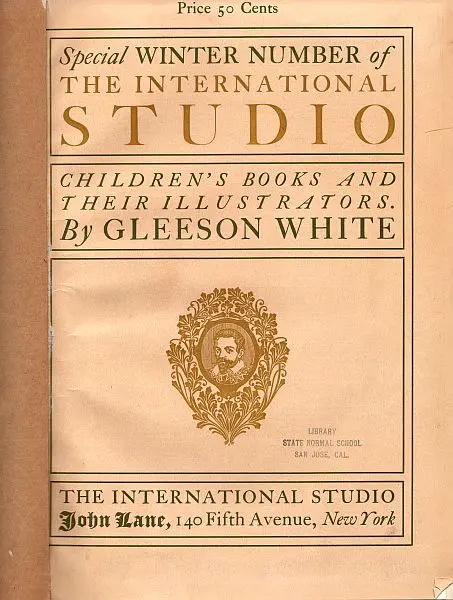
Children’s Books and Their Illustrators
Gleeson White
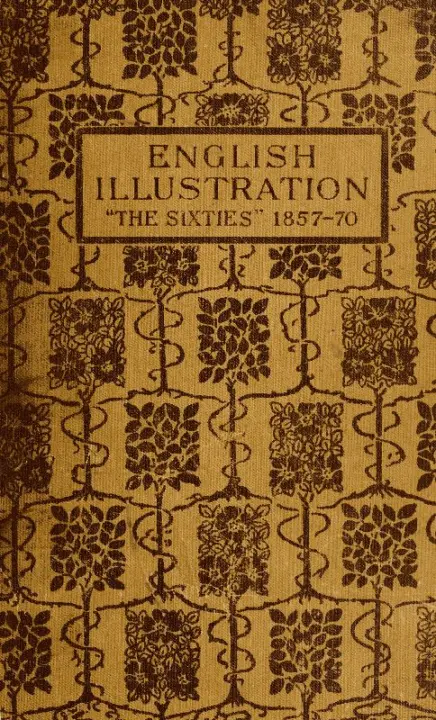
THE CLASSIC COLLECTION · 1903
"English Illustration 'The Sixties': 1855-70" by Gleeson White is a collection of critical essays and analyses written in the late 19th century. The work primarily focuses on the art and significance of various illustrators and illustrated periodicals from the 1860s, assessing their contributions to English literature and visual culture during this time. White reflects on how societal and aesthetic changes in this period influenced public perception of illustration and the artist's role. The opening of the volume sets the stage for a deep exploration of mid-Victorian illustration. Gleeson White expresses the need to reevaluate and appreciate the artists of the 1860s, who had once been overshadowed by painters but are now recognized for their merit in visual storytelling. He discusses the evolution of public interest in illustrations, linking it to a broader cultural shift that has made past styles and artists more appealing. This introduction suggests a rich examination of the art of the period and how it intermingled with societal trends, setting the groundwork for comprehensive discussions in subsequent chapters.
Introduction adapted from the source catalogue; source summaries may be automatically generated.
Free to read · English · 83,355 words · No account needed
MAKE TIME FOR A GOOD BOOK
On by default. Untick to stop anonymous reading totals. Each page counts after 10 seconds in view. How this works.
Anonymous counting is on unless you have switched it off.
It is unnecessary to belittle his art for the sake of glorifying those who succeeded him in popularity. That he obtained a strong hold upon English taste, lettered and unlettered, is undeniable. It has become part and parcel of that English life, especially of the insular middle-class, whose ideal permitted it to regard the exhibition building of 1851 not as a big conservatory, but as a new and better Parthenon, and to believe honestly enough that the millennium of universal peace with art, no less than morals, perfected to the 'nth' degree (on purely British lines), was dawning upon humanity. That the efforts of 1851 made much possible to-day which else had been impossible may be granted.
The grace and truth of John Leech's designs may be recognised despite their technical insufficiency, but at the same time we may own that, in common with Cruikshank and the rest, he has received infinitely more appreciation than his artistic achievement merited, and leave his share unconsidered here, although no doubt it was a big commercial factor in the success. To vol. i. of Once a Week he contributed no less than thirty-two designs, to vol. ii. forty-six, to vol. iii. seven, to vol. iv. one, and to vol. v. four.
John Tenniel, although he began to work much earlier, and is still an active contemporary, may be considered as belonging especially to the sixties, wherein he represents the survival of an academic type in sharply accentuated distinction to the pre-Raphaelism of one group or to the romantic naturalism of a still larger section. On page 4 of vol. i. we find his first drawing, a vignette, and page 5 a design, Audun and the White Bear, no less typically 'a Tenniel' in every particular than is the current cartoon in Punch. Those on pages 21, 30, 60, 90, 101, 103, and 170 are all relatively unimportant. The King of Thule (p. 250) is an illustration to Sir Theodore Martin's familiar translation of Goethe's poems. Others are on pp. 285, 435, 446. To vol. ii. he is a less frequent contributor. The designs, pp. 39, 98, 99, and 103 call for no comment. The one on p. 444 (not p. 404 as the index has it), to Tom Taylor's ballad Noménoë, is reprinted in Songs and Ballads of Brittany (Macmillan, 1865). In vol. iii. there is one (p. 52) of small value. On pp. 533, 561, 589, 617, 645, 673, and 701 are pictures to Shirley Brooks's The Silver Cord, showing the artist in his less familiar aspect as an illustrator of fiction. The one on p. 589 is irresistibly like a 'Wonderland' picture, while that on p. 225 (vol. iv.) suggests a Punch cartoon; but, on the whole, they are curiously free from undue mannerism in the types they depict. In vol. iv. are more illustrations to The Silver Cord (pp. 1, 29, 57, 85, 113, 141, 169, 197, 225, 253, 281, 309, 337, 365, 393, 421, 449, 477, 505, 533, 561, 589, 617, 645, 673, and 701), and illustrations to Owen Meredith's poem, Fair Rosamund (pp. 294, 295). In volume v. The Silver Cord is continued with ten more designs (pp. 1, 29, 57, 85, 113, 141, 169, 197, 225, 253), and there is one to Mark Bozzari (p. 659), translated from Müller by Sir Theodore Martin.
Your reading position is saved on this browser. Take it to another device with a library code. Reading pages adapt to text, rather than matching a printed edition.
Gleeson White
BEHIND THE BOOK
This eBook is for the use of anyone anywhere in the United States and most other parts of the world at no cost and with almost no restrictions whatsoever. You may copy it, give it away or re-use it under the terms of the Project Gutenberg License included with this eBook or online at www.gutenberg.org. If you are not located in the United States, you will have to check the laws of the country where you are located before using this eBook. Read the source licence.
The original source file, including credits and licence, is retained by this library. Request an original-format copy at no charge. Please include the book title and Project Gutenberg identifier #45426.
KEEP YOUR CURIOSITY GOING

David Patterson (Spirit) Hatch

David Patterson (Spirit) Hatch

David Patterson (Spirit) Hatch
Cécile Tormay

Moritz Busch
John L. Ransom