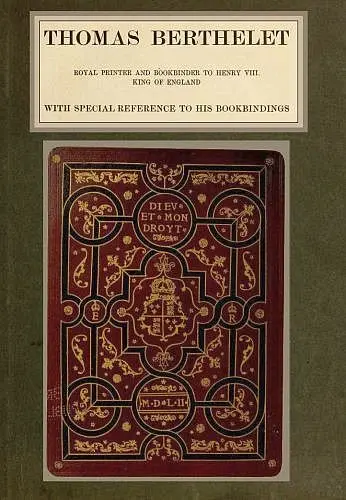
Thomas Berthelet, Royal Printer and Bookbinder to Henry VIII., King of England
Cyril Davenport
THE CLASSIC COLLECTION · 1909
"English Heraldic Book-stamps" by Cyril Davenport is a historical account written in the early 20th century. The book explores the fascinating world of heraldic book-stamps, detailing coats-of-arms and crests that adorn bookbindings across England, Scotland, and Ireland, with a focus on their historical significance and identification. The opening of the book sets the stage for an exhaustive examination of heraldic stamps, emphasizing that the material presented is just a collection of what exists, with suggestions of the vast number yet to be discovered. Davenport expresses a desire to document these symbols better, noting that little attention has previously been given to English heraldry in this context compared to French counterparts. He outlines the historical roots of heraldry, touching upon its military origins and the evolution of coats-of-arms on books from the late 15th century onward, establishing a foundation for the detailed descriptions and illustrations to follow in the subsequent chapters.
Introduction adapted from the source catalogue; source summaries may be automatically generated.
Free to read · English · 61,003 words · No account needed
MAKE TIME FOR A GOOD BOOK
On by default. Untick to stop anonymous reading totals. Each page counts after 10 seconds in view. How this works.
Anonymous counting is on unless you have switched it off.
Crest.--A Prince's coronet ppr., thereon a lion statant guardant or,
coroneted ppr.
Helmet.--Royal.
Supporters.--The lion and unicorn, the Royal Supporters of England, each charged with a Prince of Wales' label. The lion is coroneted with the coronet of a Royal Prince.
Motto.--ICH DIEN.
[PLAYFORD. Wit and Mirth. London, 1714.]
Variety.--Used as Prince of Wales. The Prince of Wales' plumes, within a princely coronet, and flanked by the initials "G. P." for "Georgius Princeps."
Motto.--ICH DIEN.
[MUSGRAVE. Antiquitates Britanno-Belgicae.
Exeter, 1719.]
George, Electoral Prince of Hanover, afterwards Prince of Wales (born 30th October 1683, died 25th October 1760), was the only son of George I., and succeeded his father on the throne of England in 1727.
In 1753 an Act was passed "For the purchase of the Museum or Collection of Sir Hans Sloane and of the Harleian Collection of MSS.; and for providing one General Repository for the better reception and more convenient use of the said Collections, and of the Cottonian Library." In 1757 King George II. added to these "Foundation Libraries" of the British Museum, the old Royal Library of England, which had been largely brought together by Henry, Prince of Wales. The old Royal Library underwent several vicissitudes after the death of Prince Henry. It was kept at St. James's Palace. When it was at length incorporated with the Sloane and Cotton collections it numbered altogether about fifteen thousand volumes, manuscripts, and printed books.
On 2nd September 1705, Prince George, then Electoral Prince of Hanover, married Wilhelmina Caroline (born 1st March 1683, died 20th November 1737), the eldest daughter of John Frederick, Margrave of Brandenburg-Anspach. Queen Caroline made herself as important in Court and political affairs as she had already done as Princess, and allied herself strongly with Sir Robert Walpole, then Minister of State, and her power became very great, as the King gave way to her wishes almost invariably. Both George II. and Queen Caroline disliked their eldest son Frederick. During the King's several absences in Hanover, Queen Caroline acted as Regent, to the great annoyance of the Prince of Wales.
GEORGE III., KING OF GREAT BRITAIN, FRANCE, AND IRELAND, AFTERWARDS KING OF GREAT BRITAIN AND IRELAND, AFTERWARDS KING OF THE UNITED KINGDOM OF GREAT BRITAIN AND IRELAND.
First Coat-of-Arms
Arms.--Within the Garter. Quarterly.
1st, England and Scotland impaled. 2nd, France. 3rd, Ireland. 4th, The arms of the Royal Dominions in Germany; all as used by George I. (q.v.).
Crest.--A royal crown ppr., thereon a lion statant guardant or,
crowned ppr.
Supporters.--The lion and the unicorn, as used by James I. (q.v.).
Motto.--DIEU ET MON DROIT.
Badges.--A rose for England and a thistle for Scotland.
Your reading position is saved on this browser. Take it to another device with a library code. Reading pages adapt to text, rather than matching a printed edition.
Cyril Davenport
Cyril Davenport
Cyril Davenport
BEHIND THE BOOK
This eBook is for the use of anyone anywhere in the United States and most other parts of the world at no cost and with almost no restrictions whatsoever. You may copy it, give it away or re-use it under the terms of the Project Gutenberg License included with this eBook or online at www.gutenberg.org. If you are not located in the United States, you will have to check the laws of the country where you are located before using this eBook. Read the source licence.
The original source file, including credits and licence, is retained by this library. Request an original-format copy at no charge. Please include the book title and Project Gutenberg identifier #47714.
KEEP YOUR CURIOSITY GOING
Cécile Tormay

Moritz Busch
John L. Ransom
Frances Wright
Cécile Tormay

Mabel Potter Daggett