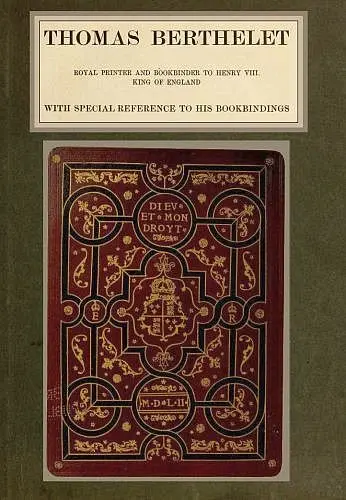
Thomas Berthelet, Royal Printer and Bookbinder to Henry VIII., King of England
Cyril Davenport
THE CLASSIC COLLECTION · 1909
"English Heraldic Book-stamps" by Cyril Davenport is a historical account written in the early 20th century. The book explores the fascinating world of heraldic book-stamps, detailing coats-of-arms and crests that adorn bookbindings across England, Scotland, and Ireland, with a focus on their historical significance and identification. The opening of the book sets the stage for an exhaustive examination of heraldic stamps, emphasizing that the material presented is just a collection of what exists, with suggestions of the vast number yet to be discovered. Davenport expresses a desire to document these symbols better, noting that little attention has previously been given to English heraldry in this context compared to French counterparts. He outlines the historical roots of heraldry, touching upon its military origins and the evolution of coats-of-arms on books from the late 15th century onward, establishing a foundation for the detailed descriptions and illustrations to follow in the subsequent chapters.
Introduction adapted from the source catalogue; source summaries may be automatically generated.
Free to read · English · 61,003 words · No account needed
MAKE TIME FOR A GOOD BOOK
On by default. Untick to stop anonymous reading totals. Each page counts after 10 seconds in view. How this works.
Anonymous counting is on unless you have switched it off.
Note.--Used from 24th October 1760 until 1st January 1801.
[VITRUVIUS POLLIO. Architecture. London, 1791.]
First Coat-of-Arms
Variety.--With supporters bearing the standards of St. George and St. Andrew. Probably a foreign design.
[SECONDAT. Le Temple de Guide. Parisiis, 1772.]
First Coat-of-Arms
Variety.--Within the Garter, with the "George" jewel, and the badges and collars of the Orders of the Thistle and the Bath (Civil), with their respective mottoes, NEMO ME IMPUNE LACESSIT and TRIA JUNCTA IN UNO.
[PETAVIUS. De Nithardo breve Syntagma. Parisiis,
1613.]
First Coat-of-Arms
Variety.--Used without supporters.
[MONRO. Works. Edinburgh, 1781.]
Second Coat-of-Arms
Arms.--Within the Garter. Quarterly.
1st and 4th, England. 2nd, Scotland. 3rd, Ireland.
Over all, on an escutcheon of pretence, the arms of the Royal Dominions in Germany ensigned with an electoral bonnet gu., turned up with miniver. Used from 1st January 1801 until 8th June 1816. Colours as used by George I. (q.v.).
Crest, Supporters, and Motto as used by James I. (q.v.).
Badges.--Roses and thistles.
[S. AUGUSTINUS. De Civitate Dei, etc. 1467.]
Third Coat-of-Arms
Arms.--Within the Garter. Quarterly, as in the preceding case, but with the Royal Hanoverian Crown, instead of the electoral bonnet, over the escutcheon of pretence. Used from 8th June 1816 until 29th January 1820.
Crest, Supporters, Badges, and Motto.--As before, with a Royal helmet, but the shield is additionally enclosed within the collar of the Order of the Garter, dependent from which is the badge of the Great George.
[Inventories of plate belonging to the Crown, etc.]
The Royal Initials ensigned with a Royal Crown.
[ALLIONIUS. Tractatio de Miliarium origine et curatione. Aug. Taurinorum, 1758.]
The Irish Harp, crowned.
[Lord's Journals of Ireland. Dublin, 1780.]
George III. (born 4th June 1738, died 29th January 1820) was the eldest son of Frederick, Prince of Wales, and grandson of George II. He succeeded to the throne in 1760.
The troubles in Ireland ended, for a time, in the Legislative Union in 1801. During the latter part of his reign George III. became insane and the Prince of Wales was appointed Regent. Almost as soon as George III. succeeded to the throne he began collecting books, no doubt to a great extent induced to do so because of the fact that George II. had practically denuded the Royal Libraries of their treasures in 1757, but in many ways he possessed the true collector's instinct. The Royal Librarian was Sir Frederick Barnard, K.C.H., who travelled about the Continent seeking early editions and desirable books generally, under the advice of Dr. Samuel Johnson. Besides the books collected abroad by Sir Frederick, large numbers were acquired in England, among these the entire library of Joseph Smith, British Consul at Venice. Sir Frederick Barnard did not neglect the sale-room, and he acquired especially valuable additions to the Royal Library at the sales of the important libraries of James West, John Ratcliffe, and Richard Farmer, all of which took place about the same time.
Your reading position is saved on this browser. Take it to another device with a library code. Reading pages adapt to text, rather than matching a printed edition.
Cyril Davenport

Cyril Davenport
Cyril Davenport
BEHIND THE BOOK
This eBook is for the use of anyone anywhere in the United States and most other parts of the world at no cost and with almost no restrictions whatsoever. You may copy it, give it away or re-use it under the terms of the Project Gutenberg License included with this eBook or online at www.gutenberg.org. If you are not located in the United States, you will have to check the laws of the country where you are located before using this eBook. Read the source licence.
The original source file, including credits and licence, is retained by this library. Request an original-format copy at no charge. Please include the book title and Project Gutenberg identifier #47714.
KEEP YOUR CURIOSITY GOING
Cécile Tormay

Moritz Busch
John L. Ransom
Frances Wright
Cécile Tormay

Mabel Potter Daggett