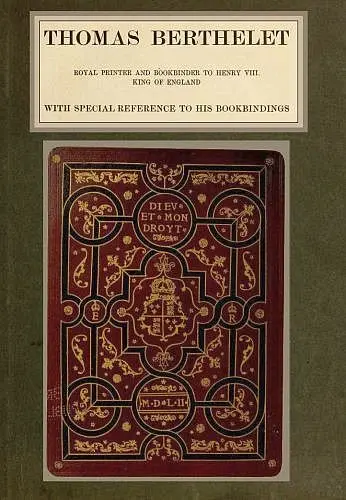
Thomas Berthelet, Royal Printer and Bookbinder to Henry VIII., King of England
Cyril Davenport
THE CLASSIC COLLECTION · 1909
"English Heraldic Book-stamps" by Cyril Davenport is a historical account written in the early 20th century. The book explores the fascinating world of heraldic book-stamps, detailing coats-of-arms and crests that adorn bookbindings across England, Scotland, and Ireland, with a focus on their historical significance and identification. The opening of the book sets the stage for an exhaustive examination of heraldic stamps, emphasizing that the material presented is just a collection of what exists, with suggestions of the vast number yet to be discovered. Davenport expresses a desire to document these symbols better, noting that little attention has previously been given to English heraldry in this context compared to French counterparts. He outlines the historical roots of heraldry, touching upon its military origins and the evolution of coats-of-arms on books from the late 15th century onward, establishing a foundation for the detailed descriptions and illustrations to follow in the subsequent chapters.
Introduction adapted from the source catalogue; source summaries may be automatically generated.
Free to read · English · 61,003 words · No account needed
MAKE TIME FOR A GOOD BOOK
On by default. Untick to stop anonymous reading totals. Each page counts after 10 seconds in view. How this works.
Anonymous counting is on unless you have switched it off.
On an escutcheon of pretence on the centre point. Quarterly.
1st and 4th; gu., a bend or. Chalon.
2nd and 3rd; or, a bugle horn az., stringed gu. Orange.
Over all chequy, or and az. Geneva.
In the centre chief point on an escutcheon or, a fess gu. Moers.
In the base point on an escutcheon gu., a fess embattled arg. Buren.
Over all a Ducal coronet.
Note.--Used before 1689.
[Apologie pour la Maison de Nassau. Madril, 1664.]
Prince William (born 4th November 1650, died 8th March 1702) was the son of William Prince of Orange and the Princess Mary, eldest daughter of Charles I. Prince William married the Princess Mary, eldest daughter of James, Duke of York, afterwards James II., and Anne Hyde. The Prince of Orange deposed his father-in-law James II., in 1689, and was declared king in his stead. William and Mary were, however, joint sovereigns, and the crowns, sceptres, and orbs were all doubled for them, and on the Great Seal they are both represented, one hand of each resting on the orb.
Queen Mary died in 1694, and after that date King William reigned alone. The same coat-of-arms was used all through, but during the double reign the initials "WR" and "MR" are generally added. It is curious to note that William III. several times altered the place of the coat-of-arms of France on the English coat.
Arms.--Within the Garter and with the collar and badge of the order.
Quarterly.
1st and 4th, England.
2nd, Scotland.
3rd, Ireland.
And on an escutcheon of pretence, ensigned with the Royal Crown of Hanover, the arms of the Dominions in Germany, as used by George III. (q.v.) after 1816.
Crest.--A Royal crown ppr., thereon a lion statant or, crowned ppr.
Helmet.--That of a King.
Supporters.--A lion and a unicorn, as used by James I. (q.v.).
Motto.--DIEU ET MON DROIT.
Badges.--Tudor Rose, Thistle, and Shamrock.
[Inventories of the various Services of Plate belonging to the Crown. London, 1832.]
Variety.--The Royal Cypher "WR IIII." (William Rex IIII.) within the Garter and ensigned with a Royal Crown.
[DELPECH. Iconographie des contemporains. Paris, 1832.]
William, Duke of Clarence (born 21st August 1763, died 20th June 1837), was the third son of George III., and succeeded his brother George IV. on the throne of England in 1830. He was parsimonious, and the economy used at his coronation was so marked that it was called a "Half Crown-ation." William IV. married Adelaide, daughter of George Frederick, Duke of Saxe-Meiningen, and their two daughters died as children.
Your reading position is saved on this browser. Take it to another device with a library code. Reading pages adapt to text, rather than matching a printed edition.
Cyril Davenport
Cyril Davenport
Cyril Davenport
BEHIND THE BOOK
This eBook is for the use of anyone anywhere in the United States and most other parts of the world at no cost and with almost no restrictions whatsoever. You may copy it, give it away or re-use it under the terms of the Project Gutenberg License included with this eBook or online at www.gutenberg.org. If you are not located in the United States, you will have to check the laws of the country where you are located before using this eBook. Read the source licence.
The original source file, including credits and licence, is retained by this library. Request an original-format copy at no charge. Please include the book title and Project Gutenberg identifier #47714.
KEEP YOUR CURIOSITY GOING
Cécile Tormay

Moritz Busch
John L. Ransom
Frances Wright
Cécile Tormay

Mabel Potter Daggett