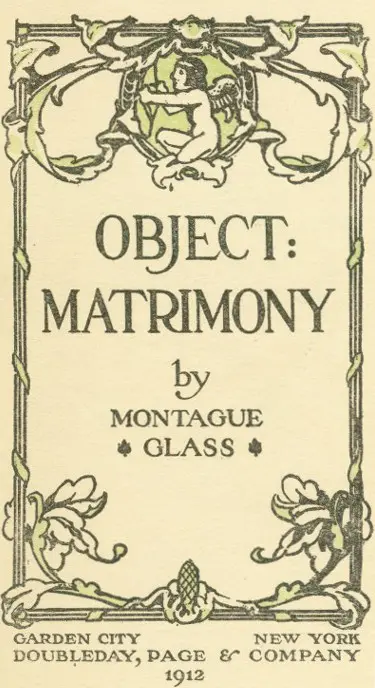
Object: matrimony
Montague Glass

THE CLASSIC COLLECTION · 1911
"Elkan Lubliner, American" by Montague Glass is a novel written in the early 20th century. The story revolves around the character Elkan Lubliner and his experiences as he navigates life as an immigrant in America. The narrative explores themes of family, cultural challenges, and the dynamics of business relationships in a humorous and engaging manner. The opening of the book introduces us to Marcus Polatkin and Philip Scheikowitz, partners in a clothing business, as they discuss family matters related to Philip's brother-in-law, who is trying to emigrate from Russia. Their conversation is filled with humor and cultural references that illustrate their backgrounds and the immigrant experience. The focus soon shifts to the arrival of Philip's nephew, Elkan Lubliner, who is expected to come work at their store. However, complications arise when it is revealed that Elkan's father has gambled away the money sent for his passage, prompting questions about family honor and trust. This sets the tone for the unfolding drama, highlighting family ties, identity challenges, and the comedic misunderstandings of immigrant life in America.
Introduction adapted from the source catalogue; source summaries may be automatically generated.
Free to read · English · 69,088 words · No account needed
MAKE TIME FOR A GOOD BOOK
On by default. Untick to stop anonymous reading totals. Each page counts after 10 seconds in view. How this works.
Anonymous counting is on unless you have switched it off.
Dishkes again buried his head in his hands, while Ringentaub blushed
guiltily.
"That may be all right in the antic business, Mr. Ringentaub," Elkan went on, "but in the garment business we ain't two hundred and fifty years behind the times exactly. We got associations of manufacturers and we got good lawyers, too, understand me; and we get right after crooks like Sammet, just the same as some of us helps out retailers that want to be decent, like Dishkes here."
Louis Dishkes raised his head suddenly.
"Then you heard the whole thing?" he cried; and Elkan nodded.
"I heard enough, Dishkes," he said; "and if you want my help you could come down to my place to-morrow morning at ten o'clock."
At this juncture the triggered bell rang loudly, and raising his hand for silence Ringentaub returned to the store.
"Why, how do you do, Mr. Paul!" he said.
He addressed a broad-shouldered figure arrayed in the height of Canal
Street fashion.
Aside from his clothing, however, there was little to betray the connoisseur of fine arts and antiques in the person of Jacob Paul, who possessed the brisk, businesslike manner and steel-blue eyes of a detective sergeant.
"Hello, Ringentaub!" he said. "You are doing a rushing business here--ain't it? More customers in the back room too?"
He glanced sharply at the open doorway in the partition, through which Elkan and Dishkes could be seen engaged in earnest conversation.
"Yow--customers!" Ringentaub exclaimed. "You know how it is in the antic business, Mr. Paul. For a hundred that looks, understand me, one buys; and that one, Mr. Paul, he comes into your place a dozen times before he makes up his mind yet."
"Well," Paul said with a smile, "I've made up my mind at last, Ringentaub, and I'll take them other two chairs at forty-five dollars."
Ringentaub nodded his head slowly.
"I thought you would, Mr. Paul," he said; "but just the same you are a little late, on account this here gentleman already bought 'em for fifty dollars."
A shade of disappointment passed over Paul's face as he turned to Max
Merech.
"I congratulate you, Mister----"
"Merech," Max suggested.
"Merech," Paul continued. "You paid a high price for a couple of good
pieces."
"I ain't paying nothing," Max replied. "I bought 'em for this lady here
and her husband."
It was then that Jacob Paul for the first time noticed Yetta's presence, and he bowed apologetically.
"Is he also a collector?" he asked, and Max shook his head.
"He's in the garment business," Yetta volunteered, "for himself."
A puzzled expression wrinkled Paul's flat nose.
"I guess I ain't caught the name," he said.
Your reading position is saved on this browser. Take it to another device with a library code. Reading pages adapt to text, rather than matching a printed edition.
Montague Glass
Montague Glass
Montague Glass
Montague Glass
BEHIND THE BOOK
This eBook is for the use of anyone anywhere in the United States and most other parts of the world at no cost and with almost no restrictions whatsoever. You may copy it, give it away or re-use it under the terms of the Project Gutenberg License included with this eBook or online at www.gutenberg.org. If you are not located in the United States, you will have to check the laws of the country where you are located before using this eBook. Read the source licence.
The original source file, including credits and licence, is retained by this library. Request an original-format copy at no charge. Please include the book title and Project Gutenberg identifier #27423.
KEEP YOUR CURIOSITY GOING
Coulson Kernahan

Maurice Baring
Frances Wright
Cécile Tormay

Frederic Jesup Stimson

W. H. P. (William Henry Pope) Jarvis