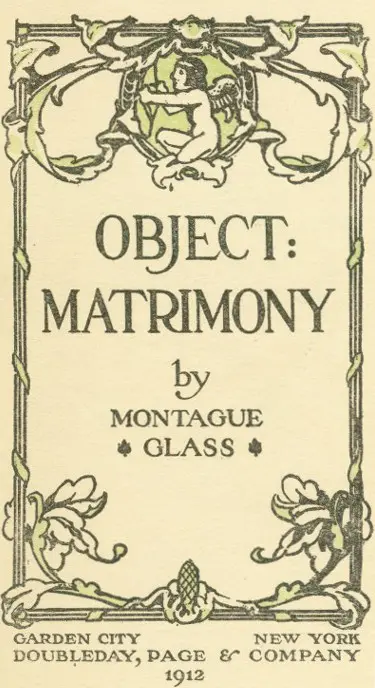
Object: matrimony
Montague Glass

THE CLASSIC COLLECTION · 1911
"Elkan Lubliner, American" by Montague Glass is a novel written in the early 20th century. The story revolves around the character Elkan Lubliner and his experiences as he navigates life as an immigrant in America. The narrative explores themes of family, cultural challenges, and the dynamics of business relationships in a humorous and engaging manner. The opening of the book introduces us to Marcus Polatkin and Philip Scheikowitz, partners in a clothing business, as they discuss family matters related to Philip's brother-in-law, who is trying to emigrate from Russia. Their conversation is filled with humor and cultural references that illustrate their backgrounds and the immigrant experience. The focus soon shifts to the arrival of Philip's nephew, Elkan Lubliner, who is expected to come work at their store. However, complications arise when it is revealed that Elkan's father has gambled away the money sent for his passage, prompting questions about family honor and trust. This sets the tone for the unfolding drama, highlighting family ties, identity challenges, and the comedic misunderstandings of immigrant life in America.
Introduction adapted from the source catalogue; source summaries may be automatically generated.
Free to read · English · 69,088 words · No account needed
MAKE TIME FOR A GOOD BOOK
On by default. Untick to stop anonymous reading totals. Each page counts after 10 seconds in view. How this works.
Anonymous counting is on unless you have switched it off.
"Yes, Mr. Lubliner," said Max Merech as he sat in the front parlour of Elkan's flat one April Sunday; "if you are going to work to buy furniture, understand me, it's just so easy to select good-looking chairs as bad-looking chairs."
"Aber sometimes it's a whole lot harder to sit on 'em comfortably," Elkan retorted sourly. On the eve of moving to a larger apartment he and Yetta had invited Max to suggest a plan for furnishing and decorating their new dwelling; and it seemed to Elkan that Max had taken undue advantage of the privilege thus accorded him. Indeed, Polatkin, Scheikowitz & Company's aesthetic designer held such pronounced views on interior decoration, and had expressed them so freely to Elkan and Yetta, that after the first half-hour of his visit the esteem which they had always felt toward their plush furniture and Wilton rugs had changed--first to indifference and then, in the case of Yetta, at least, to loathing.
"I always told you that the couch over there was hideous, Elkan," Yetta
said.
"Hideous it ain't," Max interrupted; "aber it ain't so beautiful."
"Well, stick the couch in the bedroom, then," Elkan said. "It makes no
difference to me."
"Sure, I know," Yetta exclaimed: "but what would we put in its place?"
Elkan shrugged his shoulders.
"What d'ye ask me for?" Elkan cried. "Like as not I'd say another
couch."
"There is couches and couches," Max said with an apologetic smile, "but if you would ask my advice I would say why not a couple nice chairs there--something in monhogany, like Shippendaler oder Sheratin."
Suddenly he slapped his thigh in an access of inspiration.
"I came pretty near forgetting!" he cried. "I got the very thing you want--and a big bargain too! Do you know Louis Dishkes, which runs the Villy dee Paris Store in Amsterdam Avenue?"
"I think I know him," Elkan said with ironic emphasis. "He owes us four hundred dollars for two months already."
"Well, Dishkes is got a brother-in-law by the name Ringentaub, on Allen Street, which he is a dealer in antics."
"Antics?" Elkan exclaimed.
"Sure!" Max explained. "Antics--old furniture and old silver."
"You mean a second-hand store?" Elkan suggested.
"Not a second-hand store," Max declared. "A second-hand store is got old furniture from two years old oder ten years old, understand me; aber an antic store carries old furniture from a hundred years old already."
"And this here Ringentaub is got furniture from a hundred years old
already?" Elkan cried.
"From older even," answered Max; "from two hundred and fifty years old
also."
"Ich glaub's!" Elkan cried.
Your reading position is saved on this browser. Take it to another device with a library code. Reading pages adapt to text, rather than matching a printed edition.
Montague Glass
Montague Glass
Montague Glass
Montague Glass
BEHIND THE BOOK
This eBook is for the use of anyone anywhere in the United States and most other parts of the world at no cost and with almost no restrictions whatsoever. You may copy it, give it away or re-use it under the terms of the Project Gutenberg License included with this eBook or online at www.gutenberg.org. If you are not located in the United States, you will have to check the laws of the country where you are located before using this eBook. Read the source licence.
The original source file, including credits and licence, is retained by this library. Request an original-format copy at no charge. Please include the book title and Project Gutenberg identifier #27423.
KEEP YOUR CURIOSITY GOING
Coulson Kernahan

Maurice Baring
Frances Wright
Cécile Tormay

Frederic Jesup Stimson

W. H. P. (William Henry Pope) Jarvis