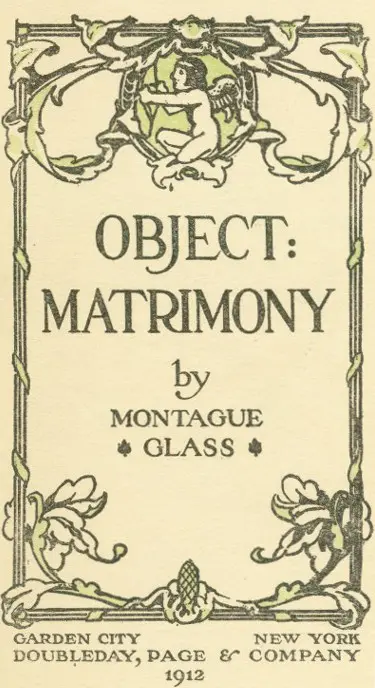
Object: matrimony
Montague Glass

THE CLASSIC COLLECTION · 1911
"Elkan Lubliner, American" by Montague Glass is a novel written in the early 20th century. The story revolves around the character Elkan Lubliner and his experiences as he navigates life as an immigrant in America. The narrative explores themes of family, cultural challenges, and the dynamics of business relationships in a humorous and engaging manner. The opening of the book introduces us to Marcus Polatkin and Philip Scheikowitz, partners in a clothing business, as they discuss family matters related to Philip's brother-in-law, who is trying to emigrate from Russia. Their conversation is filled with humor and cultural references that illustrate their backgrounds and the immigrant experience. The focus soon shifts to the arrival of Philip's nephew, Elkan Lubliner, who is expected to come work at their store. However, complications arise when it is revealed that Elkan's father has gambled away the money sent for his passage, prompting questions about family honor and trust. This sets the tone for the unfolding drama, highlighting family ties, identity challenges, and the comedic misunderstandings of immigrant life in America.
Introduction adapted from the source catalogue; source summaries may be automatically generated.
Free to read · English · 69,088 words · No account needed
MAKE TIME FOR A GOOD BOOK
On by default. Untick to stop anonymous reading totals. Each page counts after 10 seconds in view. How this works.
Anonymous counting is on unless you have switched it off.
"Lubliner," Yetta replied; "Elkan Lubliner, of Polatkin, Scheikowitz &
Company."
"You don't tell me?" Jacob Paul said. "And so Mr. Lubliner is interested in antiques. That's quite a jump, from cloaks and suits to antiques already."
"Well," Merech explained, "Mr. Lubliner is refurnishing his house."
"Maybe," Elkan added as he appeared in the doorway of the partition, followed by Dishkes and Mrs. Ringentaub. "Buying a couple pieces of furniture is one thing, Merech, and refurnishing your house is another."
"You made a good start anyhow," Paul interrupted. "A couple chairs like them gives a tone to a room which is got crayon portraits hanging in it even."
Yetta blushed in the consciousness of what she had always considered to be a fine likeness of Elkan's grandfather--the Lubliner Rav--which hung in a silver-and-plush frame over the mantelpiece of the Lubliner front parlour. Elkan was unashamed, however, and he glared angrily at the connoisseur, who had started to leave the store.
"I suppose," he cried, "it ain't up to date that a feller should have hanging in his flat a portrait of his grandfather--olav hasholem!--which he was a learned man and a Tzadek, if there ever was one."
Paul hesitated, with his hand on the doorknob.
"I'll tell you, Mr. Lubliner," he said solemnly; "to me a crayon portrait is rotten, understand me, if it would be of a Tzadek oder a murderer."
And with a final bow to Mrs. Lubliner he banged the door behind him.
"Well, what d'ye think for a Rosher like that?" Elkan exclaimed.
"The fellow is disappointed that you got ahead of him buying the chairs, Mr. Lubliner," Ringentaub explained; "so he takes a chance that you and Mrs. Lubliner is that kind of people which is got hanging in the parlour crayon portraits, understand me, and he knocks you for it."
Elkan shrugged his shoulders.
"What could you expect from a feller which is content at fifty years of age to be a collector only?" he asked, and Dishkes nodded sympathetically.
"I bet yer, Mr. Lubliner," he agreed; "and so I would be at your store to-morrow morning at ten o'clock sure."
"I don't doubt your word for a minute, Elkan," Marcus Polatkin said the following morning when Elkan related to him the events of the preceding night; "aber you couldn't blame Sammet none. Concerns like Sammet Brothers, which they are such dirty crooks that everybody is got suspicions of 'em, y'understand, must got to pay their bills prompt to the day, Elkan; because if they wouldn't be themselves good collectors, understand me, they would bust up quick."
"Sammet Brothers ain't in no danger of busting up," Elkan declared.
Your reading position is saved on this browser. Take it to another device with a library code. Reading pages adapt to text, rather than matching a printed edition.
Montague Glass
Montague Glass
Montague Glass
Montague Glass
BEHIND THE BOOK
This eBook is for the use of anyone anywhere in the United States and most other parts of the world at no cost and with almost no restrictions whatsoever. You may copy it, give it away or re-use it under the terms of the Project Gutenberg License included with this eBook or online at www.gutenberg.org. If you are not located in the United States, you will have to check the laws of the country where you are located before using this eBook. Read the source licence.
The original source file, including credits and licence, is retained by this library. Request an original-format copy at no charge. Please include the book title and Project Gutenberg identifier #27423.
KEEP YOUR CURIOSITY GOING
Coulson Kernahan

Maurice Baring
Frances Wright
Cécile Tormay

Frederic Jesup Stimson

W. H. P. (William Henry Pope) Jarvis