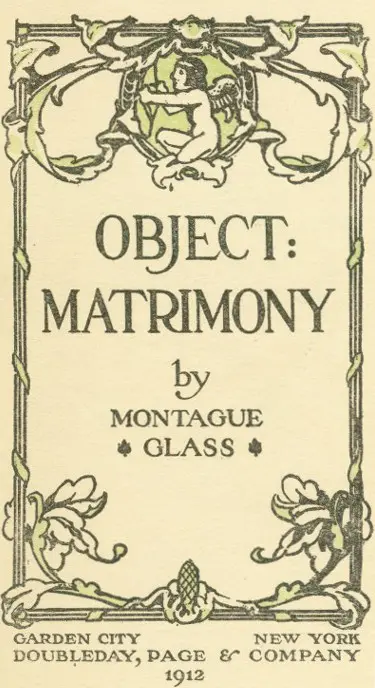
Object: matrimony
Montague Glass

THE CLASSIC COLLECTION · 1911
"Elkan Lubliner, American" by Montague Glass is a novel written in the early 20th century. The story revolves around the character Elkan Lubliner and his experiences as he navigates life as an immigrant in America. The narrative explores themes of family, cultural challenges, and the dynamics of business relationships in a humorous and engaging manner. The opening of the book introduces us to Marcus Polatkin and Philip Scheikowitz, partners in a clothing business, as they discuss family matters related to Philip's brother-in-law, who is trying to emigrate from Russia. Their conversation is filled with humor and cultural references that illustrate their backgrounds and the immigrant experience. The focus soon shifts to the arrival of Philip's nephew, Elkan Lubliner, who is expected to come work at their store. However, complications arise when it is revealed that Elkan's father has gambled away the money sent for his passage, prompting questions about family honor and trust. This sets the tone for the unfolding drama, highlighting family ties, identity challenges, and the comedic misunderstandings of immigrant life in America.
Introduction adapted from the source catalogue; source summaries may be automatically generated.
Free to read · English · 69,088 words · No account needed
MAKE TIME FOR A GOOD BOOK
On by default. Untick to stop anonymous reading totals. Each page counts after 10 seconds in view. How this works.
Anonymous counting is on unless you have switched it off.
"Well, then, thirty-seven-fifty, Mr. Ringentaub," Max continued; and Ringentaub made a flapping gesture with both hands.
"Say, lookyhere," he growled, "what is the use talking nonsense, Mr. Merech? For ten dollars apiece you could get on Twenty-third Street a couple chairs, understand me, made in some big factory, y'understand--A-Number-One pieces of furniture--which would suit you a whole lot better as gen-wine pieces. These here chairs is for conoozers, Mr. Merech; so, if you want any shiny candlesticks oder Moskva samovars from brass-spinners on Center Street, y'understand, a couple doors uptown you would find plenty fakers. Aber here is all gen-wine stuff, y'understand; and for gen-wine stuff you got to pay full price, understand me, which if them chairs stays in my store till they are five hundred years old already I wouldn't take a cent less for 'em as fifty dollars."
Max turned inquiringly to Mrs. Lubliner; and, during the short pause that followed, the agonized voice of Louis Dishkes came once more from the back room.
"What could I do?" he said to Mrs. Ringentaub. "I want to be square mit everybody, and I must got to act quick on account that sucker Sammet will close me up sure."
"Ai, tzuris!" Mrs. Ringentaub moaned; at which her husband coughed noisily and Elkan moved nearer to the partition.
"Would you go as high as fifty dollars, Mrs. Lubliner?" Max asked, and
Yetta nodded.
"All right, Mr. Ringentaub," Max concluded; "we'll take 'em at fifty
dollars."
"And you wouldn't regret it neither," Ringentaub replied. "I'll make you
out a bill right away."
He darted into the rear room and slammed the partition door behind him.
"Koosh, Dishkes!" he hissed. "Ain't you got no sense at all--blabbing out your business in front of all them strangers?"
It was at this juncture that Elkan rapped on the door.
"Excuse me, Mr. Ringentaub," he said, "but I ain't no stranger to Mr. Dishkes--not by four hundred dollars already."
He opened the door as he spoke, and Dishkes, who was sitting at a table with his head bowed on his hands, looked up mournfully.
"Nu, Mr. Lubliner!" he said. "You are after me, too, ain't it?"
Elkan shook his head.
"Not only I ain't after you, Dishkes," he said, "but I didn't even know you was in trouble until just now."
"And you never would of known," Ringentaub added, "if he ain't been such a dummer Ochs and listened to people's advice. He got a good chance to sell out, and he wouldn't took it."
"Sure, I know," Elkan said, "to an auction house; the idee being to run away mit the proceeds and leave his creditors in the lurches!"
Your reading position is saved on this browser. Take it to another device with a library code. Reading pages adapt to text, rather than matching a printed edition.
Montague Glass
Montague Glass
Montague Glass
Montague Glass
BEHIND THE BOOK
This eBook is for the use of anyone anywhere in the United States and most other parts of the world at no cost and with almost no restrictions whatsoever. You may copy it, give it away or re-use it under the terms of the Project Gutenberg License included with this eBook or online at www.gutenberg.org. If you are not located in the United States, you will have to check the laws of the country where you are located before using this eBook. Read the source licence.
The original source file, including credits and licence, is retained by this library. Request an original-format copy at no charge. Please include the book title and Project Gutenberg identifier #27423.
KEEP YOUR CURIOSITY GOING
Coulson Kernahan

Maurice Baring
Frances Wright
Cécile Tormay

Frederic Jesup Stimson

W. H. P. (William Henry Pope) Jarvis