
Last letters from the living dead man
David Patterson (Spirit) Hatch
THE CLASSIC COLLECTION · 1892
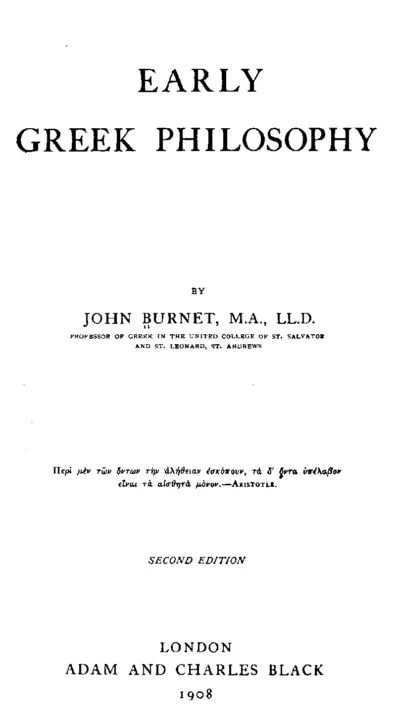
"Early Greek Philosophy" by John Burnet is a scholarly account of ancient Greek philosophical thought written in the late 19th century. The work explores the evolution of philosophical ideas and cosmological theories from the early Greek thinkers, particularly focusing on how their inquiries laid the groundwork for subsequent philosophical developments. The opening of the text introduces the cosmological character of early Greek philosophy, emphasizing that it arose from the breakdown of traditional views of the world and life. Burnet explains that the earliest philosophers were preoccupied with understanding nature and existence, as old maxims were challenged and replaced by rigorous inquiry. He sets the stage for a detailed examination of various schools of thought, beginning with the Milesian school and its notable figures, such as Thales, who began to systematize knowledge in an attempt to explain the universe's order and structure. Overall, the initial chapters highlight the shift from mythological explanations to rational inquiry that characterized this formative period of philosophical history.
Introduction adapted from the source catalogue; source summaries may be automatically generated.
Free to read · English · 137,668 words · No account needed
MAKE TIME FOR A GOOD BOOK
On by default. Untick to stop anonymous reading totals. Each page counts after 10 seconds in view. How this works.
Anonymous counting is on unless you have switched it off.
Man, Anaximander, 73;
Herakleitos, 168 sqq.
Maoris, 9
Map, Anaximander’s, 53
Materialism, 208
Matter. See ὕλη
Measures, 167 sq., 181, 410, 413
Medicine, history of, 222, 225, 226, 234, 236, 265 sq., 288 n. 645,
322, 344, 405, 411, 414
Megarians, 355
Melissos, 369 sqq.
Melissos, Xenophanes and Gorgias, 138 sqq.
Menon, Ἰατρικά, 49 n. 85, 235 n. 527, 322 n. 742, 327 n. 763,
340 n. 799, 406 n. 988
Metapontion, 95 n. 199, 97 n. 205
Metempsychosis. See Transmigration
Meteorological interest, 49, 70
Miletos, 37 sqq., 76, 380, 382
Milky Way, 69, 220, 314
Milo, 99, 222
Mochos of Sidon, 19 n. 27
Monism, 206, 227
Monotheism, 141 sqq.
Moon, 68;
light of, 202 n. 446, 275, 276, 299, 314
Motion, eternal, 15, 61;
denied by Parmenides, 207;
explained by Empedokles, 267;
Anaxagoras, 309;
criticised by Zeno, 366;
denied by Melissos, 376;
reaffirmed by Leukippos, 392 sq.
Mysteries, 90, 190
Necessity. See Ἀνάγκη
Nikomachos, 92, 112 n. 234
Nile, 43 sq., 313
Noumenios, 19
Nous, 309 sq.
Numbers, Pythagorean, 331 sqq.;
triangular, square, and oblong, 114
Obliquity of the ecliptic (zodiac), 52, 82, 401
Observation, 29 sq., 73 sq.
Octave, 118
Opposites, 56, 186 sq., 225, 235, 266, 305
Oriental influences, 17 sqq.
Orphicism, 5, 9 sqq., 87 sq., 95 n. 195, 109 n. 229, 194, 221, 232,
257 n. 571, 258 n. 573
Parmenides, 192 sqq.;
on Herakleitos, 143, 198 n. 438, 204 sq., 210;
and Pythagoreanism, 210 sqq.
Pausanias, 234 n. 523, 238
Pentagram, 343
Perception, Parmenides, 202 n. 447, 222;
Alkmaion, 223 sq.;
Empedokles, 284 sq.;
Anaxagoras, 316 sq.;
Leukippos, 401 sq.;
Diogenes of Apollonia, 414
Perikles and Zeno, 193;
and Anaxagoras, 294 sq.;
and Melissos, 369
Petron, 65, 121
Pherekydes of Syros, 9, 87
Philistion, 234 n. 523, 235 n. 526 and 527, 266 n. 587, 288 n.
645, 356 n. 850
Philo of Byblos, 19 n. 27
Philo Judaeus, 18, 158, 185
Philodemos, 50 n. 89, 64, 221 n. 483
Philolaos, 319, 320 sqq.
Philosophy as κάθαρσις, 89;
Pythagorean use of the word, 89 sqq., 194, 321 n. 739, 359;
synonymous with asceticism, 18
Phleious, 89 n. 178, 94 n. 191, 109 n. 229, 320
Phoenician influence, 18, 19 n. 27, 39
Physiology, Parmenides, 221 sq.;
Alkmaion, 223;
Empedokles, 282;
Diogenes of Apollonia, 411
Pindar, 232
Planets, names of, 26 n. 40, 220;
distinguished from fixed stars, 26, 82, 276, 392, 401;
motion of, 122 sq., 225, 350, 353;
system of, 344 sq.
Plants, Empedokles, 277 sq.;
Anaxagoras, 315 sq.
Plato, App. § 1;
on Egyptians and Phoenicians, 17, 20, 27 n. 41;
on Egyptian arithmetic, 22;
on schools of philosophy, 35;
on Pythagoras, 96 n. 202;
on Xenophanes, 140;
on Herakleitos, 140, 159, 162, 176, 178;
on Herakleiteans, 161 n. 373, 188 n. 418;
on Parmenides, 192, 207, 221;
on Empedokles, 159, 178, 269 n. 593;
on Anaxagoras, 291 n. 655, 295, 297 sq., 309;
on Philolaos, 319;
on Pythagoreans, 121, 124;
on incommensurables, 117 n. 245;
on Zeno, 192, 358, 360, 361;
on Melissos, 379 n. 919;
Phaedo, 89 n. 178, 91 n. 183, 108 n. 228, 109 n. 229, 172
n. 391,182 n. 411, 320 sq., 342, 343, 345, 354;
Cratylus, 417 n. 1027;
Theaetetus, 117 n. 245, 263 n. 580, 338 n. 794, 417 n.
1027;
Sophist, 356 n. 849, 358 n. 853;
Politicus, 280 n. 621;
Parmenides, 358 n. 852, 359, 360 sq.;
Philebus, 323;
Symposium, 221, 281 n. 625;
Phaedrus, 295;
Gorgias, 321;
Meno, 234 n. 524;
Republic, 25 n. 39, 90 n. 181, 177 n. 400, 216, 219 sq., 352;
Timaeus, 61 n. 115, 79 n. 154, 113 n. 237, 118 n. 248, 121,
122, 225, 287, 340, 342, 345 n. 818, 346, 352, 396;
Laws, 107 n. 227, 117 n. 246, 353
Pleasure and pain, Empedokles, 285;
Anaxagoras, 317
Pliny, 42, 52
Pluralism, 227 sqq., 357
Political activity of philosophers, Thales, 46;
Pythagoras, 96 sq.;
Parmenides, 195;
Empedokles, 230 sq.;
Zeno, 358
Polybios, 99 n. 206
Polybos, 379
Polykrates, era of, 53 n. 97, 94
Pores. See πόροι
Porphyry, 92 n. 187, 104 n. 219, 257 n. 571
Poseidonios, 19 n. 27, 81 n. 159
Precession. See Equinoxes
Proclus, commentary on Euclid, 44, 115 n. 243
Proportion, 117 sq.
Protagoras, 188, 360
Purification. See καθαρμός, κάθαρσις
Pyramids, measurement of, 45.
See πυραμίς
Pythagoras, 91 sqq.;
forged writings, 325
Pythagoreans, 212 sqq., 319 sqq.
Rarefaction and condensation, 77 sqq., 163, 204, 403, 412
Religion, 85 sqq., 189, 294.
See Orphicism, Monotheism, Gods, Sacrifice
Respiration, 235, 253 n. 565, 284
Rest. See Motion
Revolution, diurnal, 61, 274, 346 sq.
Rhegion, 99, 220 n. 482, 319
Rhetoric, 86, 234
Rhind papyrus, 22 sqq.
Roots, 263
Your reading position is saved on this browser. Take it to another device with a library code. Reading pages adapt to text, rather than matching a printed edition.
BEHIND THE BOOK
This eBook is for the use of anyone anywhere in the United States and most other parts of the world at no cost and with almost no restrictions whatsoever. You may copy it, give it away or re-use it under the terms of the Project Gutenberg License included with this eBook or online at www.gutenberg.org. If you are not located in the United States, you will have to check the laws of the country where you are located before using this eBook. Read the source licence.
The original source file, including credits and licence, is retained by this library. Request an original-format copy at no charge. Please include the book title and Project Gutenberg identifier #67097.
KEEP YOUR CURIOSITY GOING
David Patterson (Spirit) Hatch
Cécile Tormay

Moritz Busch
Coulson Kernahan
John L. Ransom

Ralph Waldo Emerson