
Last letters from the living dead man
David Patterson (Spirit) Hatch
THE CLASSIC COLLECTION · 1892
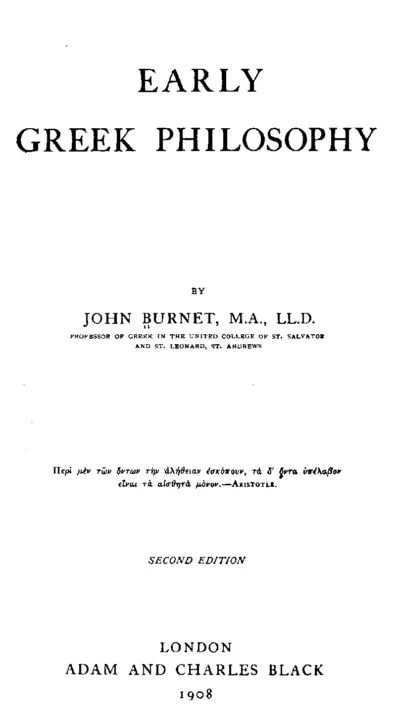
"Early Greek Philosophy" by John Burnet is a scholarly account of ancient Greek philosophical thought written in the late 19th century. The work explores the evolution of philosophical ideas and cosmological theories from the early Greek thinkers, particularly focusing on how their inquiries laid the groundwork for subsequent philosophical developments. The opening of the text introduces the cosmological character of early Greek philosophy, emphasizing that it arose from the breakdown of traditional views of the world and life. Burnet explains that the earliest philosophers were preoccupied with understanding nature and existence, as old maxims were challenged and replaced by rigorous inquiry. He sets the stage for a detailed examination of various schools of thought, beginning with the Milesian school and its notable figures, such as Thales, who began to systematize knowledge in an attempt to explain the universe's order and structure. Overall, the initial chapters highlight the shift from mythological explanations to rational inquiry that characterized this formative period of philosophical history.
Introduction adapted from the source catalogue; source summaries may be automatically generated.
Free to read · English · 137,668 words · No account needed
MAKE TIME FOR A GOOD BOOK
On by default. Untick to stop anonymous reading totals. Each page counts after 10 seconds in view. How this works.
Anonymous counting is on unless you have switched it off.
Earth, a sphere, 26;
Thales, 47 sqq.;
Anaximander, 70, 72;
Anaximenes, 80, 81, 83 n. 167;
Xenophanes, 136;
Anaxagoras, 313;
Pythagoreans, 344 sqq.;
Leukippos, 401;
Diogenes of Apollonia, 413
Echekrates, 343
Eclipses, Thales, 40 sqq.;
Anaximander, 67;
Anaximenes, 82;
Herakleitos, 164;
Alkmaion, 224;
Empedokles, 276;
Anaxagoras, 299;
Pythagoreans, 349 sq.;
Leukippos, 401
Ecliptic. See Obliquity
Effluences. See ἀπορροαί
Egypt, 39;
Thales in Egypt, 43;
Pythagoras and Egypt, 94 sq.
Egyptian arithmetic, 22 sq.;
geometry, 23 sq., 44 sq.
Ekphantos, 338 n. 794, 387 n. 939
Elea, era of, 125 n. 270, 127, 192
Eleatics (see Parmenides, Zeno, Melissos), 35 n. 49;
Leukippos and, 382 sqq.
Elements (see στοιχεῖα, Roots, Seeds, ἰδέα, εἶδος, μορφή), 56 n.
103, 57, 59, 235, 263 sqq., 265 n. 586, 339 sqq.
Eleusinia, 86
Embryology, Parmenides, 203 n. 448;
Empedokles, 282
Empedokles, 227 sqq.;
relation to Leukippos, 236, 383, 392;
on Xenophanes, 138, 246 n. 555;
on Pythagoras, 232, 259 n. 577;
on Parmenides, 239, 261
Ephesos, 143 sqq.
Epicurus and Leukippos, 380 sq., 388 n. 940, 391 n. 949, 394 sq.
Epimenides, 9, 87
Equinoxes, precession of, 25, 347 n. 824
Eratosthenes, App. § 21, 228 n. 502
Eros, 9, 219
Euclid, 116, 117
Eudemos on Thales, 44 sq.;
on Pythagoras, 115 n. 241, 116 n. 243;
on Parmenides, 203 n. 449;
on Zeno, 363, 366 n. 889;
on the term στοιχεῖον, 263 n. 580
Eudoxos, 118, 216, 342
Eukleides of Megara, 355
Euripides (fr. inc. 910), 12 n. 14, 14 n. 18;
and Anaxagoras, 295 sq.
Eurytos, 110 sq., 320, 322
Eusebios, 19
Euthymenes, 44
Even and Odd, 333 sqq.
Evolution, Anaximander, 73 sq.;
Empedokles, 281;
Anaxagoras, 315
Examyes, 40
Experiment, 31 sq., 274
Figures, numerical, 110 sq., 337
Fire, 121, 160 sq., 215
Fire, central, 218, 344 sqq.
Forgeries, 46, 113 n. 235, 185
Fossils, 136
Galen, 234
Galeus levis, 74 n. 141
Geocentric hypothesis, 31, 123, 218
Geometry, Egyptian, 23 sq.;
of Thales, 45 sq.;
of Pythagoras, 115 sq.
Glaukos of Rhegion, 228 n. 503
Gnomon (the instrument), 31 n. 4, 53
Gnomon (in geometry and arithmetic), 114 n. 238
Gods, Thales, 50;
Anaximander, 64, 74;
Anaximenes, 82;
Xenophanes, 140 sq.;
Herakleitos, 188 sq.;
Empedokles, 264, 272, 288 sq.;
Diogenes of Apollonia, 410 n. 1005
Gorgias, 229 n. 504, 231, 234, 256 n. 569, 287 n. 642, 417
Great Year, 25, 175
Harmonics, 118
“Harmony of the Spheres,” 122, 351.
See ἁρμονία and Soul
Harpedonapts, 24, 116
Hearing, Empedokles, 285;
Anaxagoras, 317
Heart, 235, 288 n. 645
Heavenly bodies, Anaximander, 66 sqq.;
Anaximenes, 80, 81;
Pythagoras, 122 sq.;
Xenophanes, 133 sqq.;
Herakleitos, 165 sqq.;
Parmenides, 215;
Empedokles, 274 sq.;
Anaxagoras, 312;
Leukippos, 401;
Diogenes of Apollonia, 413
Hekataios, 20, 44, 46, 53
Heliocentric hypothesis, 27, 347 n. 825, 348 sq.
Herakleides of Pontos, on Pythagoras, 104, 105, 108, 321 n. 739, 387
n. 939;
on Empedokles, 228 n. 502, 3, 233 n. 520, 236 n. 532;
heliocentric hypothesis of, 349
Herakleiteans, 35 n. 48, 140, 417
Herakleitos, 143 sqq.;
on Homer, 182, 185;
on Pythagoras, 94, 107, 143;
on Xenophanes, 143
Hermodoros, 143
Herodotos, on Homer and Hesiod, 8;
on Egyptian influence, 17;
on geometry, 23;
on Orphicism, 95 n. 195;
on Solon, 28;
on Lydian influence, 38;
on Thales, 38, 39, 40, 43 sq., 46;
on Pythagoras, 93, 94 n. 191, 95 n. 195, 2, 107
Hesiod, 6 sqq.
Hieron, 125
Hippasos, 103 n. 217, 117, 121, 156, 215, 341, 343, 354
Hippokrates, 235 n. 528, 405 n. 987, 411 n. 1008;
Περὶ ἀέρων ὑδάτων τόπων, 79 n. 154
[Hippokrates] Περὶ διαίτης, 167 n. 383, 183 n. 413, 305 n. 695,
307 n. 699, 405 n. 986
Hippokrates, lunules of, 343
Hippolytos, App. § 13, 156
Hippon of Samos, 49, 58 n. 109, 406 sqq.
Hippys of Rhegion, 121 n. 260
Homer, 5 sqq.
Hylozoism, 15
Hypotenuse, 116
Iamblichos, V. Pyth., 92 n. 186
Ibykos, 220 n. 482
Idaios of Himera, 58 n. 109, 407
Ideas, theory of, 354 sqq.
Immortality, 91, 172 sq., 225
Incommensurability, 116 sq.
Indian philosophy, 21.
See Transmigration
Infinity, Anaximander, 59 sqq.;
Xenophanes, 137 sq.;
Parmenides, 207;
Melissos, 375.
See Divisibility, ἄπειρον
Injustice, 56, 71, 160, 226
Ionic dialect, 327 sq., 408
Justice, 32, 161 n. 374
Kebes and Simmias, 320, 343, 354, 355
Kebes, Πίναξ, 194
Kratinos, 406
Kratylos, 417
Kritias, 288 n. 645
Kroton, 95 n. 198, 222
Kylon, 97 n. 204, 98
Lampsakos, 297, 415
Leukippos, 380 sqq.;
and the Eleatics, 382, 384 sqq.;
and Empedokles, 236, 383, 392;
and Anaxagoras, 383 sq., 392;
and the Pythagoreans, 387, 389, 392;
and Demokritos, 381, 389 sqq., 401 n. 979
Light, Empedokles, 276.
See Moon
Lightning and Thunder, 68, 70, 401 n. 979
Limit, 121, 215, 333 sqq.
Lives, the three, 108, 109 n. 229, 154 n. 362
Love. See Eros, Love and Strife, 266 sqq.
Lucretius, on Empedokles, 237;
on Anaxagoras, 306 n. 696
Lydia, 37 sqq.
Lysis, 99, 319, 326
Your reading position is saved on this browser. Take it to another device with a library code. Reading pages adapt to text, rather than matching a printed edition.
BEHIND THE BOOK
This eBook is for the use of anyone anywhere in the United States and most other parts of the world at no cost and with almost no restrictions whatsoever. You may copy it, give it away or re-use it under the terms of the Project Gutenberg License included with this eBook or online at www.gutenberg.org. If you are not located in the United States, you will have to check the laws of the country where you are located before using this eBook. Read the source licence.
The original source file, including credits and licence, is retained by this library. Request an original-format copy at no charge. Please include the book title and Project Gutenberg identifier #67097.
KEEP YOUR CURIOSITY GOING
David Patterson (Spirit) Hatch
Cécile Tormay

Moritz Busch
Coulson Kernahan
John L. Ransom

Ralph Waldo Emerson