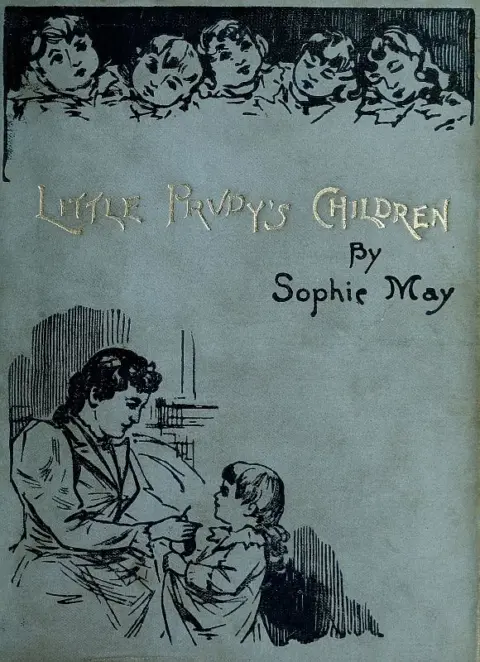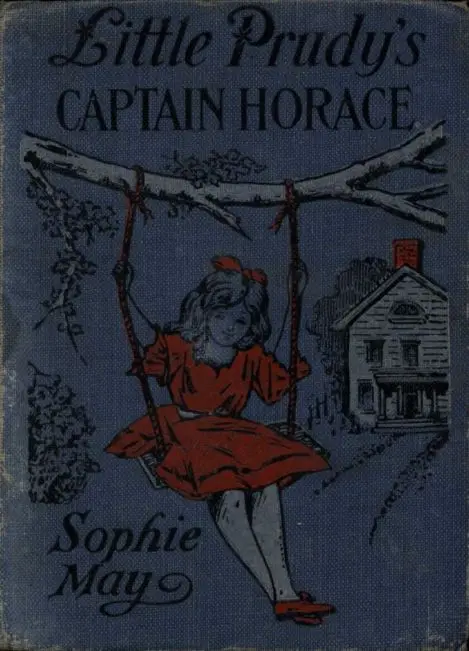
Little Prudy’s Captain Horace
Sophie May
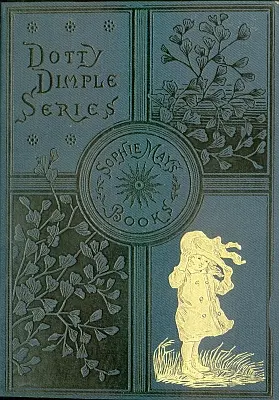
THE CLASSIC COLLECTION · 1868
"Dotty Dimple at Her Grandmother's" by Sophie May is a children's fiction book, likely written in the late 19th century. The story follows a young girl named Dotty, or Alice, as she navigates life with her siblings while spending time at her grandmother's home. The narrative captures the innocence and curiosities of childhood, focusing on Dotty's adventures, interactions with other children, and her moral lessons learned throughout. At the start of the book, the three Parlin siblings are introduced as they arrive at their grandmother's house on a lovely Sunday morning. Dotty Dimple observes the beauty of nature and finds herself grappling with feelings of envy and admiration as she compares herself to another girl, Jennie. The opening reveals Dotty’s innocence and her childlike misunderstanding of social status, wealth, and virtue, particularly as she contemplates the act of giving and the lessons learned in Sunday school. The interactions and discussions amongst the children set the stage for Dotty's adventures and moral growth throughout the story, indicating that themes of generosity, honesty, and childhood imagination will be central to the narrative.
Introduction adapted from the source catalogue; source summaries may be automatically generated.
Free to read · English · 24,521 words · No account needed
MAKE TIME FOR A GOOD BOOK
On by default. Untick to stop anonymous reading totals. Each page counts after 10 seconds in view. How this works.
Anonymous counting is on unless you have switched it off.
"Starch?" cried Dotty, in disgust; "and you never told me, Ruthie! How did I know it wasn't arrow-root?"
"You see, Polly," said Ruth in a discouraged tone, "just what we are to expect from these children to-day. Next thing we know, that morsel of a Katie will be running away. They are enough to try the patience of Job when they both of them set out to see what they can do. And if Jennie Vance comes, the house will be turned upside down in five minutes."
Ruth might have known better than to complain to Polly, who always had something in her own experience which was worse than anybody else had known.
"We all have our trials," sighed that sorrowful woman; "if it isn't children, it's aches and pains. Now, for my part, I've been troubled for ten years with--"
Here followed a list of diseases. Ruth shut her lips together, resolved to say nothing more about her own trials.
"They don't either of them like me," thought Dotty. "I'm going off in the barn, and perhaps they'll think I'm dead. Katie," said she, sternly, "I'm going off somewhere, and you mustn't try to find me."
Then there was some one else who felt quite alone in the world, and that was little Katie. Her cousin had pushed her one side as if she was of no value. Katie was a very little child, but she was old enough to feel aggrieved. She went into the parlor, and threw herself face downwards on the sofa, thinking.
"Somebody leave me alone. O, dear! Some naughty folks don't think I'm
any gooder than a baby."
Then the poor little thing ran out to "breve the fleshy air." No, she wasn't quite alone in the world after all, for there was Charlie Gray at the gate.
"Is um you?" she cried gleefully.
Charlie said it was.
"You didn't came to see big folks--did you? You camed to see Katie. I
love you deely."
Then she tried to kiss him; but Charlie drew away.
"O, is your face sore?" asked the little girl.
By this time they had got as far as the seat in the trees, and Charlie
had found his tongue.
"I didn't come thee you," said he. "I came thee your grandpa'th pig."
"O," said Katie, perfectly satisfied.
Off they started for the pig-pen.
"I'm glad Dotty Dimble goed away," said Katie, swinging Charlie's hand; "her's stinchy and foolidge."
"Good girlth don't thay tho," said sweet little Charlie rather shocked.
"Well, I do; stinchy and foolidge!" repeated Katie, as severely as if she had known what the words meant.
Your reading position is saved on this browser. Take it to another device with a library code. Reading pages adapt to text, rather than matching a printed edition.
BEHIND THE BOOK
This eBook is for the use of anyone anywhere in the United States and most other parts of the world at no cost and with almost no restrictions whatsoever. You may copy it, give it away or re-use it under the terms of the Project Gutenberg License included with this eBook or online at www.gutenberg.org. If you are not located in the United States, you will have to check the laws of the country where you are located before using this eBook. Read the source licence.
The original source file, including credits and licence, is retained by this library. Request an original-format copy at no charge. Please include the book title and Project Gutenberg identifier #20699.
KEEP YOUR CURIOSITY GOING
Coulson Kernahan

Maurice Baring
Frances Wright
Cécile Tormay

Frederic Jesup Stimson

W. H. P. (William Henry Pope) Jarvis