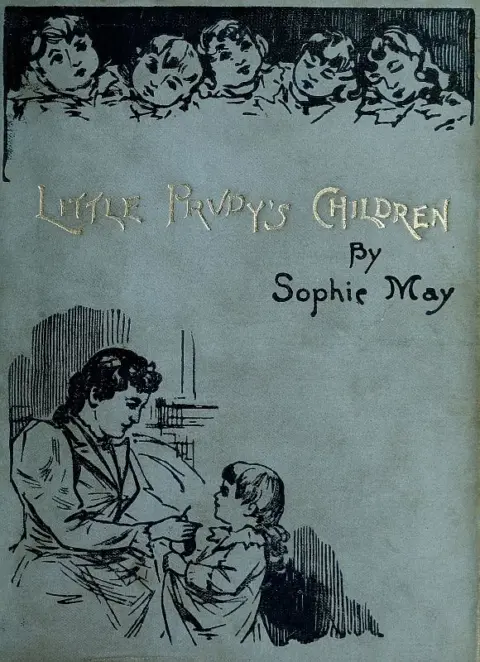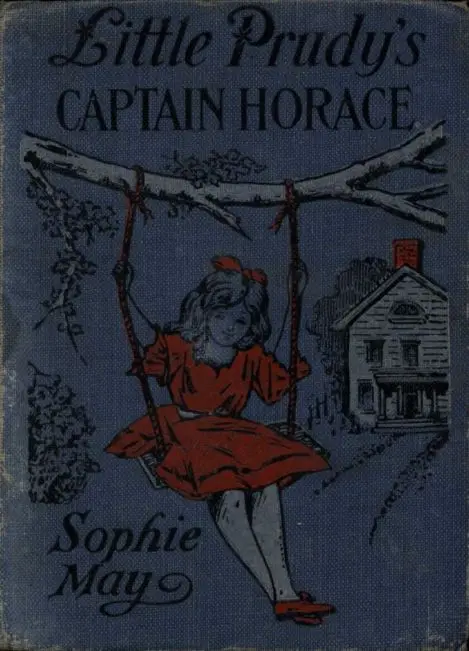
Little Prudy’s Captain Horace
Sophie May
THE CLASSIC COLLECTION · 1868
"Dotty Dimple at Her Grandmother's" by Sophie May is a children's fiction book, likely written in the late 19th century. The story follows a young girl named Dotty, or Alice, as she navigates life with her siblings while spending time at her grandmother's home. The narrative captures the innocence and curiosities of childhood, focusing on Dotty's adventures, interactions with other children, and her moral lessons learned throughout. At the start of the book, the three Parlin siblings are introduced as they arrive at their grandmother's house on a lovely Sunday morning. Dotty Dimple observes the beauty of nature and finds herself grappling with feelings of envy and admiration as she compares herself to another girl, Jennie. The opening reveals Dotty’s innocence and her childlike misunderstanding of social status, wealth, and virtue, particularly as she contemplates the act of giving and the lessons learned in Sunday school. The interactions and discussions amongst the children set the stage for Dotty's adventures and moral growth throughout the story, indicating that themes of generosity, honesty, and childhood imagination will be central to the narrative.
Introduction adapted from the source catalogue; source summaries may be automatically generated.
Free to read · English · 24,521 words · No account needed
MAKE TIME FOR A GOOD BOOK
On by default. Untick to stop anonymous reading totals. Each page counts after 10 seconds in view. How this works.
Anonymous counting is on unless you have switched it off.
"What party?" cried Dotty, dancing on her well foot.
"There, now, don't feel so happy, darling, for you can't go; its a family party, and Cousin Lydia wrote she hadn't room for the two youngest; that's you and Flyaway."
Dotty looked as if she had received a blow. True, she knew nothing about Cousin Lydia, who lived twenty miles away; but if that individual was going to have a party, of course Dotty wished to go to it.
"Uncle John is going, all his wife and children," said Prudy; "and I don't see why Dotty can't."
Uncle John was Aunt Martha's husband, and "all his wife and children" meant only Aunt Martha and Lonnie.
"Cousin Lydia wanted to make me cry," exclaimed Dotty, her eyes shooting out sparks of displeasure; "she 'spected I'd cry, and that's why--Katie," added she, drawing the little one up to her, "Cousin Lydia won't let you come to her house."
"What for she won't?" cried Katie, looking defiant. "If I good would her put me in the closet? I don't like her tall, tenny rate."
This was the strongest expression of wrath Katie dared use; and when she said she did not like a person "tall tenny rate," it meant that she was very, very angry.
"Has Cousin Yiddy got some heart?" asked she indignantly.
"Not a bit," replied Dotty, fiercely.
Mrs. Parlin now tried to explain. She said Mrs. Tenny did not intend any disrespect to the two youngest ones; but she really had no room for them, as her guests were to spend the night.
"The mistake she made was in asking Susy and Prudy," said Aunt Louise; "but I suppose she was curious to see our little poetess."
Prudy blushed, and hid her face behind the curtain.
"Poor little sister," thought she, "how she feels!" For Dotty sat in the rocking-chair, as stiff as a jointed doll, looking as if she loved nobody and nobody loved her. Her beautiful eyes had ceased to shoot sparks of fire, and now appeared hard and frozen, like thick blue ice. In fact, a fit of the pouts was coming on very fast, and gentle Prudy dreaded it. She had been so happy in the thought of riding to Bloomingdale; could she give up that pleasure, and stay at home with Dotty? Nothing less, she knew, would satisfy the child. All her life Prudy had been learning to think of the happiness of others before her own. She cast another glance at the still face.
"I'm not going to Bloomingdale," sighed she, behind the curtain.
But when she told Mrs. Parlin so, that night, her voice was very
tremulous.
Your reading position is saved on this browser. Take it to another device with a library code. Reading pages adapt to text, rather than matching a printed edition.
BEHIND THE BOOK
This eBook is for the use of anyone anywhere in the United States and most other parts of the world at no cost and with almost no restrictions whatsoever. You may copy it, give it away or re-use it under the terms of the Project Gutenberg License included with this eBook or online at www.gutenberg.org. If you are not located in the United States, you will have to check the laws of the country where you are located before using this eBook. Read the source licence.
The original source file, including credits and licence, is retained by this library. Request an original-format copy at no charge. Please include the book title and Project Gutenberg identifier #20699.
KEEP YOUR CURIOSITY GOING
Coulson Kernahan

Maurice Baring
Frances Wright
Cécile Tormay

Frederic Jesup Stimson

W. H. P. (William Henry Pope) Jarvis