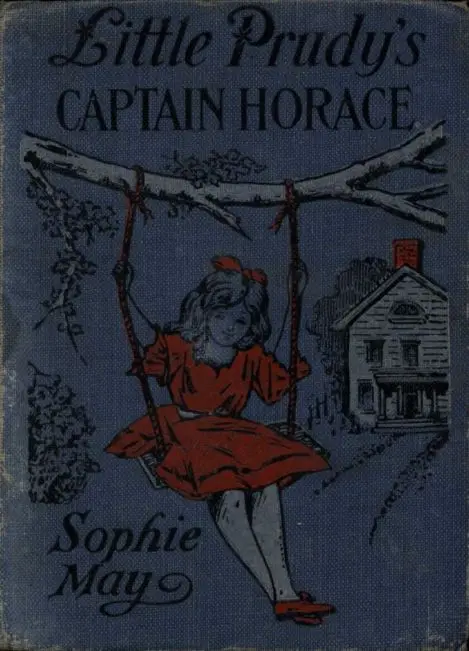
Little Prudy’s Captain Horace
Sophie May
THE CLASSIC COLLECTION · 1868
"Dotty Dimple at Her Grandmother's" by Sophie May is a children's fiction book, likely written in the late 19th century. The story follows a young girl named Dotty, or Alice, as she navigates life with her siblings while spending time at her grandmother's home. The narrative captures the innocence and curiosities of childhood, focusing on Dotty's adventures, interactions with other children, and her moral lessons learned throughout. At the start of the book, the three Parlin siblings are introduced as they arrive at their grandmother's house on a lovely Sunday morning. Dotty Dimple observes the beauty of nature and finds herself grappling with feelings of envy and admiration as she compares herself to another girl, Jennie. The opening reveals Dotty’s innocence and her childlike misunderstanding of social status, wealth, and virtue, particularly as she contemplates the act of giving and the lessons learned in Sunday school. The interactions and discussions amongst the children set the stage for Dotty's adventures and moral growth throughout the story, indicating that themes of generosity, honesty, and childhood imagination will be central to the narrative.
Introduction adapted from the source catalogue; source summaries may be automatically generated.
Free to read · English · 24,521 words · No account needed
MAKE TIME FOR A GOOD BOOK
On by default. Untick to stop anonymous reading totals. Each page counts after 10 seconds in view. How this works.
Anonymous counting is on unless you have switched it off.
One day Dottie stood with Katie by the back-door blowing bubbles. The blue sky, the white fences, the green trees, and even the people who passed in the street, made little pictures of themselves on the bubbles. It was very beautiful. Dotty blew with such force that her cheeks were puffed as round as rubber balls. Katie looked on in great delight.
"See," she cried, "see the trees a-yidin' on that bubbil!"
Dotty dropped the pipe and kissed her.
"Dear me," said she, the next minute, "there's Miss Polly coming!"
Katie looked along the path, and saw a forlorn woman tightly wrapped in a brown shawl, carrying a basket on her arm, and looking sadly down at her own calf-skin shoes, which squeaked dismally as she walked.
"Is um the Polly?" whispered Katie; "is um so tired?"
"No, she isn't tired," said Dotty; "but she feels dreadfully all the whole time; I don't know what it's about, though."
By this time the new-comer stood on the threshold, sighing.
"How do you do, you pretty creeturs?" said she, with a dreary smile.
"Yes, 'um," replied Katie; "is you the Polly, and does you feel
drefful?"
The sad woman kissed the little girls,--for she was fond of children,--sighed more heavily than ever, asked if their grandmother was at home, and passed through the kitchen on her way to the parlor.
Mrs. Parlin sat knitting on the sofa, Mrs. Clifford was sewing, and Miss Louise crocheting. They all looked up and greeted the visitor politely, but it seemed as if a dark cloud had entered the room. Miss Polly seated herself in a rocking-chair, and began to take off her bonnet, sighing as she untied the strings, and sighing again as she took the three pins out of her shawl.
"I hope you are well this fine weather," said Mrs. Parlin, cheerily.
"As well as ever I expect to be," replied Miss Polly, in a resigned
tone.
Then she opened the lids of her basket with a dismal creak, and took out her knitting, which was as gray as a November sky. Afterwards she slowly pinned a corn-cob to the right side of her belt, and began to knit. At the end of every needle she drew a deep breath, and felt the stocking carefully to make sure there were no "nubs" in it. She talked about the "severe drowth" and some painful cases of sickness, after which she took out her snuff-box, and then the three ladies saw that she had something particular to say.
"Where is your little boy, Maria?"
She always called Mrs. Clifford Maria, for she had known her from a
baby.
Your reading position is saved on this browser. Take it to another device with a library code. Reading pages adapt to text, rather than matching a printed edition.
BEHIND THE BOOK
This eBook is for the use of anyone anywhere in the United States and most other parts of the world at no cost and with almost no restrictions whatsoever. You may copy it, give it away or re-use it under the terms of the Project Gutenberg License included with this eBook or online at www.gutenberg.org. If you are not located in the United States, you will have to check the laws of the country where you are located before using this eBook. Read the source licence.
The original source file, including credits and licence, is retained by this library. Request an original-format copy at no charge. Please include the book title and Project Gutenberg identifier #20699.
KEEP YOUR CURIOSITY GOING
Coulson Kernahan

Maurice Baring
Frances Wright
Cécile Tormay

Frederic Jesup Stimson

W. H. P. (William Henry Pope) Jarvis