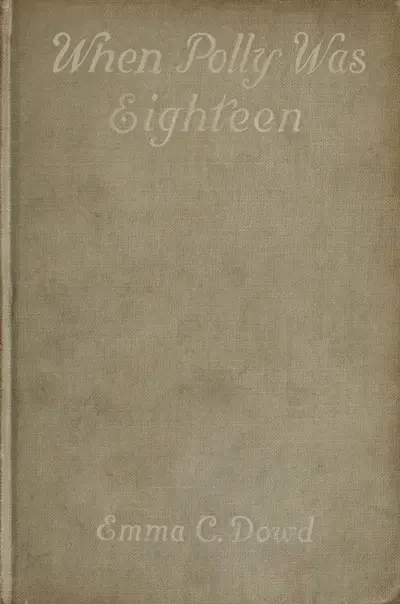
When Polly Was Eighteen
Emma C. Dowd
THE CLASSIC COLLECTION · 1915
"Doodles, the Sunshine Boy" by Emma C. Dowd is a children's novel written in the early 20th century. The story centers around a young boy named Doodles, who faces physical challenges but is filled with joy and creativity, largely brought to life through his relationship with his family and his pet mockingbird, Caruso. The narrative hints at themes of resilience, family dynamics, and the importance of friendship and community. At the start of the book, we meet Blue Stickney, Doodles's older brother, as he attends an auction at a bird shop where he unwittingly decides to buy a defeated-looking bird for Doodles—who captures hearts with his joy for life despite his struggles. Blue's initial intention is to lift Doodles's spirits, setting off a series of events that define their close bond. As the family navigates hardship, including financial concerns and Doodles's health issues, the introduction of secondary characters, like Granny O'Donnell and their neighbor, Dorothy Rose, hints at a larger community dynamic that supports Doodles and his aspirations. Blue's determination to care for Doodles and the new bird creates both tender and humorous moments, suggesting a comforting exploration of childhood joys and the complexities of familial love.
Introduction adapted from the source catalogue; source summaries may be automatically generated.
Free to read · English · 63,418 words · No account needed
MAKE TIME FOR A GOOD BOOK
On by default. Untick to stop anonymous reading totals. Each page counts after 10 seconds in view. How this works.
Anonymous counting is on unless you have switched it off.
“WHAT a sweet, sweet singer!”
Doodles turned quickly from Caruso, to see a child on the threshold. He had not heard a footfall.
She was an odd little creature, straight and slender, with a mop of jet─black curls, skin dusky as a gypsy’s, and eyes like the bluest sky. Her coarse dress of red cotton stuff reached nearly to her ankles, and a curious beaded bodice of dark green scalloped with gold added a foreign, fantastic touch to her appearance.
“How soon will he sing again?” The question was anxiously put, with a
swift backward glance.
Doodles started “Annie Laurie,” and at once the bird took up the tune, the listener in the doorway clasping her tiny hands in delight.
“Here, you kid you! what yer doin’ out there? Didn’t I tell yer to keep where yer b’long!”
A woman, in dingy yellow and black, strode across the hall, and with a jerk of her bony arm the little one was snatched away. Dolly Moon’s door slammed, and Doodles suddenly felt lonesome.
“She might have let her stay and hear Caruso,” he lamented. “Don’t see what hurt she was doing.”
As soon as his brother came home he told him about it.
“That’s the crowd I heard coming in last night,” Blue decided. “Guess you’d gone to sleep. ’T was ten or eleven. I knew ’t must be some new ones. They had a lot of traps, by the clatter. Bet they’ve got Gaylord’s room, too. The door was ajar when I went for some water this morning, and two men were in there.”
“I wish Mr. Gaylord was here now,” sighed Doodles.
“Oh, don’t you worry!” returned his brother. “He’ll be back again. You always have to go with the folks that hire you, and he had to. Mrs. Graham’ll get tired o’ spinnin’ round in an auto soon as it’s cold—by September prob’ly. That’ll be here before you can say,—
“Whimwham, rock or wiggle!
Whimwham, whoa!
Whimwham, mock or giggle!
Whimwham, go!”
“Oh!” cried Doodles gleefully.
“Whimwham, rock a wiggle!
Whimwham, whoa!
Whimwham, mock a wiggle—no, giggle!
Whimwham, go!”
“There, I did! And it hasn’t come! I’m afraid Mr. Gaylord won’t too.” His voice dropped into sadness.
“You didn’t say it right,” laughed Blue.
“Why not?”
“Nobody does till they catch on.”
“Say it again, please!”
The bit of nonsense was repeated with a dash that made Doodles gasp in admiration. But his second trial showed no improvement.
Your reading position is saved on this browser. Take it to another device with a library code. Reading pages adapt to text, rather than matching a printed edition.
Emma C. Dowd
BEHIND THE BOOK
This eBook is for the use of anyone anywhere in the United States and most other parts of the world at no cost and with almost no restrictions whatsoever. You may copy it, give it away or re-use it under the terms of the Project Gutenberg License included with this eBook or online at www.gutenberg.org. If you are not located in the United States, you will have to check the laws of the country where you are located before using this eBook. Read the source licence.
The original source file, including credits and licence, is retained by this library. Request an original-format copy at no charge. Please include the book title and Project Gutenberg identifier #58164.
KEEP YOUR CURIOSITY GOING
Coulson Kernahan

Maurice Baring
Frances Wright
Cécile Tormay

Frederic Jesup Stimson

W. H. P. (William Henry Pope) Jarvis