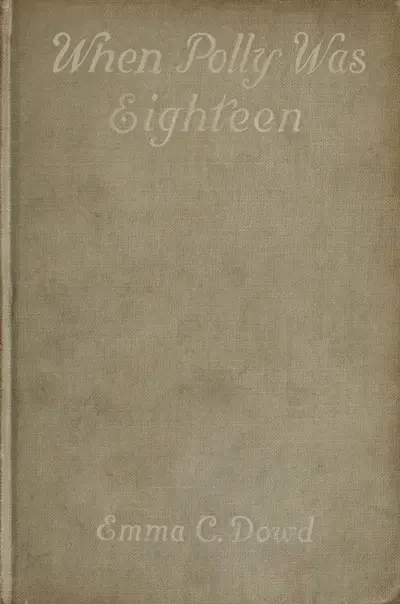
When Polly Was Eighteen
Emma C. Dowd
THE CLASSIC COLLECTION · 1915
"Doodles, the Sunshine Boy" by Emma C. Dowd is a children's novel written in the early 20th century. The story centers around a young boy named Doodles, who faces physical challenges but is filled with joy and creativity, largely brought to life through his relationship with his family and his pet mockingbird, Caruso. The narrative hints at themes of resilience, family dynamics, and the importance of friendship and community. At the start of the book, we meet Blue Stickney, Doodles's older brother, as he attends an auction at a bird shop where he unwittingly decides to buy a defeated-looking bird for Doodles—who captures hearts with his joy for life despite his struggles. Blue's initial intention is to lift Doodles's spirits, setting off a series of events that define their close bond. As the family navigates hardship, including financial concerns and Doodles's health issues, the introduction of secondary characters, like Granny O'Donnell and their neighbor, Dorothy Rose, hints at a larger community dynamic that supports Doodles and his aspirations. Blue's determination to care for Doodles and the new bird creates both tender and humorous moments, suggesting a comforting exploration of childhood joys and the complexities of familial love.
Introduction adapted from the source catalogue; source summaries may be automatically generated.
Free to read · English · 63,418 words · No account needed
MAKE TIME FOR A GOOD BOOK
On by default. Untick to stop anonymous reading totals. Each page counts after 10 seconds in view. How this works.
Anonymous counting is on unless you have switched it off.
THE vision in the doorway arrested the word of welcome on Doodles’s lips. As soon as he could command his tongue he smiled a cordial “How do you do? Will you walk in?”
And the vision in brown cloth and creamy lace and fluffy feathers came straight across the room and took one of his hands between her soft gloves, saying, in the sweetest of voices, “My dear Doodles! Do you know me?”
“I think you must be Miss Fleming,” the boy answered, “because—” he
hesitated.
“Because Daphne and I look alike?” she questioned.
Doodles shook his head. “Because you are so beautiful,” he replied
bravely.
The girl laughed her remonstrance, yet she did not appear to be displeased, and Doodles smiled shyly up at her.
“I have come to thank you for sending your bird to me,” she began.
“Oh! did Caruso comfort you?” cried Doodles.
Her delicate face grew pinker—and even prettier, the boy thought.
“I enjoyed his singing very much,” she said. “Indeed, his coming has led to such pleasant things, life seems to have been made all over for me.”
“I am just as glad, glad!” he rejoiced. “Caruso is a dear comforter—why, he comforts me all the time!”
The girl’s eyes suddenly grew soft and glistening, and she gave no
response.
Caruso, with his usual courtesy, flung a little carol into the pause, and that brought about the visitor’s asking Doodles to sing for her.
The child’s selection chanced to be Nevin’s “Little Boy Blue,” which Leona Montgomery had taught him one rainy holiday. As always, he threw his heart into the simple words, and they became words of life. At the end his listener surprised him by taking both his hands in hers.
“Doodles dear, has anybody ever told you that you have a wonderful
voice?”
“Nobody but a lady who lived downstairs,” he replied modestly. “I sang to her before she died. She said I ought to take lessons.”
“You shall,” declared Miss Fleming. “And my teacher in New York must certainly hear you sing. I will try to manage it.”
After another song the visitor said good─bye, leaving a message for Mrs. Stickney, which when it was given her threw the little woman into a panic.
“Coming to see me?” she exclaimed. “For what? I shan’t know a thing to say to her! I wish folks wouldn’t—such folks!”
But Eudora Fleming always kept her word, and her next call was in the evening, when the mother was apt to be at home.
Your reading position is saved on this browser. Take it to another device with a library code. Reading pages adapt to text, rather than matching a printed edition.
Emma C. Dowd
BEHIND THE BOOK
This eBook is for the use of anyone anywhere in the United States and most other parts of the world at no cost and with almost no restrictions whatsoever. You may copy it, give it away or re-use it under the terms of the Project Gutenberg License included with this eBook or online at www.gutenberg.org. If you are not located in the United States, you will have to check the laws of the country where you are located before using this eBook. Read the source licence.
The original source file, including credits and licence, is retained by this library. Request an original-format copy at no charge. Please include the book title and Project Gutenberg identifier #58164.
KEEP YOUR CURIOSITY GOING
Coulson Kernahan

Maurice Baring
Frances Wright
Cécile Tormay

Frederic Jesup Stimson

W. H. P. (William Henry Pope) Jarvis