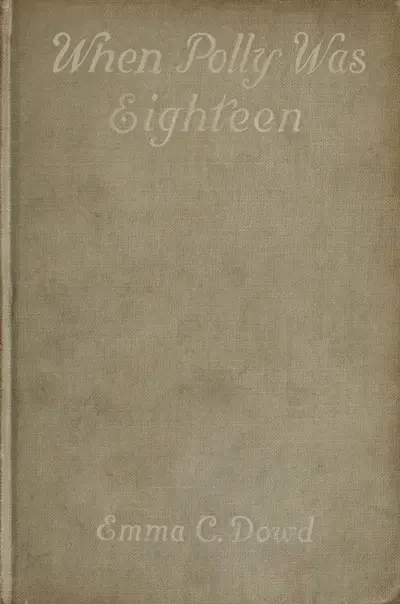
When Polly Was Eighteen
Emma C. Dowd
THE CLASSIC COLLECTION · 1915
"Doodles, the Sunshine Boy" by Emma C. Dowd is a children's novel written in the early 20th century. The story centers around a young boy named Doodles, who faces physical challenges but is filled with joy and creativity, largely brought to life through his relationship with his family and his pet mockingbird, Caruso. The narrative hints at themes of resilience, family dynamics, and the importance of friendship and community. At the start of the book, we meet Blue Stickney, Doodles's older brother, as he attends an auction at a bird shop where he unwittingly decides to buy a defeated-looking bird for Doodles—who captures hearts with his joy for life despite his struggles. Blue's initial intention is to lift Doodles's spirits, setting off a series of events that define their close bond. As the family navigates hardship, including financial concerns and Doodles's health issues, the introduction of secondary characters, like Granny O'Donnell and their neighbor, Dorothy Rose, hints at a larger community dynamic that supports Doodles and his aspirations. Blue's determination to care for Doodles and the new bird creates both tender and humorous moments, suggesting a comforting exploration of childhood joys and the complexities of familial love.
Introduction adapted from the source catalogue; source summaries may be automatically generated.
Free to read · English · 63,418 words · No account needed
MAKE TIME FOR A GOOD BOOK
On by default. Untick to stop anonymous reading totals. Each page counts after 10 seconds in view. How this works.
Anonymous counting is on unless you have switched it off.
“BLUE,” Doodles began tentatively, “you know that poor sick lady that Granny O’Donnell was telling us about last night.”
“M─hm.”
“I’ve thought of her ever since, and I guess she is one of God’s people that needs comforting. Don’t you think so?”
“What?” scowled Blue in surprise.
Doodles repeated innocently, adding, “It must be pretty dreadful to lie there all day long without anybody to talk to.”
Blue nodded, wondering what scheme Doodles was amusing himself with now.
“I’m glad you think just as I do,” the small boy went on, “because, of course, you’ll have to do most of it for me.”
Blue straightened in his chair, and began to listen with more interest.
“At first I didn’t see any way I could comfort her, and then I thought of Caruso. It was his singing that made me think—oh, he sung just beautifully!”
“And the door wasn’t open, was it?” put in Blue. “Too bad! I shut it, the hall was so cold.”
“Door?” Doodles looked puzzled.
“Why, the hall door! You wanted the sick woman to hear Caruso, didn’t
you?”
“Oh!” Doodles brightened understandingly. “I didn’t think about the door. Maybe she could hear if it was open.”
“S’posed that was what you were drivin’ at.”
“No! I meant for you to take him down to her room. You wouldn’t mind, would you?” The query wore an anxious tone.
Blue’s grimace would not have encouraged a stranger, but Doodles laughed contentedly. He knew his brother.
“Caruso don’t sing much now,” the elder boy argued evasively. “Mr. Gillespie said they didn’t in the winter.”
“I know,” admitted Doodles. “But I guess he would, if I wanted him to. You whistle to him, and see if he won’t.”
Blue good─humoredly struck up a tune, and to his surprise and disappointment the bird started into song.
“There!” Doodles clapped his hands gleefully.
“Wha’ ’d yer stop him for?” laughed Blue, for Caruso was suddenly
silent.
“Never mind, he’ll do it again!”
He did—to the uneasiness of Blue.
“Do you want to take him now?” asked Doodles trustingly. “And tell her, please, that I’d have come myself if I could.”
“I don’t b’lieve she’d care anything about hearin’ him,” began Blue, feeling after an excuse.
“Seem’s if anybody would, ’specially if they were sick,” replied Caruso’s master plaintively. “I don’t see how I can comfort folks any other way.”
Blue looked curiously at his brother.
“You seem to be fierce to comfort somebody all of a sudden,” he laughed.
Your reading position is saved on this browser. Take it to another device with a library code. Reading pages adapt to text, rather than matching a printed edition.
Emma C. Dowd
BEHIND THE BOOK
This eBook is for the use of anyone anywhere in the United States and most other parts of the world at no cost and with almost no restrictions whatsoever. You may copy it, give it away or re-use it under the terms of the Project Gutenberg License included with this eBook or online at www.gutenberg.org. If you are not located in the United States, you will have to check the laws of the country where you are located before using this eBook. Read the source licence.
The original source file, including credits and licence, is retained by this library. Request an original-format copy at no charge. Please include the book title and Project Gutenberg identifier #58164.
KEEP YOUR CURIOSITY GOING
Coulson Kernahan

Maurice Baring
Frances Wright
Cécile Tormay

Frederic Jesup Stimson

W. H. P. (William Henry Pope) Jarvis