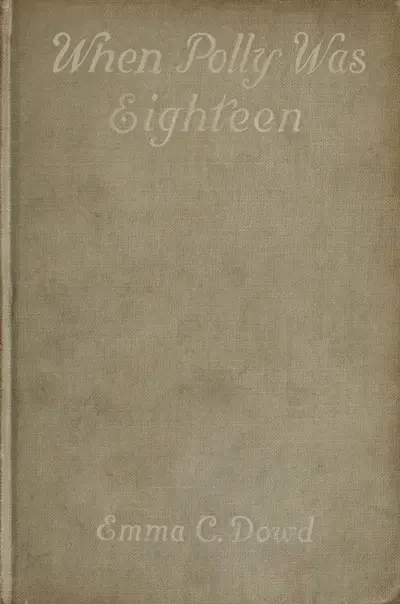
When Polly Was Eighteen
Emma C. Dowd
THE CLASSIC COLLECTION · 1915
"Doodles, the Sunshine Boy" by Emma C. Dowd is a children's novel written in the early 20th century. The story centers around a young boy named Doodles, who faces physical challenges but is filled with joy and creativity, largely brought to life through his relationship with his family and his pet mockingbird, Caruso. The narrative hints at themes of resilience, family dynamics, and the importance of friendship and community. At the start of the book, we meet Blue Stickney, Doodles's older brother, as he attends an auction at a bird shop where he unwittingly decides to buy a defeated-looking bird for Doodles—who captures hearts with his joy for life despite his struggles. Blue's initial intention is to lift Doodles's spirits, setting off a series of events that define their close bond. As the family navigates hardship, including financial concerns and Doodles's health issues, the introduction of secondary characters, like Granny O'Donnell and their neighbor, Dorothy Rose, hints at a larger community dynamic that supports Doodles and his aspirations. Blue's determination to care for Doodles and the new bird creates both tender and humorous moments, suggesting a comforting exploration of childhood joys and the complexities of familial love.
Introduction adapted from the source catalogue; source summaries may be automatically generated.
Free to read · English · 63,418 words · No account needed
MAKE TIME FOR A GOOD BOOK
On by default. Untick to stop anonymous reading totals. Each page counts after 10 seconds in view. How this works.
Anonymous counting is on unless you have switched it off.
Blue understood the unfinished sentence. Yet he said, “Doodles and I like ‘much,’ don’t we, kiddie?” Then he set the pitcher aside, and ate his second helping without replenishment of the sweet.
Doodles dozed away an hour or two of the long forenoon, and was beginning to feel quite rested when a knock announced a caller.
To his cheery “Come in!” the door opened upon a woman,—a stocky, youngish woman, with pale blue eyes, heavy cheeks, and a double chin. She swept across to the cushioned chair.
“How d’ye do! I thought I’d find you at home,” with strong emphasis. “I was at the concert last night,” she went on, seating herself somewhat laboriously in the offered chair; “perhaps you remember me.”
Doodles gave a smiling assent. He could hardly have forgotten that plumed hat with its gorgeous pins, the shimmering green satin gown, and,—when she had drawn off one of her long white gloves,—those stubby red fingers, sparkling to the knuckles with diamonds.
She abruptly introduced her errand.
“I have come to talk about your bird. I took a fancy to him last night, and I want to know what you’ll sell him for.”
“Oh!” It was a frightened, pitiful little cry, and, all in an instant, Doodles’s face matched it. “I—don’t want to sell him—I wouldn’t sell him for anything!”
The woman laughed, a cold, hateful laugh that flashed fear through the
boy’s heart.
“I guess you will,”—she winked coaxingly,—“when you know what I’ll pay for him. I’ll give you twenty dollars! Just think, tw─en─ty bright silver dollars!”
She smiled quite as if the matter were settled, but there was no response on the scared white face opposite. Doodles looked straight past her to the cluster of faded red roses on the wall paper back of her chair.
“Tw─en─ty beautiful bright silver dollars!” she reiterated in a
wheedling tone.
“I don’t want to sell him!” Doodles insisted firmly, his eyes still on
the roses.
“Well, now,” she resumed, “I know you’re a sensible little boy, and you listen while I tell you how it looks to me. I understand that your mother is in rather straitened circumstances, being just out of the hospital, and not very well, and all. So, you see, twenty dollars would help her wonderfully. Of course, you love her dearly, better than anything else in the whole world, don’t you?”
Doodles bowed his head miserably.
Your reading position is saved on this browser. Take it to another device with a library code. Reading pages adapt to text, rather than matching a printed edition.
Emma C. Dowd
BEHIND THE BOOK
This eBook is for the use of anyone anywhere in the United States and most other parts of the world at no cost and with almost no restrictions whatsoever. You may copy it, give it away or re-use it under the terms of the Project Gutenberg License included with this eBook or online at www.gutenberg.org. If you are not located in the United States, you will have to check the laws of the country where you are located before using this eBook. Read the source licence.
The original source file, including credits and licence, is retained by this library. Request an original-format copy at no charge. Please include the book title and Project Gutenberg identifier #58164.
KEEP YOUR CURIOSITY GOING
Coulson Kernahan

Maurice Baring
Frances Wright
Cécile Tormay

Frederic Jesup Stimson

W. H. P. (William Henry Pope) Jarvis