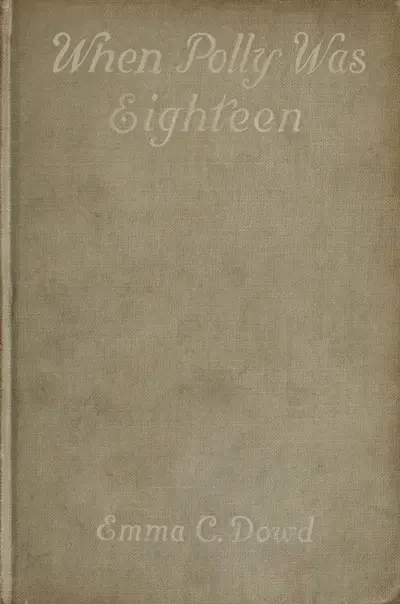
When Polly Was Eighteen
Emma C. Dowd
THE CLASSIC COLLECTION · 1915
"Doodles, the Sunshine Boy" by Emma C. Dowd is a children's novel written in the early 20th century. The story centers around a young boy named Doodles, who faces physical challenges but is filled with joy and creativity, largely brought to life through his relationship with his family and his pet mockingbird, Caruso. The narrative hints at themes of resilience, family dynamics, and the importance of friendship and community. At the start of the book, we meet Blue Stickney, Doodles's older brother, as he attends an auction at a bird shop where he unwittingly decides to buy a defeated-looking bird for Doodles—who captures hearts with his joy for life despite his struggles. Blue's initial intention is to lift Doodles's spirits, setting off a series of events that define their close bond. As the family navigates hardship, including financial concerns and Doodles's health issues, the introduction of secondary characters, like Granny O'Donnell and their neighbor, Dorothy Rose, hints at a larger community dynamic that supports Doodles and his aspirations. Blue's determination to care for Doodles and the new bird creates both tender and humorous moments, suggesting a comforting exploration of childhood joys and the complexities of familial love.
Introduction adapted from the source catalogue; source summaries may be automatically generated.
Free to read · English · 63,418 words · No account needed
MAKE TIME FOR A GOOD BOOK
On by default. Untick to stop anonymous reading totals. Each page counts after 10 seconds in view. How this works.
Anonymous counting is on unless you have switched it off.
The woman opened her eyes, and, gazing earnestly at Doodles, uttered with apparent effort the one word, “Sing!”
So promptly did he respond, Blue breathed an ejaculation as he whirled himself back to the edge of the trunk.
“A—bide with me! Fast falls the ev—en—tide, The darkness deepens—Lord, with me a—bide! When oth—er help—ers fail, and comforts flee, Help of the helpless, oh, a—bide with me!”
Softly, distinctly fell the words, while over the face of the sick woman
stole a look of peace.
Blue found himself following the hymn with unwonted interest. Never had he heard Doodles sing like that. “It’s better ’n church!” he whispered under his breath.
“Hold Thou thy cross be—fore my clos—ing eyes; Shine through the gloom, and point me to the skies; Heaven’s morn—ing breaks, and earth’s vain shadows flee! In life, in death, O Lord, a—bide with me!”
The room was silent. The little singer leaned back in weariness. Blue, with a glance toward Doodles, bent nearer the cot. The woman lay as if sleeping, though not a flicker stirred the covers. Blue’s face took on a look of awe, and noiselessly he stepped to his brother’s side.
“We’d better go upstairs now, you’re getting tired.”
“She may want me to sing again,” he objected.
“No, she won’t. She’s fast asleep.”
Doodles looked across at her.
“Well,” he yielded, putting his arms around his brother’s neck.
Mrs. Stickney had not returned, the sun was low, and the kitchen was growing shadowy; but the warmth felt grateful after the chill of the room downstairs.
“I’ll get somebody to help me bring up that trunk,” Blue decided, “and then for my papers—it’s almost time.”
“Don’t forget Caruso!”
“I declare! I had!” He dashed away, returning at once with the bird.
“Is she still asleep?” queried Doodles.
“Sure!” Blue nodded, and darted off again.
With the trunk actually in the kitchen, Doodles felt the violin to be less mythical. How wonderful it would be to have one of his very own! He was glad Blue did not urge the boy to stay, he was in haste to have the trunk opened. But the lock appeared to be an intricate kind, which Blue could not work, and he finally had to run off for his papers, leaving the trunk still closed.
Doodles was not slow to acquaint his mother with the happenings of the
afternoon.
Your reading position is saved on this browser. Take it to another device with a library code. Reading pages adapt to text, rather than matching a printed edition.
Emma C. Dowd
BEHIND THE BOOK
This eBook is for the use of anyone anywhere in the United States and most other parts of the world at no cost and with almost no restrictions whatsoever. You may copy it, give it away or re-use it under the terms of the Project Gutenberg License included with this eBook or online at www.gutenberg.org. If you are not located in the United States, you will have to check the laws of the country where you are located before using this eBook. Read the source licence.
The original source file, including credits and licence, is retained by this library. Request an original-format copy at no charge. Please include the book title and Project Gutenberg identifier #58164.
KEEP YOUR CURIOSITY GOING
Coulson Kernahan

Maurice Baring
Frances Wright
Cécile Tormay

Frederic Jesup Stimson

W. H. P. (William Henry Pope) Jarvis