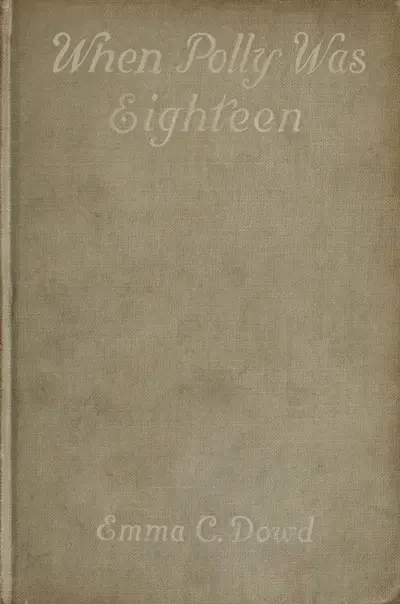
When Polly Was Eighteen
Emma C. Dowd
THE CLASSIC COLLECTION · 1915
"Doodles, the Sunshine Boy" by Emma C. Dowd is a children's novel written in the early 20th century. The story centers around a young boy named Doodles, who faces physical challenges but is filled with joy and creativity, largely brought to life through his relationship with his family and his pet mockingbird, Caruso. The narrative hints at themes of resilience, family dynamics, and the importance of friendship and community. At the start of the book, we meet Blue Stickney, Doodles's older brother, as he attends an auction at a bird shop where he unwittingly decides to buy a defeated-looking bird for Doodles—who captures hearts with his joy for life despite his struggles. Blue's initial intention is to lift Doodles's spirits, setting off a series of events that define their close bond. As the family navigates hardship, including financial concerns and Doodles's health issues, the introduction of secondary characters, like Granny O'Donnell and their neighbor, Dorothy Rose, hints at a larger community dynamic that supports Doodles and his aspirations. Blue's determination to care for Doodles and the new bird creates both tender and humorous moments, suggesting a comforting exploration of childhood joys and the complexities of familial love.
Introduction adapted from the source catalogue; source summaries may be automatically generated.
Free to read · English · 63,418 words · No account needed
MAKE TIME FOR A GOOD BOOK
On by default. Untick to stop anonymous reading totals. Each page counts after 10 seconds in view. How this works.
Anonymous counting is on unless you have switched it off.
The tolling bells recalled his thoughts to the urgent business on hand.
“Gracious! but we must hurry!” he cried. “Where’s yer cap, kiddie?”
Mrs. Stickney brought it, with the coat which Blue had outgrown.
“I don’t see how you’re going to manage,”—the mother was tucking a handkerchief about the small boy’s neck,—“I’m afraid he’s too heavy for either of you.” She glanced from one to the other.
“Oh, I could to carry him in mine arms!” declared Joseph valiantly.
“But we’re going to make a lady─chair, and take him that way,” put in
Blue.
And so they did, the mother watching, a bit anxious, from the top of the stairs, and Granny O’Donnell, in her door, cheering the little procession.
The walk from The Flatiron to The Church of the Good Shepherd was accomplished without serious mishap. Once Doodles slipped, and, righting him, Blue lost his hat; but a stranger returned it to his head, and the trio went on again.
“I could to carry him mineself,” observed Joseph.
“Guess you’d better not,” Blue advised. “I tried it last summer,—took him down to the Settlement for a concert,—I didn’t dare risk it again. It was an awful tug! Mother carried him out a little way, one night, just to get the air; but she had to ask Mr. Schloss to take him upstairs—she was all in!”
“I could to carry him,” Joseph reiterated, “sooner you gets tired.”
But Blue would not confess to fatigue, and at last the church was
gained.
No one was in sight. The hush and emptiness outside were forbidding.
“It’s begun!” announced Blue.
“Won’t they let us in?” Doodles whispered tremulously.
“Sure!” was the brave assertion—out of a dismayed heart.
They halted hesitantly, when up popped—seemingly from nowhere—an automaton, dressed in Sabbath dignity and an unsmiling face.
The doors swung silently open, and they were inside. Doodles lifted his eyes, and his fingers almost forgot their clasp. It was so different from his pictures! The rich, subdued light; the great auditorium, with its beautifully wrought pillars, peopled from altar to entrance; the sweet, thrilling undertone of the organ; the reverent stillness of the waiting throng;—it stirred his soul to awe.
Directly they were seated, in the second pew from the door, and Doodles was free to gaze about him. The vast strangeness of the place bewildered his little home─kept heart, and he reached out his hand for his brother’s.
“Tired?” whispered Blue.
“Not much,” his lips smiled, yet Blue’s arm was a grateful support, and he leaned back in content.
Your reading position is saved on this browser. Take it to another device with a library code. Reading pages adapt to text, rather than matching a printed edition.
Emma C. Dowd
BEHIND THE BOOK
This eBook is for the use of anyone anywhere in the United States and most other parts of the world at no cost and with almost no restrictions whatsoever. You may copy it, give it away or re-use it under the terms of the Project Gutenberg License included with this eBook or online at www.gutenberg.org. If you are not located in the United States, you will have to check the laws of the country where you are located before using this eBook. Read the source licence.
The original source file, including credits and licence, is retained by this library. Request an original-format copy at no charge. Please include the book title and Project Gutenberg identifier #58164.
KEEP YOUR CURIOSITY GOING
Coulson Kernahan

Maurice Baring
Frances Wright
Cécile Tormay

Frederic Jesup Stimson

W. H. P. (William Henry Pope) Jarvis