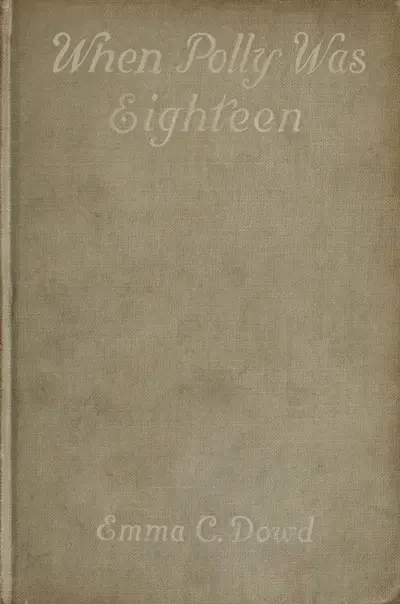
When Polly Was Eighteen
Emma C. Dowd
THE CLASSIC COLLECTION · 1915
"Doodles, the Sunshine Boy" by Emma C. Dowd is a children's novel written in the early 20th century. The story centers around a young boy named Doodles, who faces physical challenges but is filled with joy and creativity, largely brought to life through his relationship with his family and his pet mockingbird, Caruso. The narrative hints at themes of resilience, family dynamics, and the importance of friendship and community. At the start of the book, we meet Blue Stickney, Doodles's older brother, as he attends an auction at a bird shop where he unwittingly decides to buy a defeated-looking bird for Doodles—who captures hearts with his joy for life despite his struggles. Blue's initial intention is to lift Doodles's spirits, setting off a series of events that define their close bond. As the family navigates hardship, including financial concerns and Doodles's health issues, the introduction of secondary characters, like Granny O'Donnell and their neighbor, Dorothy Rose, hints at a larger community dynamic that supports Doodles and his aspirations. Blue's determination to care for Doodles and the new bird creates both tender and humorous moments, suggesting a comforting exploration of childhood joys and the complexities of familial love.
Introduction adapted from the source catalogue; source summaries may be automatically generated.
Free to read · English · 63,418 words · No account needed
MAKE TIME FOR A GOOD BOOK
On by default. Untick to stop anonymous reading totals. Each page counts after 10 seconds in view. How this works.
Anonymous counting is on unless you have switched it off.
“I—love heem!” pointing to Caruso. “I—no talk good. I—learn Eengleesh—I go school one, two, t’ree,” counting on his fingers—he shook his head sadly, and sighed. The word would not come. “One, two, t’ree,” he repeated, and halted again.
“Three years?” prompted Doodles.
The boy shook his head.
“Months?”
He smiled. “Yes, t’anks, t’ree months I go school here—America. I go
school—Athens.”
“Oh! did you live in Athens?” Doodles was interested.
“Yes,” the boy nodded. Then a thought filled his eyes with light. “I play!” He darted off, across the hall, returning with a violin, which he began to finger in a way that roused Doodles’s admiration.
He lifted it to his shoulder, and drew his bow across the strings, holding the instrument caressingly, as if it were a living thing.
Doodles sat entranced through the playing. Never had he heard such
music.
The player slipped into the tune of “Annie Laurie,” with a peremptory, “You sing!” And Doodles began, half shyly, but soon he was the chief performer, the violin playing a soft accompaniment.
On the second verse Caruso joined them with his mellow whistle, the effect being startlingly sweet and delightful.
“Where you learn?” asked the young violinist in the first pause.
“I?” repeated Doodles in surprise.
The other gave a smiling nod.
“Why, I guess I never learned. I’ve always sung.”
The boy looked the admiration he could not speak. “You sing—nice!” he
said.
“You play beautifully!” declared Doodles.
The dark little face brightened. “Yes, that! You sing beau─tee─fully! I no get word—you sing beau─tee─fully!”
“Do you think so?” Doodles grew pink with pleasure. “I never heard anybody play the violin so well as you,” he went on. “I wish you’d play more.”
“I play—you sing.” The Greek boy waited expectantly.
After a moment’s thought Doodles began one of his favorite hymns, “The Ninety and Nine,” the other listening, his violin on his shoulder. He quickly caught the air, and was soon playing a charming accompaniment.
There was another who was not content to be silent. The boys had not counted on the mocking bird, but suddenly he started one of his amusing medleys. Discords increased, and at last, with a chuckle, the violinist dropped his instrument, Doodles doubled over in a laugh, and Caruso was left as star performer.
Your reading position is saved on this browser. Take it to another device with a library code. Reading pages adapt to text, rather than matching a printed edition.
Emma C. Dowd
BEHIND THE BOOK
This eBook is for the use of anyone anywhere in the United States and most other parts of the world at no cost and with almost no restrictions whatsoever. You may copy it, give it away or re-use it under the terms of the Project Gutenberg License included with this eBook or online at www.gutenberg.org. If you are not located in the United States, you will have to check the laws of the country where you are located before using this eBook. Read the source licence.
The original source file, including credits and licence, is retained by this library. Request an original-format copy at no charge. Please include the book title and Project Gutenberg identifier #58164.
KEEP YOUR CURIOSITY GOING
Coulson Kernahan

Maurice Baring
Frances Wright
Cécile Tormay

Frederic Jesup Stimson

W. H. P. (William Henry Pope) Jarvis