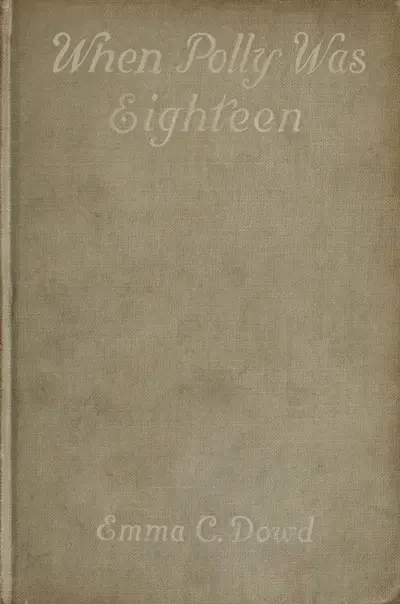
When Polly Was Eighteen
Emma C. Dowd
THE CLASSIC COLLECTION · 1915
"Doodles, the Sunshine Boy" by Emma C. Dowd is a children's novel written in the early 20th century. The story centers around a young boy named Doodles, who faces physical challenges but is filled with joy and creativity, largely brought to life through his relationship with his family and his pet mockingbird, Caruso. The narrative hints at themes of resilience, family dynamics, and the importance of friendship and community. At the start of the book, we meet Blue Stickney, Doodles's older brother, as he attends an auction at a bird shop where he unwittingly decides to buy a defeated-looking bird for Doodles—who captures hearts with his joy for life despite his struggles. Blue's initial intention is to lift Doodles's spirits, setting off a series of events that define their close bond. As the family navigates hardship, including financial concerns and Doodles's health issues, the introduction of secondary characters, like Granny O'Donnell and their neighbor, Dorothy Rose, hints at a larger community dynamic that supports Doodles and his aspirations. Blue's determination to care for Doodles and the new bird creates both tender and humorous moments, suggesting a comforting exploration of childhood joys and the complexities of familial love.
Introduction adapted from the source catalogue; source summaries may be automatically generated.
Free to read · English · 63,418 words · No account needed
MAKE TIME FOR A GOOD BOOK
On by default. Untick to stop anonymous reading totals. Each page counts after 10 seconds in view. How this works.
Anonymous counting is on unless you have switched it off.
“Oh, I forgot!” exclaimed Doodles in compunction.
“Only an Armour─Bearer” was succeeded by “Jerusalem, the Golden,” which proved to be one of the visitor’s favorites.
“Mother likes that,” confided Doodles, as he rested from his singing; “it reminds her so of Uncle Jim. Once, when he was a little boy, there was company to stay over night, a minister and his wife named Hall. Before they went to bed they sung some hymns; Grandmother Blue played on the melodeon, and the rest stood around back of her. When they came to that line, ‘They stand, those halls of Zion,’ Jim nudged mother, and pointed to Mr. and Mrs. Hall, and she giggled right out! Nobody noticed it much, they were singing so loud; but she was dreadfully mortified.”
Mr. Moon laughed with Doodles, then, after thanking him for his singing, he arose to his unsteady feet.
“If I don’t find her to─day, I think I’ll have to stay over till to─morrow,” he said quaveringly; “seems’s if I couldn’t go back without my little Dolly!”
“Dolly?” repeated Doodles, his eyes round with wonder. “Dolly, did you
say?”
“Why, yes, of course, Dolly!” The voice was sharp with pain and something akin to impatience.
“You never said her name was Dolly!” breathed the boy reproachfully, trying to follow out the sudden possible clue. “But she’s Dolly Rose!” he added, with a little shake of his head.
“Child! child! what are you talking about?”
“Dolly—my Dolly Rose! But she ain’t a Moon! She said her name was
Rose—Dorothy Rose.”
“Boy! tell me what you’re driving at! Who’s Dorothy Rose?” The man dropped heavily into the chair he had just quitted.
“Why, she’s a girl,” Doodles explained. “That’s her room,” pointing to the opposite side of the hall. “But she ain’t there now,” he added hastily, for the old man was rising, his face set towards the door indicated.
“Oh!” exclaimed Doodles softly, “she said her grandpa called her Dolly! She did! But her name’s Rose,” he insisted sadly.
“Oh, ’t ain’t likely it’s my Dolly!” was the dreary conclusion. Then a light stole into the clouded eyes. “Her name ain’t Rosetta, is it?”
“No, just Rose,” the boy replied slowly.
“And—” he hesitated, reluctant to let go his forlorn hope, “she ain’t
lame, is she?”
“Oh, she is!” piped Doodles excitedly. “Only a little—not enough to hurt her a bit!” even in that significant moment loyal to his friend.
The withered face flushed and whitened. The faded eyes grew bright. “And has she got curly hair?”
Your reading position is saved on this browser. Take it to another device with a library code. Reading pages adapt to text, rather than matching a printed edition.
Emma C. Dowd
BEHIND THE BOOK
This eBook is for the use of anyone anywhere in the United States and most other parts of the world at no cost and with almost no restrictions whatsoever. You may copy it, give it away or re-use it under the terms of the Project Gutenberg License included with this eBook or online at www.gutenberg.org. If you are not located in the United States, you will have to check the laws of the country where you are located before using this eBook. Read the source licence.
The original source file, including credits and licence, is retained by this library. Request an original-format copy at no charge. Please include the book title and Project Gutenberg identifier #58164.
KEEP YOUR CURIOSITY GOING
Coulson Kernahan

Maurice Baring
Frances Wright
Cécile Tormay

Frederic Jesup Stimson

W. H. P. (William Henry Pope) Jarvis