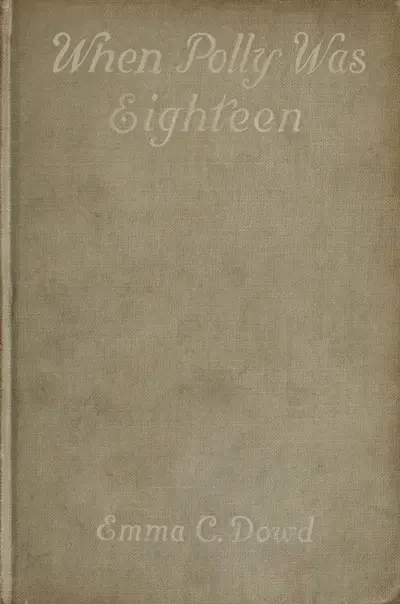
When Polly Was Eighteen
Emma C. Dowd
THE CLASSIC COLLECTION · 1915
"Doodles, the Sunshine Boy" by Emma C. Dowd is a children's novel written in the early 20th century. The story centers around a young boy named Doodles, who faces physical challenges but is filled with joy and creativity, largely brought to life through his relationship with his family and his pet mockingbird, Caruso. The narrative hints at themes of resilience, family dynamics, and the importance of friendship and community. At the start of the book, we meet Blue Stickney, Doodles's older brother, as he attends an auction at a bird shop where he unwittingly decides to buy a defeated-looking bird for Doodles—who captures hearts with his joy for life despite his struggles. Blue's initial intention is to lift Doodles's spirits, setting off a series of events that define their close bond. As the family navigates hardship, including financial concerns and Doodles's health issues, the introduction of secondary characters, like Granny O'Donnell and their neighbor, Dorothy Rose, hints at a larger community dynamic that supports Doodles and his aspirations. Blue's determination to care for Doodles and the new bird creates both tender and humorous moments, suggesting a comforting exploration of childhood joys and the complexities of familial love.
Introduction adapted from the source catalogue; source summaries may be automatically generated.
Free to read · English · 63,418 words · No account needed
MAKE TIME FOR A GOOD BOOK
On by default. Untick to stop anonymous reading totals. Each page counts after 10 seconds in view. How this works.
Anonymous counting is on unless you have switched it off.
“And not going back to The Flatiron?” queried Doodles.
“Never!” was the prompt reply.
“Isn’t that beautiful!” exclaimed the lad.
“To think of your walking along just like anybody!” marveled Mrs. Stickney. “I can’t believe it yet!” she continued to Dorothy, as they hurried inside.
Doodles had to tell how he wondered and wondered when they did not stop at The Flatiron, and whom he saw at the windows, before his brother would be satisfied.
After the Gaylords were gone Blue must show the newcomer all over the little bungalow, the happy mother following them and putting an arm around each boy every time they stopped to admire a new piece of furniture or the view from a window.
“The house was intended for the gardener,” Blue explained; “but he went back to Scotland before it was done, and so it was empty, and Mrs. Fleming and mother fixed it up together that we’d come here to live. I’m going in to school every day on the trolley, and next spring you are to go!”
“O—h!” breathed Doodles delightedly.
“And I shall take my dinner, and be gone all day! S’pose you’ll be
lonesome?”
“Now, Blue!” interposed his mother.
“You just wait!” giggled Blue. “Shall you, Doodles?”
“Why, I shall miss you and mother, of course; but I shan’t mind being alone—I can walk, you know! Will mother carry her dinner, too?”
This was what Blue had been waiting for. “No!” he chuckled. “She isn’t going on the trolley either!”
“Don’t tease him, Blue! Tell him all about it!” laughed Mrs. Stickney. “I must go down and see to my muffins.”
“What is it?” begged Doodles. “I can’t wait a minute longer!”
“Mother has given up working in the shop!”
“Oh, how lovely!”
“She’s going to do mending for Mrs. Fleming, and make some dresses for Daphne, and sew for the rest of ’em,—I do’ know what,—and help out any time. And they don’t charge us a cent more here than we paid at The Flatiron, and the steam is brought right down in pipes from their house! The wires come from there, too! Did you see we’ve got electricity?”
No, Doodles had not noticed, and he must be shown how each fixture
worked.
“Isn’t it nice that you found Daphne?” reflected the small boy happily.
“Nicer that you made me carry Caruso out to Miss Fleming,” Blue put in, wagging his head slowly. “My, didn’t I hate to go!”
“I almost thought you didn’t like it,” smiled Doodles.
Blue laughed. “Glad I went! What if I hadn’t!”
Your reading position is saved on this browser. Take it to another device with a library code. Reading pages adapt to text, rather than matching a printed edition.
Emma C. Dowd
BEHIND THE BOOK
This eBook is for the use of anyone anywhere in the United States and most other parts of the world at no cost and with almost no restrictions whatsoever. You may copy it, give it away or re-use it under the terms of the Project Gutenberg License included with this eBook or online at www.gutenberg.org. If you are not located in the United States, you will have to check the laws of the country where you are located before using this eBook. Read the source licence.
The original source file, including credits and licence, is retained by this library. Request an original-format copy at no charge. Please include the book title and Project Gutenberg identifier #58164.
KEEP YOUR CURIOSITY GOING
Coulson Kernahan

Maurice Baring
Frances Wright
Cécile Tormay

Frederic Jesup Stimson

W. H. P. (William Henry Pope) Jarvis