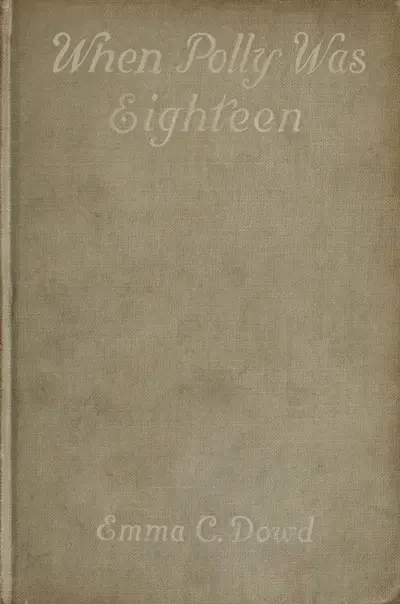
When Polly Was Eighteen
Emma C. Dowd
THE CLASSIC COLLECTION · 1915
"Doodles, the Sunshine Boy" by Emma C. Dowd is a children's novel written in the early 20th century. The story centers around a young boy named Doodles, who faces physical challenges but is filled with joy and creativity, largely brought to life through his relationship with his family and his pet mockingbird, Caruso. The narrative hints at themes of resilience, family dynamics, and the importance of friendship and community. At the start of the book, we meet Blue Stickney, Doodles's older brother, as he attends an auction at a bird shop where he unwittingly decides to buy a defeated-looking bird for Doodles—who captures hearts with his joy for life despite his struggles. Blue's initial intention is to lift Doodles's spirits, setting off a series of events that define their close bond. As the family navigates hardship, including financial concerns and Doodles's health issues, the introduction of secondary characters, like Granny O'Donnell and their neighbor, Dorothy Rose, hints at a larger community dynamic that supports Doodles and his aspirations. Blue's determination to care for Doodles and the new bird creates both tender and humorous moments, suggesting a comforting exploration of childhood joys and the complexities of familial love.
Introduction adapted from the source catalogue; source summaries may be automatically generated.
Free to read · English · 63,418 words · No account needed
MAKE TIME FOR A GOOD BOOK
On by default. Untick to stop anonymous reading totals. Each page counts after 10 seconds in view. How this works.
Anonymous counting is on unless you have switched it off.
“That’s what I came for,” Blue admitted. “I thought—that is, Doodles thought—p’raps she’d like to hear him; but the girl said she couldn’t see anybody, and you were out, and so—I didn’t stay,” he ended lamely.
“Then you will come?” She opened the door.
For an instant he hesitated.
“He can sit with Simon,” suggested the attendant.
“There is plenty of room here,” asserted Daphne, moving aside with a
cordial smile.
The boy stepped lightly in, and Simon reached back and shut the door.
Presently the ride was at an end, and Blue was following his young hostess into the wide hall, and passing the maid with head held high. Then he was seated in a small, luxurious room where parti─colored shadows played over the floor. The flickering lights seemed to inspire Caruso to a song, for he broke the stillness with a few startling notes. The boy hushed him at once, whereupon he retreated to the farther end of his perch, mopish as a reproved child.
Light feet came running along the hall, and Daphne appeared.
“Will you come upstairs? Mother is not at home, but Eudora would like to hear the bird. Wasn’t he singing a minute ago?”
“Yes,” nodded Blue. “I shut him up as quick as I could,” he added
apologetically.
“Why did you?” was the surprised query.
The boy only gave a soft laugh.
The room into which Blue was ushered the little dressmaker might well have called “heavenly”; but he did not bestow upon it a second glance. The “princess” sister held his eyes—and his heart.
She was all and more, far more than Tillie Shook had pictured her, and he found himself wondering how “any feller could go off to Europe” and leave so beautiful a girl languishing for his love.
“Will he sing best in the sunshine?” Daphne’s question brought Blue back to the errand in hand.
“I do’ know. He don’t sing so much now as he did.—Caruso!”
The boy whistled softly the opening strain of “Annie Laurie,” but the bird continued to preen a ruffled feather or two. The air ended, yet Caruso was still silent.
“It takes my brother to set him going,” Blue explained, somewhat nettled at the bird’s indifference.
Livelier tunes were tried, and then, just as the boy was beginning to wonder if, after all, Caruso were going to disappoint than, he burst into a torrent of song, ending, as often, with the beloved “Annie Laurie.”
Your reading position is saved on this browser. Take it to another device with a library code. Reading pages adapt to text, rather than matching a printed edition.
Emma C. Dowd
BEHIND THE BOOK
This eBook is for the use of anyone anywhere in the United States and most other parts of the world at no cost and with almost no restrictions whatsoever. You may copy it, give it away or re-use it under the terms of the Project Gutenberg License included with this eBook or online at www.gutenberg.org. If you are not located in the United States, you will have to check the laws of the country where you are located before using this eBook. Read the source licence.
The original source file, including credits and licence, is retained by this library. Request an original-format copy at no charge. Please include the book title and Project Gutenberg identifier #58164.
KEEP YOUR CURIOSITY GOING
Coulson Kernahan

Maurice Baring
Frances Wright
Cécile Tormay

Frederic Jesup Stimson

W. H. P. (William Henry Pope) Jarvis