THE CLASSIC COLLECTION✦An outlaw’s diary: the CommuneCLASSIC FREE BOOKS
An outlaw’s diary: the Commune
Cécile Tormay
THE CLASSIC COLLECTION · 1865
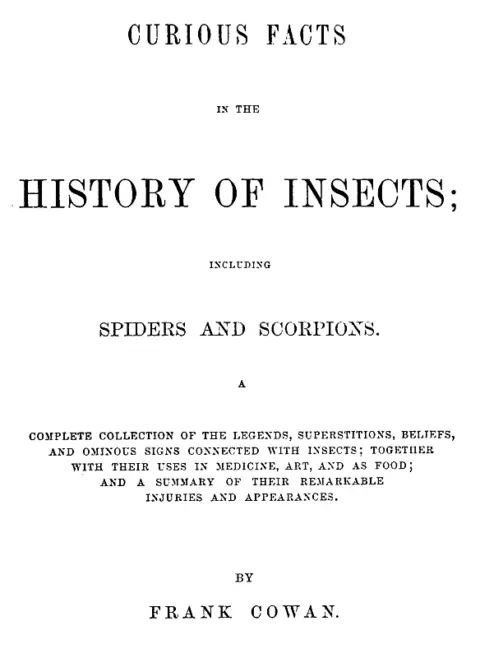
"Curious Facts in the History of Insects; Including Spiders and Scorpions" by Frank Cowan is a scientific publication written in the mid-19th century. The work explores entomology through the lens of legends, superstitions, beliefs, and various uses of insects, alongside their historical significance in medicine, art, and as food. The focus is not just on biological facts, but also on the fascinating folklore and cultural narratives associated with these creatures. At the start of the text, the author outlines his ambition to compile intriguing historical accounts related to insects, moving beyond traditional scientific boundaries. He emphasizes collecting facts from unusual sources, including chronicles and travel books, to illustrate the connections between human culture and the insect world. The opening sets the stage for a detailed examination of specific insects, beginning with the Ladybird, discussing its folklore across different cultures, and thus combining scientific classifications with rich, anecdotal history.
Introduction adapted from the source catalogue; source summaries may be automatically generated.
Free to read · English · 139,897 words · No account needed
MAKE TIME FOR A GOOD BOOK
On by default. Untick to stop anonymous reading totals. Each page counts after 10 seconds in view. How this works.
Anonymous counting is on unless you have switched it off.
[678] Cf. N. & Q., vii. 478, 553; viii. 30.
[679] Harper’s New Monthly Mag., xxvi. 441.
[680] Il. β. 87; μ. 67; Odyss., ν. 106.
[681] Hesiod, Theog., 594, seq.
[682] Bucke on Nature, ii. 75.
[683] Cf. Kalm, ii. 427; Schneider, Observ. sur Ulloa, ii. 198.
[684] Ibid.
[685] Tour in the Prairies, ch. ix.
[686] Langstroth on the Honey-Bee, p. 236.
[687] Letters.
[688] Voyages dans les Alpes. Ins. Misc., p. 262.
[689] Brookes mentions the Duchy of Juliers, a district of Westphalia, Germany.--Nat. Hist. of Ins., p. 160.
[690] Columella says the Greeks were accustomed, every year, to remove the hives from Achaia into Attica.--Ibid.
[691] One person in particular, in the territory called Gatonois, has been at the pains of removing his hives, after the harvest of Sainfoin, into the plains of Beauce, where the melilot abounds, and thence into Sologne, where it is well known the Bees may enjoy the advantage of buckwheat, till toward the end of September, for so long that plant retains its flowers.--Ibid.
[692] Ins. Misc., p. 262.
[693] Mag. of Nat. Hist., iii. 652.
[694] Wood’s Zoog., ii. 429.
[695] Ins. Misc., p. 263.
[696] Quot. by Langstroth--On Honey-Bee, p. 305, note.
[697] Nat. Hist., x. 9.
[698] Journ. of Geog. Soc., 1843, xiii. 40.
[699] Murray’s Africa, i. 168.
[700] Scot’s Mag., Nov. 1766. Chamb. Journ., 1st S. xi. 184.
[701] The Bees.
[702] Treatise on Bees, 1769. Ins. Misc., p. 320-1.
[703] Fem. Monarchie, ch. i. 39.
[704] Travels, p. 178, Harper’s ed.
[705] B. VII. c. xvi. p. 667. Printed, 1613.
[706] Montaigne’s Works, p. 243.
[707] Lesser, ii. 171. K. & S. Introd., ii. 247.
[708] Knox, Pt. I. c. vi. p. 48.
[709] Martyr, p. 274.
[710] Banc. Guiana, p. 230.
[711] Nat. Hist. of Selborne, p. 293.
[712] Trav., i. 9.
[713] Med. Dict.
[714] Langstroth on Honey-Bee, p. 315, note.
[715] Med. Dict.
[716] Fem. Monarchie, c. x. 1.
[717] B. 3, c. xv. xvi. p. 274-9. See also extract from Works of Sir J. More, London, 1707, given by Langstroth--on the Honey-Bee, p. 287, note.
[718] The Koran, p. 219, note, Sale’s.
[719] Ibid., p. 219.
[720] Athen. Deipn., B. 2, c. 26.
[721] Moufet, Theatr. Ins., p. 29. Topsel’s Trans., p. 911.
[722] Brooke’s Nat. Hist. of Ins., p. 168.
[723] Quot. by Langstroth on the Honey-Bee, p. 78-9.
[724] Anab., B. 4.
[725] Pliny, Nat. Hist., xxi. 13. Tournefort, Letters, 17.
[726] Mission. Lab., p. 121.
[727] Hollingsh. Chron., i. 384.
[728] Hawk’s Peruvian Antiq., p. 198.
[729] Voyage to C. of G. Hope, i. 255.
[730] Jamieson’s Scot. Dict.
[731] Wright’s Prov. Dict.
[732] Epigrams, B. iv. epigr. 32.
[733] Smith’s Dict. of the Bible.
[734] Osbeck’s Travels, i. 32-3.
[735] Josselyn’s Voy., p. 121.
[736] Chambers’ Pop. Rhymes of Scot., p. 292. Edit. of 1841, p. 172.
[737] Dalyell’s Superst. of Scotland, p. 563.
[738] Shaw’s Zool., vi. 346-7. Wood’s Zoog., ii. 436-7.
[739] Kirby’s Wonderful Museum, v. 390-1, given at length.
[740] Kirby’s Wond. Museum, vi. 260-2, at length.
[741] Livy, B. 34, c. 10.
[742] Ibid., B. 40, c. 19.
[743] Ibid., B. 43, c. 13.
[744] Brown’s Book of Butterflies, i. 126.
[745] Annales, p. 15.
[746] Ibid.
[747] Holling., i. 449. Graft., i. 37. Fabyan, p. 17.
[748] Howitt’s North. Literat., i. 187.
[749] Bucke on Nature, i. 277.
[750] Moufet, p. 107.
Your reading position is saved on this browser. Take it to another device with a library code. Reading pages adapt to text, rather than matching a printed edition.
BEHIND THE BOOK
This eBook is for the use of anyone anywhere in the United States and most other parts of the world at no cost and with almost no restrictions whatsoever. You may copy it, give it away or re-use it under the terms of the Project Gutenberg License included with this eBook or online at www.gutenberg.org. If you are not located in the United States, you will have to check the laws of the country where you are located before using this eBook. Read the source licence.
The original source file, including credits and licence, is retained by this library. Request an original-format copy at no charge. Please include the book title and Project Gutenberg identifier #41625.
KEEP YOUR CURIOSITY GOING
Cécile Tormay

Moritz Busch
John L. Ransom

Maurice Baring
Frances Wright
Cécile Tormay