THE CLASSIC COLLECTION✦An outlaw’s diary: the CommuneCLASSIC FREE BOOKS
An outlaw’s diary: the Commune
Cécile Tormay
THE CLASSIC COLLECTION · 1865
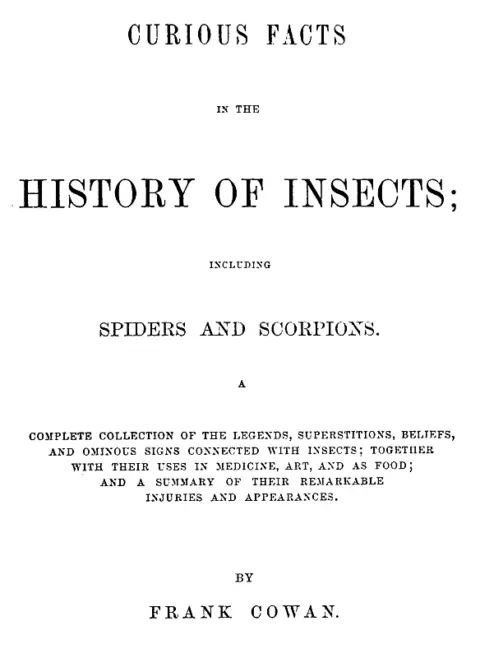
"Curious Facts in the History of Insects; Including Spiders and Scorpions" by Frank Cowan is a scientific publication written in the mid-19th century. The work explores entomology through the lens of legends, superstitions, beliefs, and various uses of insects, alongside their historical significance in medicine, art, and as food. The focus is not just on biological facts, but also on the fascinating folklore and cultural narratives associated with these creatures. At the start of the text, the author outlines his ambition to compile intriguing historical accounts related to insects, moving beyond traditional scientific boundaries. He emphasizes collecting facts from unusual sources, including chronicles and travel books, to illustrate the connections between human culture and the insect world. The opening sets the stage for a detailed examination of specific insects, beginning with the Ladybird, discussing its folklore across different cultures, and thus combining scientific classifications with rich, anecdotal history.
Introduction adapted from the source catalogue; source summaries may be automatically generated.
Free to read · English · 139,897 words · No account needed
MAKE TIME FOR A GOOD BOOK
On by default. Untick to stop anonymous reading totals. Each page counts after 10 seconds in view. How this works.
Anonymous counting is on unless you have switched it off.
8. A Scarabæus with a hawk-headed gryphon, emblem of Menta-Ra, or Mars. Behind the monster is the goddess Sati, or Nuben. The hawk-headed lion is one of the shapes into which the sun turns himself in the hours of the day. It is a common emblem of the Aramæan religion.
9. Scarabæus with hawk-headed gryphon, having before in the uræus and the nabla or guitar, hieroglyphic of good. Above it are the hieroglyphics “Lord of the earth.”
10. Small Scarabæus in dark steaschist, with a man in adoration to a king or deity, wearing a crown of the upper country, and holding in the left hand a lotus flower. Between this is the emblem of life.
11. Scarabæus, with the hawk-headed Scarabæus, emblem of Ra-cheper, “the creator Sun,” flying with expanded wings, four in number, which do not appear in Egyptian mythology till after the time of the Persians, when the gods assume a more Pantheistic form. Such a representation of the sun, for instance, is found in the Torso Borghese.
It will be observed, adds Layard, that most of the Egyptian relics discovered in the Assyrian ruins are of the time of the XVIII. Egyptian dynasty, or of the fifteenth century before Christ; a period when, as we learn from Egyptian monuments, there was a close connection between Assyria and Egypt.--Layard’s Babylon and Nineveh, p. 239-240.
[116] Layard’s Babylon and Nineveh, p. 157, 166.
[117] Hist. of Mum., 53-5; Wilkin. Anct. Egypt., ii. (2d S.) 261,
note.
[118] Wilkin. Anct. Egypt., ii. (2d S.) 156.
[119] Pliny, Nat. Hist., xxx. 11; Holland, ii. 395. K.
[120] Phil. Trans. Abridg., ii. 785; Gent. Mag., xix. 264-5.
[121] Phil. Trans. Abridg., ix. 11. Concerning the worship of animals in general by the Egyptians, the following remarks in a note may not be inappropriate, as they embrace the worship of the Scarabæus.
1. A class of animals, to which may be referred the cow, dog, sheep, and ibis, were at first naturally protected and respected out of gratitude for the benefits derived from them. But in time, it is supposed, this respect, by unthoughtful descendants believing too implicitly the teachings of their fathers, was gradually enlarged to so great extent that it became reverence, and at last, perhaps after centuries, worship. For example, at A time, the ibis is respected on account of its destroying noxious serpents; at B, reverenced; and at C, worshiped.
Your reading position is saved on this browser. Take it to another device with a library code. Reading pages adapt to text, rather than matching a printed edition.
BEHIND THE BOOK
This eBook is for the use of anyone anywhere in the United States and most other parts of the world at no cost and with almost no restrictions whatsoever. You may copy it, give it away or re-use it under the terms of the Project Gutenberg License included with this eBook or online at www.gutenberg.org. If you are not located in the United States, you will have to check the laws of the country where you are located before using this eBook. Read the source licence.
The original source file, including credits and licence, is retained by this library. Request an original-format copy at no charge. Please include the book title and Project Gutenberg identifier #41625.
KEEP YOUR CURIOSITY GOING
Cécile Tormay

Moritz Busch
John L. Ransom

Maurice Baring
Frances Wright
Cécile Tormay