THE CLASSIC COLLECTION✦An outlaw’s diary: the CommuneCLASSIC FREE BOOKS
An outlaw’s diary: the Commune
Cécile Tormay
THE CLASSIC COLLECTION · 1865
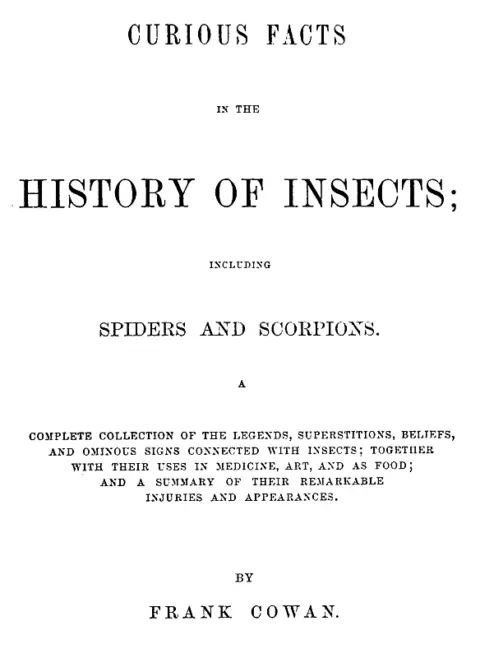
"Curious Facts in the History of Insects; Including Spiders and Scorpions" by Frank Cowan is a scientific publication written in the mid-19th century. The work explores entomology through the lens of legends, superstitions, beliefs, and various uses of insects, alongside their historical significance in medicine, art, and as food. The focus is not just on biological facts, but also on the fascinating folklore and cultural narratives associated with these creatures. At the start of the text, the author outlines his ambition to compile intriguing historical accounts related to insects, moving beyond traditional scientific boundaries. He emphasizes collecting facts from unusual sources, including chronicles and travel books, to illustrate the connections between human culture and the insect world. The opening sets the stage for a detailed examination of specific insects, beginning with the Ladybird, discussing its folklore across different cultures, and thus combining scientific classifications with rich, anecdotal history.
Introduction adapted from the source catalogue; source summaries may be automatically generated.
Free to read · English · 139,897 words · No account needed
MAKE TIME FOR A GOOD BOOK
On by default. Untick to stop anonymous reading totals. Each page counts after 10 seconds in view. How this works.
Anonymous counting is on unless you have switched it off.
[751] Hone’s Ev. Day Book, p. 1127.
[752] Chambers’ Domest. Annals of Scotland, ii. 489.
[753] Gassendi’s Life of Peireskius, p. 123-5; and Reaumur, i. 638,
667.
[754] Shaw, Zool., vi. 206.
[755] The origin of red snow has likewise been a puzzle and query for ages, and many theories have been advanced by philosophers and naturalists to account for it. To those interested in the solution of this phenomenon, the following extract from the Mag. of Nat. Hist., vol. ii. p. 322, may be curious, if not satisfactory. Mr. Thomas Nicholson, accompanied with two other gentlemen, made an excursion the 24th July, 1821, to Sowallick Point, near Bushman’s Island, in Prince Regent’s Bay, in quest of meteoric iron. “The summit of the hill,” he says, “forming the point, is covered with huge masses of granite, whilst the side, which forms a gentle declivity to the bay, was covered with crimson snow. It was evident, at first view, that this colour was imparted to the snow by a substance lying on the surface. This substance lay scattered here and there in small masses, bearing some resemblance to powdered cochineal, surrounded by a lighter shade, which was produced by the colouring matter being partly dissolved and diffused by the deliquescent snow. During this examination our hats and upper garments were observed to be daubed with a substance of a similar red colour, and a moment’s reflection convinced us that this was the excrement of the little Auk (Uria alle, Temmink), myriads of which were continually flying over our heads, having their nests among the loose masses of granite. A ready explanation of the origin of the red snow was now presented to us, and not a doubt remained in the mind of any that this was the correct one. The snow on the mountains of higher elevation than the nests of these birds was perfectly white, and a ravine at a short distance, which was filled with snow from top to bottom, but which afforded no hiding-place for these birds to form their nests, presented an appearance uniformly white.”
This testimony seems to be as clear and indisputable as the explanation given by Peiresc of the ejecta of the Butterflies at Aix. But though it will account, perhaps, for the red snow of the polar regions, it will not explain that of the Alps, the Apennines, and the Pyrenees, which are not, so far as is known, visited by the little Auk.--Vide Ins. Transf., p. 352-5.
[756] Chamb. Domes. Annals of Scotl., ii. 199.
[757] Chamb. Domes. Annals of Scotl., ii. 447-8.
[758] Gent. Mag., xxxiv. 496.
[759] Ibid., xxxiv. 542.
[760] Bucke on Nature, i. 277.
[761] Brown’s Bk. of Butterflies, i. 129.
[762] Chamb. Domes. Annals of Scotl., ii. 448.
[763] Swam. Hist. of Ins., Pt. I. p. 40.
Your reading position is saved on this browser. Take it to another device with a library code. Reading pages adapt to text, rather than matching a printed edition.
BEHIND THE BOOK
This eBook is for the use of anyone anywhere in the United States and most other parts of the world at no cost and with almost no restrictions whatsoever. You may copy it, give it away or re-use it under the terms of the Project Gutenberg License included with this eBook or online at www.gutenberg.org. If you are not located in the United States, you will have to check the laws of the country where you are located before using this eBook. Read the source licence.
The original source file, including credits and licence, is retained by this library. Request an original-format copy at no charge. Please include the book title and Project Gutenberg identifier #41625.
KEEP YOUR CURIOSITY GOING
Cécile Tormay

Moritz Busch
John L. Ransom

Maurice Baring
Frances Wright
Cécile Tormay