THE CLASSIC COLLECTION✦An outlaw’s diary: the CommuneCLASSIC FREE BOOKS
An outlaw’s diary: the Commune
Cécile Tormay
THE CLASSIC COLLECTION · 1865
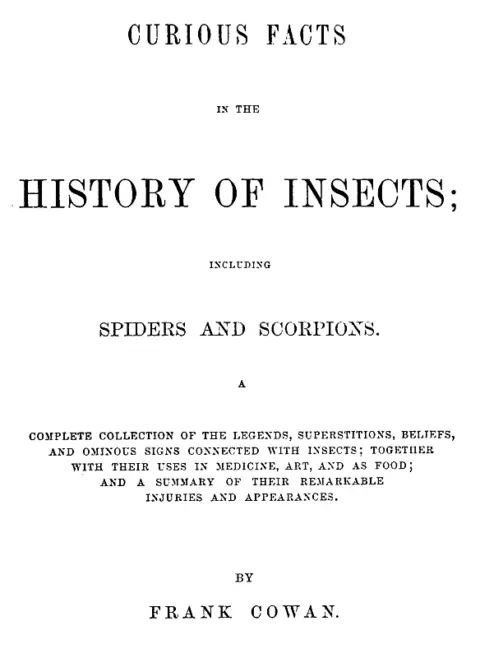
"Curious Facts in the History of Insects; Including Spiders and Scorpions" by Frank Cowan is a scientific publication written in the mid-19th century. The work explores entomology through the lens of legends, superstitions, beliefs, and various uses of insects, alongside their historical significance in medicine, art, and as food. The focus is not just on biological facts, but also on the fascinating folklore and cultural narratives associated with these creatures. At the start of the text, the author outlines his ambition to compile intriguing historical accounts related to insects, moving beyond traditional scientific boundaries. He emphasizes collecting facts from unusual sources, including chronicles and travel books, to illustrate the connections between human culture and the insect world. The opening sets the stage for a detailed examination of specific insects, beginning with the Ladybird, discussing its folklore across different cultures, and thus combining scientific classifications with rich, anecdotal history.
Introduction adapted from the source catalogue; source summaries may be automatically generated.
Free to read · English · 139,897 words · No account needed
MAKE TIME FOR A GOOD BOOK
On by default. Untick to stop anonymous reading totals. Each page counts after 10 seconds in view. How this works.
Anonymous counting is on unless you have switched it off.
[630] Nat. Hist., xix. 7. Holl. Trans., p. 23. E.
[631] N. and Q., ii. 165. Chamb. Bk. of Days, i. 752.
[632] N. & Q., xii. 200.
[633] Mag. of Nat. Hist., ii. 405.
[634] Bucke on Nature, i. 419.
[635] Brand’s Pop. Antiq., ii. 300.
[636] Ibid.
[637] Ibid.
[638] Thorpe’s North. Mythol., iii. 161.
[639] Vide N. and Q. in Devon, v. 148; Essex, v. 437; Lincolnshire, iv. 270; Surrey, iv. 291; a Cornish superstition, too, xii. 38; in Buckinghamshire, Sussex, Lithuania, and France, iv. 308.
[640] Brande’s Pop. Antiq., ii. 300.
[641] Bucke on Nature, i. 413, note.
[642] N. and Q., iv. 309.
[643] Brand’s Pop. Antiq., ii. 300.
[644] Fosbr. Encycl. of Antiq., ii. 738.
[645] Brand’s Pop. Antiq., ii. 300.
[646] Langstroth on Honey-Bee, p. 80.
[647] Mag. of Nat. Hist., iii. 211, note.
[648] Ibid., i. 303. London, 1829.
[649] Peter Rotharmel had three specialties: Bees, Wheat, and Bonaparte. Concerning Bees, he had many strange notions, but the above recorded is the only one of which I have any positive information. Concerning wheat, at one time in his life he purchased an almanac, which indicated, among other things, the high and low tides, and, from studying this, he got it into his head that the fluctuations in the price of wheat were intimately connected with the rise and fall of the tides. So impressed was he with this idea, that he ever afterward yearly bought that particular almanac, and prophesied from it to his neighbors the probable value of their coming crops of wheat. On Sunday, he would walk fifteen and twenty miles through the country, to examine the different wheat-fields, and to afford him a topic of conversation for the ensuing week. But Napoleon was his principal study and his greatest mania. On him he would talk for hours, on the slightest provocation. The history of Bonaparte and his campaigns, which he only read, was an old German one.
[650] Mag. of Nat. Hist., ii. 209.
[651] Geog., Dryden’s Trans., iv. 82-9.
[652] On the Honey-Bee, p. 113.
[653] N. and Q., 2d Ser., ix. 443.
[654] Nat. Hist., xxi. 20, Holl. Trans., p. 106. K.
[655] Quot. in Brand’s Pop. Antiq., iii. 225.
[656] Langstroth on the Honey-Bee, p. 132.
[657] Quot. by Langstroth on the Honey-Bee, p. 231.
[658] Campbell’s Travels in S. Africa, p. 339.
[659] Percy Soc. Public., iv. 99.
[660] Owen’s Geoponika, ii. 109-10.
[661] Nat. Hist., xx. 13. Holl., p. 56. M.
[662] Ibid., Holl., p. 95. A.
[663] Ibid., xxi. 20. Holl., p. 106. K.
[664] Ibid., xxiii. 18. Holl., p. 173. A.
[665] Ibid., xxix. 4. Holl., p. 361. D.
[666] Ibid., xxx. 16. Holl., p. 399. F.
[667] Langstroth on the Honey-Bee, p. 316, note.
[668] Brand’s Pop. Antiq., iii. 225.
[669] Georg., iv. 280-4; Dryden’s Trans.
[670] Fosb. Encycl. of Antiq., ii. 738.
[671] Judg. xiv. 8.
[672] Cf. Swammerdam, Hist. of Ins., Pt. I. p. 227, and Smith’s Dict.
of the Bible.
[673] Herod., v. 114-5.
[674] Excursions, i. 127.
[675] Fem. Monarchie, c. vi. 49.
[676] Williams’ Chinese Empire, i. 275.
[677] Chiflet, 164-181; Montf. Monarch. Franc., i. 12; Gough’s Sepul. Mon., vol. i. p. lxii.
Your reading position is saved on this browser. Take it to another device with a library code. Reading pages adapt to text, rather than matching a printed edition.
BEHIND THE BOOK
This eBook is for the use of anyone anywhere in the United States and most other parts of the world at no cost and with almost no restrictions whatsoever. You may copy it, give it away or re-use it under the terms of the Project Gutenberg License included with this eBook or online at www.gutenberg.org. If you are not located in the United States, you will have to check the laws of the country where you are located before using this eBook. Read the source licence.
The original source file, including credits and licence, is retained by this library. Request an original-format copy at no charge. Please include the book title and Project Gutenberg identifier #41625.
KEEP YOUR CURIOSITY GOING
Cécile Tormay

Moritz Busch
John L. Ransom

Maurice Baring
Frances Wright
Cécile Tormay