THE CLASSIC COLLECTION✦An outlaw’s diary: the CommuneCLASSIC FREE BOOKS
An outlaw’s diary: the Commune
Cécile Tormay
THE CLASSIC COLLECTION · 1865
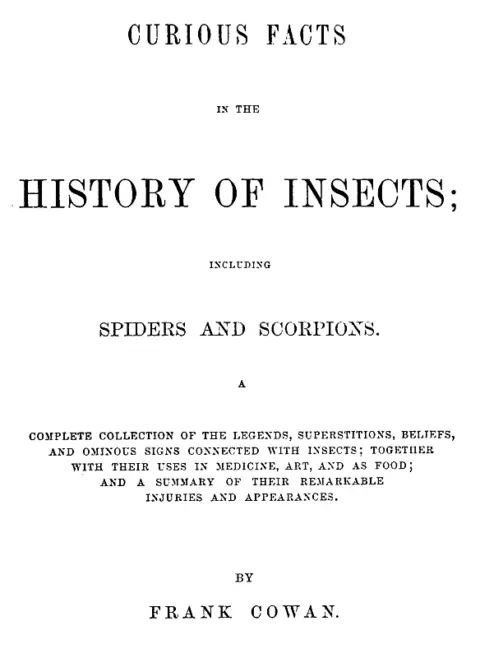
"Curious Facts in the History of Insects; Including Spiders and Scorpions" by Frank Cowan is a scientific publication written in the mid-19th century. The work explores entomology through the lens of legends, superstitions, beliefs, and various uses of insects, alongside their historical significance in medicine, art, and as food. The focus is not just on biological facts, but also on the fascinating folklore and cultural narratives associated with these creatures. At the start of the text, the author outlines his ambition to compile intriguing historical accounts related to insects, moving beyond traditional scientific boundaries. He emphasizes collecting facts from unusual sources, including chronicles and travel books, to illustrate the connections between human culture and the insect world. The opening sets the stage for a detailed examination of specific insects, beginning with the Ladybird, discussing its folklore across different cultures, and thus combining scientific classifications with rich, anecdotal history.
Introduction adapted from the source catalogue; source summaries may be automatically generated.
Free to read · English · 139,897 words · No account needed
MAKE TIME FOR A GOOD BOOK
On by default. Untick to stop anonymous reading totals. Each page counts after 10 seconds in view. How this works.
Anonymous counting is on unless you have switched it off.
Pthah-Sokari-Osiris, Scarab emblem of, 33.
Ptinidæ, 58-61.
Public events, Bees informed of, 185.
Pulex irritans, 305-314.
penetrans, 314.
Pulicidæ, 305-315.
Pulices arborescentes, 223.
Pupæ of Ants as food for birds, 159;
of Termites eaten, 137.
Purgatory, beetle connected with, 368.
Putrefaction, generation from, 290, 322.
Pygolampis Italica, 56.
Pythagoreans, Honey eaten by, 209.
Python natalensis killed by Ants, 157.
Quang-tong, Butterflies of, 229.
Quarrel prognosticated by Blacksmith-beetle, 55.
Quarrelsome family, Bees will not thrive for, 184.
Quartan ague, Bed-bugs for, 267;
Spiders, 359.
Quercus ilex, 259.
Quinsey, Caterpillars for, 245.
Radish to destroy Scorpions, 325.
Rain: see weather.
Rain, bloody, 216-225.
Rain-doctors, Locusts brought by, 125.
Ram, flesh of, for sting of Scorpions, 326;
Scarab figured with head of, 34.
Ravages of the Antler-moth, 246;
Ants, 166-169;
Coccus Hesperidum, 264;
Dermestes vulpinus, 24;
Ear-wigs, 76;
Gnats and Mosquitoes, 281-283;
Grasshoppers, 100;
Hop-fly, 258;
larvæ of Woolly-bear Moths, 242;
Locusts, 101-118;
May-bugs, 48, 49;
Scorpions, 327;
Spiders, 353;
Termites, 132-134;
Turnip-fly, 74;
Typographer-beetle, 61.
Raven and the Scorpion, a fable, 331.
Reason of Ants, 154.
Red-haired persons stung by Bees, 182.
Red snow, origin of, 220, n.
Regeneration, Scarab symbol of, 33.
Rewards offered for killing Ants, 167;
Locusts, 116.
Revenue of “Lice” of Montecusuma, 316.
Rheumatism, Oil-beetle for, 63.
Rhynchitus auratus, 71.
Richards, Buprestidæ called, 51.
Rifle-balls, protection against, 241.
Ringing swarms of Bees, 189.
Rings, Scarab as signet in, 32, 39.
Riordan, Mary, insects in stomach of, 67.
Roach, sound as a, 79.
Robin, veneration for the, 43, n.
Rock, solid, living Bees in, 215.
Romans, Bees in divination by, 215;
Cossi eaten, 27;
Scarab emblem adopted by, 32;
silks used, 236.
Rome, Flies in, 289;
showers of blood in, 216.
Rose-chafers, 49.
Rotharmel, Peter, 188.
Rouge, Cochineal made into, 262.
Rue, antidote for poisons, 193.
Russia, Honey in, 195;
Locusts, 104-130.
Sabbath, Jews not permitted to burn Fleas on the, 311.
Sacred-Scarab of the Egyptians, 29-44.
St. Ambrose, eloquence of, foretold by Bees, 178.
Domingo and the Flea, 310.
Eustace, Spider at church of, 343.
Felix, life of, saved by Spiders, 333.
Francis, Lice nourished by, 317.
George, Flies from the dragon killed by, 304;
prayer to, to keep away Scorpions, 327.
John, Locusts eaten by, 125.
Hector, manner of discovering Bee-trees, 198.
’s day, fires to kill Canker-worms on, 248.
Julien, lawsuit between Commune of, and an Insect, 71.
Macarius, penance of, for killing a Gnat, 285.
Milburge, cure effected by the water in which his bones
were washed, 364.
Roche and “Sound as a Roach,” 79.
Saturnine, patron saint to destroy Ants, 166.
Xavier and the Mantis, 88.
Salt, use of, in witchcraft, 207.
Salamander, antidote for poison of, 193.
Samson, Bees from lion slain by, 184, 194.
Sandwich Islands, Fleas in, 306.
Sapor, army of, routed by Mosquitoes, 283.
Scaliger, his fondness for Crickets, 95.
Scandinavia, Dung-beetle in, 28-29;
Lady-bird in, 17.
Scarabæidæ, 27-45.
Scarabæus auratus, 45.
cornutus, 26.
nasicornis, 45.
pilurarius, 27-44, 293.
sacer, 27-44.
unctuosus, 63.
Scarlet, history of dyeing, 259.
Schurman, Anna Maria, Spiders eaten by, 355.
cured of boils by Ants, 162.
Scleranthus perennis, 260.
Scolopendras as food, 365.
Scorpions, 65, 100, 295, 321-331.
Scotland, bloody-rain in, 221;
Flies, 289;
Humble-bees, 213;
Lady-birds, 19-20;
Lice, 319, 320.
Scrofula in horses, combs of Hornets’ nest for, 172.
Scurvy, Bedeguar for, 144.
Scutcheons, Scarab on Egyptian royal, 35.
Scythia, Lice in, 318.
Your reading position is saved on this browser. Take it to another device with a library code. Reading pages adapt to text, rather than matching a printed edition.
BEHIND THE BOOK
This eBook is for the use of anyone anywhere in the United States and most other parts of the world at no cost and with almost no restrictions whatsoever. You may copy it, give it away or re-use it under the terms of the Project Gutenberg License included with this eBook or online at www.gutenberg.org. If you are not located in the United States, you will have to check the laws of the country where you are located before using this eBook. Read the source licence.
The original source file, including credits and licence, is retained by this library. Request an original-format copy at no charge. Please include the book title and Project Gutenberg identifier #41625.
KEEP YOUR CURIOSITY GOING
Cécile Tormay

Moritz Busch
John L. Ransom

Maurice Baring
Frances Wright
Cécile Tormay