THE CLASSIC COLLECTION✦An outlaw’s diary: the CommuneCLASSIC FREE BOOKS
An outlaw’s diary: the Commune
Cécile Tormay
THE CLASSIC COLLECTION · 1865
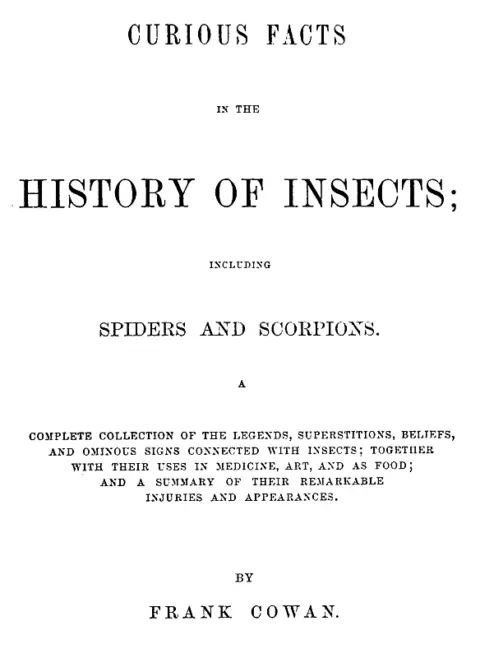
"Curious Facts in the History of Insects; Including Spiders and Scorpions" by Frank Cowan is a scientific publication written in the mid-19th century. The work explores entomology through the lens of legends, superstitions, beliefs, and various uses of insects, alongside their historical significance in medicine, art, and as food. The focus is not just on biological facts, but also on the fascinating folklore and cultural narratives associated with these creatures. At the start of the text, the author outlines his ambition to compile intriguing historical accounts related to insects, moving beyond traditional scientific boundaries. He emphasizes collecting facts from unusual sources, including chronicles and travel books, to illustrate the connections between human culture and the insect world. The opening sets the stage for a detailed examination of specific insects, beginning with the Ladybird, discussing its folklore across different cultures, and thus combining scientific classifications with rich, anecdotal history.
Introduction adapted from the source catalogue; source summaries may be automatically generated.
Free to read · English · 139,897 words · No account needed
MAKE TIME FOR A GOOD BOOK
On by default. Untick to stop anonymous reading totals. Each page counts after 10 seconds in view. How this works.
Anonymous counting is on unless you have switched it off.
Œdipoda corallipes, 112.
Œstridæ, 302-304.
Œstrus equi, 302.
ovis, 302.
Ohio, Bed-bugs for ague in, 268.
Oiketicus, 245.
Oil-beetles, 63.
Old folks, Crickets supposed to be, 95.
Ophthalmia, Fly in linen for, 295.
Orange-trees injured by Coccidæ, 264.
Orators compared to Cicadas, 252.
Ornaments, Blister-flies as, 64;
Butterflies, 229;
Buprestidæ, 50;
Cicadas, 251;
Cucujus, 54;
Diamond-beetle, 68;
Fire-flies, 57;
Geotrupes stercorarius, 44;
Glow-worms, 57;
Gold-beetles, 23;
Lady-bird, 21;
Scarabs, 38;
Spiders, 354.
Orthoptera, 78-131.
Oryctes rhinoceros, 46.
Ovens, Ant-hills made into, 134;
Crickets reared in, 96.
Owlet antidote for sting of Bees, 193.
Oxford, bringing in the Fly at, 291.
Painted, Flies on vessels newly, 287.
Palm-tree, generation of the, 322.
Palm-weevil, 68-70.
Palpitations, wax to prevent, 254.
Palsy, Ants remedy for, 162.
Pans, beating of, when Bees swarm, 189.
Paper, manufacture of, from silk, 239.
Papilionidæ, 216-232.
Paradise, Solomon’s Ant in, 153.
Paraguay, Spiders in, 362.
Parasol, swarm of Bees on a lady’s, 214.
Paris, Cucujus in, 53.
Park, Mungo, attacked by Bees, 203.
Parnassius Apollo, 367.
Paroxysms, Spiders for, 358.
Parthians, Locusts eaten by, 121.
Passalus cornutus, 27.
Paul, Prince, anecdote of, 369.
Pausidæ, 23-24.
Peace foretold by Locusts, 119.
Pediculidæ, 316-320.
Pediculi corporis, 317.
Pedipalpi, 321-331.
Peiresc’s solution of bloody-rain, 218.
Pelisson and his pet Spider, 335.
Pennsylvania, Bees in, 182, 188;
Butterflies, 229.
Persia, Aphis in, 258;
Scorpions, 328;
Silk-worms, 235.
Peruvians, Flies offered to the Sun by, 292.
Pestilence foretold by Spiders, 143.
Petrified Bee-hive, 214.
Pets, beetles as, 50;
Mantis, 88-90;
Spiders, 235.
Pewter for sting of Scorpions, 326.
Phaerus, Spiders eaten by, 355.
Phaeton’s sisters, origin of fable of, 91, n.
Phalangidæ, 321.
Phalangium, 321.
Philology, study of, from names of insects, 369.
Phonetic, Scarab as a, 35.
Phosphor Paste for killing Roaches, etc.,
manufacture and vending of, 80-82.
Phthiriasis, 121, 320.
Phthisic, Honey-dew for, 257.
Physicians, Pliny’s invective against, 67.
Piety of Bees, 174-177.
Pigeon for sting of Scorpions, 326;
Mohammed’s life saved by, 333.
Pig-manure, Bee-hives prepared with, 189.
Pimelia spinulosa, 41.
Pindar, Bees induce, to write verses, 178.
Pismires, 146-170.
Pithecius, 41.
Plague, oil of Scorpions for, 330;
occasioned by Locusts, 101-118.
Plant-lice, 257-259.
Plants, animals becoming, 90-92.
Plato, eloquence of, foretold by Bees, 178.
Platyphyllon concavum, 131.
Plenty foretold by Lady-bird, 18.
Plum, Ear-wig in a, 76.
Poems on a Flea, 313.
Poison of Spiders, antidotes for, 356;
from ants, 161.
Poisonous Honey, 210.
Poland, poisonous Sirex in, 142;
scarlet grain of, 260;
Locusts in, 103-130.
Poma insana, 145.
Pontia brassicæ, 225.
cardimines, 226.
Poor Humphrey’s satire on killing Fleas, 309.
Popes, Caterpillars cursed by, 243.
Poppy, Honey antidote for, 208.
Poterium sanguisorba, 260.
Prayers offered to destroy caterpillars, 242;
to prevent stinging of Scorpions, 327.
Praying-Mantis, 82-92.
Priest, Cicada symbol of, 253.
Primæ viæ, acidity in, Stag-beetle for, 26.
Prionus cervicornis, 74.
coriarius, 27.
damicornis, 27, 73.
Prognostications from Ants, 152;
Army-worm, 243;
Bees, 178;
Butterflies, 229;
Cicadas, 252;
comets, 246;
Crane-fly, 286;
Crickets, 92;
Daddy-Long-legs, 321;
Death’s-head Moth, 232;
Death-watch, 58;
Dragon-fly, 140;
Dung-beetle, 148;
Fleas, 310;
Flies, 289;
Gall-flies, 143;
Glow-worm, 57;
Gnats, 280;
Grasshoppers, 98;
Hornets, 172;
Katy-did, 131;
Lady-bird, 18;
Locusts, 119;
Mantis, 82;
May-bugs, 47;
Moths, 242;
Span-worms, 248;
Spiders, 336-340;
Wasps, 173.
Propolis, curious uses of, by Bees, 210.
Prosecution against Ants, 168.
Prosperity foretold by Ants, 152.
Proverbial phrases connected with Bees, 212.
Psalms, singing of, to Bees, 188.
Psyche, Butterfly symbol of, 228.
Psychidæ, 245-246.
Pthah, Scarab sacred to, 30;
emblematical of, 32.
Pthah Tore, Scarab emblematical of, 33.
Your reading position is saved on this browser. Take it to another device with a library code. Reading pages adapt to text, rather than matching a printed edition.
BEHIND THE BOOK
This eBook is for the use of anyone anywhere in the United States and most other parts of the world at no cost and with almost no restrictions whatsoever. You may copy it, give it away or re-use it under the terms of the Project Gutenberg License included with this eBook or online at www.gutenberg.org. If you are not located in the United States, you will have to check the laws of the country where you are located before using this eBook. Read the source licence.
The original source file, including credits and licence, is retained by this library. Request an original-format copy at no charge. Please include the book title and Project Gutenberg identifier #41625.
KEEP YOUR CURIOSITY GOING
Cécile Tormay

Moritz Busch
John L. Ransom

Maurice Baring
Frances Wright
Cécile Tormay