THE CLASSIC COLLECTION✦An outlaw’s diary: the CommuneCLASSIC FREE BOOKS
An outlaw’s diary: the Commune
Cécile Tormay
THE CLASSIC COLLECTION · 1865
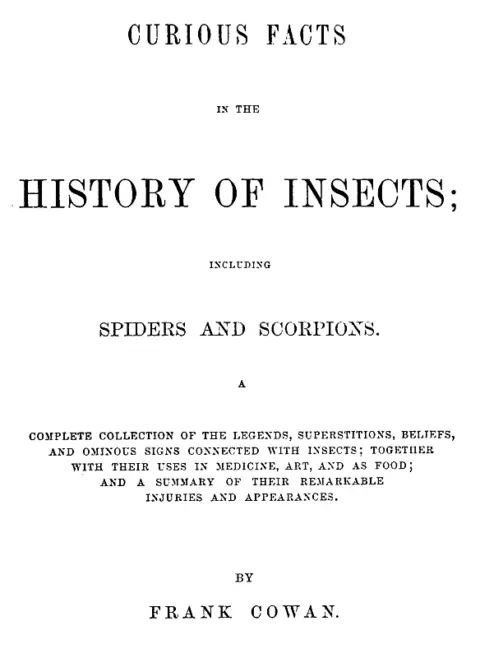
"Curious Facts in the History of Insects; Including Spiders and Scorpions" by Frank Cowan is a scientific publication written in the mid-19th century. The work explores entomology through the lens of legends, superstitions, beliefs, and various uses of insects, alongside their historical significance in medicine, art, and as food. The focus is not just on biological facts, but also on the fascinating folklore and cultural narratives associated with these creatures. At the start of the text, the author outlines his ambition to compile intriguing historical accounts related to insects, moving beyond traditional scientific boundaries. He emphasizes collecting facts from unusual sources, including chronicles and travel books, to illustrate the connections between human culture and the insect world. The opening sets the stage for a detailed examination of specific insects, beginning with the Ladybird, discussing its folklore across different cultures, and thus combining scientific classifications with rich, anecdotal history.
Introduction adapted from the source catalogue; source summaries may be automatically generated.
Free to read · English · 139,897 words · No account needed
MAKE TIME FOR A GOOD BOOK
On by default. Untick to stop anonymous reading totals. Each page counts after 10 seconds in view. How this works.
Anonymous counting is on unless you have switched it off.
Sea-crabs, Scorpions generated from, 322.
Sea-water for sting of Scorpions, 326.
Seals, Scarab-gems as, 39.
Sechell Islands, Dry-leaf Mantis in, 92.
Seed-lac, 263.
Seeds, Cochineal supposed to be, 261;
sown in the hide of a tortoise, 75.
Selborne, the Bee-eater of, 205.
Selk, Scorpion emblem of, 328.
Selling of Bees, notions concerning, 185.
Septuagint, Bee eulogized in the, 212.
Serpents and Ants, 157;
enmity between Spiders and, 341;
Honey for bite of, 208;
a Mantis the parent of the, 157;
of Tiberias Cæsar eaten by Ants, 151;
to kill Nits, 320;
worship of, in Egypt, 43, n.
Seventeen-year Locust, 254.
Sheep, artificial migration of, 198;
dung of, for bite of Spider, 356;
killed by Ants, 157;
maggots in brain of, 302.
Shield-lice, 259-264.
Shell-lac, 263.
Ships, monkeys kept on board, to kill Roaches, 78.
Showers of blood, 216-225;
of Gossamer, 347;
insects with snow, 364.
Siam, Ants in, 159;
interpretation of signs and dreams of insects in, 370;
beetle for fighting in, 368;
Grasshoppers in, 98;
Spiders, 354.
Sideritis, the herb, for sting of Scorpions, 326.
Singing to Bees, 188.
Signs: see prognostications and superstitions.
Silesia, poisonous Sirex in, 142.
Silk of Silk-worms, 234-241, 248.
Spiders, 361.
Silk-worm Moths, 234-241.
Silver for sting of Scorpions, 325, 326.
Sins expiated by assisting Dung-beetles, 28.
Sirex fusicornis, 142.
gigas, 142.
juvencus, 142.
spectrum, 142.
Skull, Bees make Honey in a, 195.
Sleep, Caterpillar to procure, 245;
chirping of Crickets to induce, 95-96.
Sleight-of-hand, supposed performance of, 372.
Sloth, Fleas to prevent, 306.
Sluggard referred to the Ant, 148.
Smoke to drive away Locusts, 115.
Snails embalmed by Bees, 210;
eaten in the West Indies, 98.
Snake, living, hung by a Spider, 345;
danger from, in collecting Locusts, 124;
fed by Dragon-flies, 139.
Snow, Fleas on the, 314;
Gnats falling with, 280;
insects in numbers on, 364;
origin of red, 220, n.
Soap, beetle made into, 23;
Cicadas, 254.
Socrates measures the jump of a Flea, 311.
Solomon and the Ant, 148;
Ant in Paradise, 153.
Song, Locusts kept for sake of, 130;
vessel saved by song of a Spanish Gryllo, 130.
Son, Scarab emblematical of an only, 33.
Soothsayers, 82-92.
Soul, Butterfly symbol of, 228;
Moths supposed to be, 243;
of industrious from Ants, 150.
Sound as a Roach, 79.
South America, Ants in, 160;
Goliath-beetle, 46;
Grou-grou worm, 69;
Hercules-beetle, 45-46;
Termites, 132-137.
Spain, Bees in, 212;
Cantharides, 63;
Locusts, 102-130;
Silk-worms, 237.
Spanish-flies, 62.
Spanish Inquisition, detectives of, called Flies, 292.
Span-worms, 248.
Sparrman, Dr., anecdote of, 366.
Spawn, fish, Locusts hatched from, 118;
sold for eggs of Silk-worms, 241.
Spectacles, Hornets’ nest to clean, 172.
Speke, Capt., beetle in the ear of, 79, n.
Spiders, 61, 99, 113, 193, 322, 324, 332-362, 370.
Spirits, Ants and lizards eaten by, 161.
Sphex, notion respecting, 174.
Sphingidæ, 232-234.
Sphinx Atropos, 232.
(Deilephila) hippophaes, 367.
ligustris, 233.
Spring-beetles, 51-55.
Spring, Scarab symbolical of, 33.
Squill for sting of Scorpions, 326.
Stag-beetles, 24-27.
Stag, feet of, to drive away Bugs, 266.
Sternocera chrysis, 50.
sternicornis, 50.
Stick-lac, 263.
Stiffness in knees cured by Ants, 162.
Sting of Bees, Hornets, etc., remedies for, 174, 193.
Stockings, silk, 238.
Stolen Bees will not thrive, 184.
Stomach, insects introduced into the human, 67.
Stone, Bedeguar for, 144;
Glow-worm, 57;
Scorpions, 329.
Storm, prognostication of, from Gnats, 280.
Strangles in horses, combs of Hornets for, 172.
Strangury, Bed-bugs for, 267;
Bees, 206.
Your reading position is saved on this browser. Take it to another device with a library code. Reading pages adapt to text, rather than matching a printed edition.
BEHIND THE BOOK
This eBook is for the use of anyone anywhere in the United States and most other parts of the world at no cost and with almost no restrictions whatsoever. You may copy it, give it away or re-use it under the terms of the Project Gutenberg License included with this eBook or online at www.gutenberg.org. If you are not located in the United States, you will have to check the laws of the country where you are located before using this eBook. Read the source licence.
The original source file, including credits and licence, is retained by this library. Request an original-format copy at no charge. Please include the book title and Project Gutenberg identifier #41625.
KEEP YOUR CURIOSITY GOING
Cécile Tormay

Moritz Busch
John L. Ransom

Maurice Baring
Frances Wright
Cécile Tormay