
Charles Sumner: his complete works, volume 20 (of 20)
Charles Sumner
THE CLASSIC COLLECTION · 1873
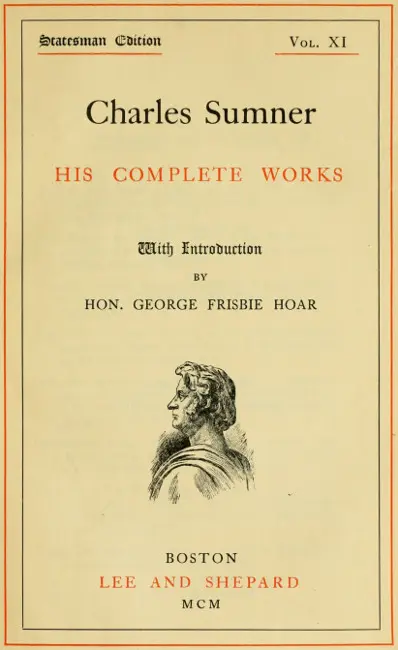
"Charles Sumner: His Complete Works, Volume 11 (of 20)" by Charles Sumner is a historical collection written in the late 19th century. The volume features a series of speeches and reports that reflect Sumner's strong advocacy for equality, civil rights, and the abolition of slavery. These works encapsulate significant political debates and legislative matters from the era of the Civil War through Reconstruction, offering insight into the social and legal struggles faced in the United States during this tumultuous period. The opening of this volume introduces several key issues addressed by Sumner, particularly the exclusion of colored witnesses in judicial proceedings. He highlights the historical injustices that arise from discriminatory laws allowing states to deny people of color their rights as witnesses based on their race. Sumner's opening remarks present a thorough examination of various state statutes that enforced these exclusions, showing how such legal frameworks contributed to the systemic oppression of African Americans. He passionately argues for legislative changes to rectify these injustices, drawing comparisons to historical injustices and advocating for an equitable legal system.
Introduction adapted from the source catalogue; source summaries may be automatically generated.
Free to read · English · 136,786 words · No account needed
MAKE TIME FOR A GOOD BOOK
On by default. Untick to stop anonymous reading totals. Each page counts after 10 seconds in view. How this works.
Anonymous counting is on unless you have switched it off.
The declarations of the Executive are as explicit as the declarations of Congress. In the instructions to our plenipotentiaries, under date of October 22, 1799, the Secretary of State, after mentioning the spoliations of France, says: “This conduct of the French Republic would well have justified an immediate declaration of war on the part of the United States; but, desirous of maintaining peace, and still willing to leave open the door of reconciliation with France, the United States contented themselves with preparations for defence and measures calculated to protect their commerce.”[226] These plenipotentiaries declared to the French, under date of April 11, 1800, that the Acts of Congress, “far from contemplating a coöperation with the enemies of the Republic, did not even authorize reprisals upon her merchantmen, but were restricted solely to the giving of safety to their own, till a moment should arrive when their sufferings could be heard and redressed.”[227] Again, in a despatch to our minister in England, under date of September 20, 1800, the Secretary of State, who was none other than John Marshall, says: “The aggressions sometimes of one and sometimes of another belligerent power have forced us to contemplate and to prepare for war as a probable event”:[228] not as an actual event already arrived, but only as a probable event. In the face of such declarations, who can say that war existed?
On the part of France the declarations are equally explicit. It is true, that, on the 12th September, 1800, in conversation, the French plenipotentiaries let drop fitful words, to the effect, that, “if the question could be determined by an indifferent nation, such a tribunal would say that the present state of things was war on the side of America, and that no indemnities could be claimed.”[229] But the context shows, that, to avoid the payment of these indemnities, they were driven to every possible subterfuge; and the whole suggestion is contrary to all the admissions of the French Government, both in the executive and legislative branches. Indeed, these very plenipotentiaries of France, in a formal communication to the American plenipotentiaries, under date of August 11, 1800, declared that “the state of misunderstanding which has existed for some time between France and the United States, by the act of some agents rather than by the will of the respective Governments, has not been a state of war, at least on the side of France.”[230] We have already seen that it was not on the side of the United States. Then again, under date of December 12, 1801, they contented themselves with characterizing the relations of the two powers at this period as “almost hostile.”[231] At an earlier day, Talleyrand, as Minister of Exterior Relations, had written, under date of August 28, 1798: “France has a double motive, as a nation and as a republic, not to expose to any hazard the present existence of the United States. Therefore it never thought of making war against them; … and every contrary supposition is an insult to common sense.”[232] When the Convention, in its final form, was laid before the Legislative Assembly, one of the French plenipotentiaries charged with its vindication announced in a speech, November 26, 1801, that “it had terminated the misunderstanding between France and America,” which, he said, had become such “that it was necessary the reconciliation should be hastened, if it was desired that it should not become very difficult.” A report was also made to the Legislative Assembly by M. Adet, formerly French minister to the United States, in which it is declared: “There had not been any declaration of war. Commissions granted by the President to attack the armed vessels of France are not to be regarded as a declaration of war. The will of the President does not suffice to put America in a state of war. In order to this a positive declaration of Congress is requisite. None has ever existed.” And these legislative documents, so positive in character, are introduced by the learned editor in words which fitly characterize the international relations to which they refer, when he says that “they will serve to make known the causes which momentarily disturbed the harmony of the two states.”[233] True enough. Unhappily, the harmony of the two states was disturbed, but war did not exist.
Your reading position is saved on this browser. Take it to another device with a library code. Reading pages adapt to text, rather than matching a printed edition.
Charles Sumner

Charles Sumner

Charles Sumner

Charles Sumner
BEHIND THE BOOK
This eBook is for the use of anyone anywhere in the United States and most other parts of the world at no cost and with almost no restrictions whatsoever. You may copy it, give it away or re-use it under the terms of the Project Gutenberg License included with this eBook or online at www.gutenberg.org. If you are not located in the United States, you will have to check the laws of the country where you are located before using this eBook. Read the source licence.
The original source file, including credits and licence, is retained by this library. Request an original-format copy at no charge. Please include the book title and Project Gutenberg identifier #48376.
KEEP YOUR CURIOSITY GOING

David Patterson (Spirit) Hatch

David Patterson (Spirit) Hatch

David Patterson (Spirit) Hatch
Cécile Tormay

Moritz Busch
John L. Ransom