
Charles Sumner: his complete works, volume 20 (of 20)
Charles Sumner
THE CLASSIC COLLECTION · 1873
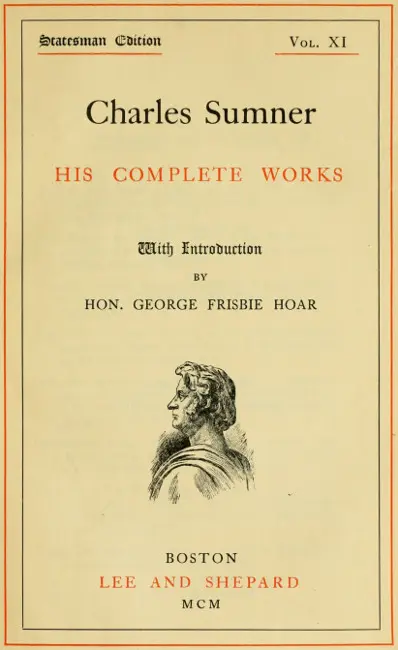
"Charles Sumner: His Complete Works, Volume 11 (of 20)" by Charles Sumner is a historical collection written in the late 19th century. The volume features a series of speeches and reports that reflect Sumner's strong advocacy for equality, civil rights, and the abolition of slavery. These works encapsulate significant political debates and legislative matters from the era of the Civil War through Reconstruction, offering insight into the social and legal struggles faced in the United States during this tumultuous period. The opening of this volume introduces several key issues addressed by Sumner, particularly the exclusion of colored witnesses in judicial proceedings. He highlights the historical injustices that arise from discriminatory laws allowing states to deny people of color their rights as witnesses based on their race. Sumner's opening remarks present a thorough examination of various state statutes that enforced these exclusions, showing how such legal frameworks contributed to the systemic oppression of African Americans. He passionately argues for legislative changes to rectify these injustices, drawing comparisons to historical injustices and advocating for an equitable legal system.
Introduction adapted from the source catalogue; source summaries may be automatically generated.
Free to read · English · 136,786 words · No account needed
MAKE TIME FOR A GOOD BOOK
On by default. Untick to stop anonymous reading totals. Each page counts after 10 seconds in view. How this works.
Anonymous counting is on unless you have switched it off.
“The two parties guaranty, mutually, from the present time and forever, against all other powers, to wit: The United States to His Most Christian Majesty, the present possessions of the crown of France in America, as well as those which it may acquire by the future treaty of peace; and His Most Christian Majesty guaranties, on his part, to the United States, their liberty, sovereignty, and independence, absolute and unlimited, as well in matters of government as commerce, and also their possessions, and the additions or conquests that their Confederation may obtain during the war from any of the dominions now or heretofore possessed by Great Britain in North America.”[148]
To fix more precisely the sense of this article, it was further
stipulated, that,--
“In case of a rupture between France and England, the reciprocal guaranty shall have its full force and effect the moment such war shall break out; and if such rupture shall not take place, the mutual obligations of the said guaranty shall not commence until the moment of the cessation of the present war between the United States and England shall have ascertained their possessions.”[149]
The possessions of France in America at this date were the islands of San Domingo, Martinique, Guadeloupe, St. Lucia, St. Bartholomew, Deseada, Mariegalante, St. Pierre, Miquelon, and, on the main-land, Cayenne,--each and all of which the United States guarantied to France forever, being a continuing guaranty, so far as this term of law is applicable to an international transaction, which, beginning “in case of a rupture between France and England,” was operative after “the cessation of the present war between the United States and England,” and was to continue “forever.”
The terms of the “guaranty” are general, and it was “forever.” Even if limited to defensive war, it would be difficult to say that France was not engaged in such a war, with the added incident that it was a war by a combination of kings to overcome a republic. France was alone, with the royalties of Europe embattled against her. Only after the execution of the King England joined this array, lending to it invincible navies. But, according to official avowals, it was what King George called “the atrocious act recently perpetrated at Paris”[150] that finally prompted the part she undertook, and her real object, in the language of Mr. Fox, was no other than “the destruction of the internal Government of France.”[151] The case was unprecedented; but it is difficult to say that it did not come under the “guaranty.” The casus fœderis had occurred. If France did not exact performance, that is no reason why our obligations should be disowned, when, at the present moment, we are trying to arrive at some appreciation of their extent. A careful examination of the treaty shows that the “guaranty” became primarily obligatory on the occurrence of a rupture between France and England. Nothing is said or suggested as to the character of the war, whether offensive or defensive. It is enough that there was “a rupture.” In such a case, the “guaranty,” according to the illustration of Cicero, was, tanquam gladius in vagina, at the disposal of France. Our Secretary of State, even while seeking to limit its application, seems to have seen it prospectively in this light, when, in his instructions of July 15, 1797, to our plenipotentiaries, Messrs. Pinckney, Marshall, and Gerry, he said, “Our guaranty of the possessions of France in America will perpetually expose us to the risk and expense of war, or to disputes and questions concerning our national faith.”[152]
Your reading position is saved on this browser. Take it to another device with a library code. Reading pages adapt to text, rather than matching a printed edition.
Charles Sumner

Charles Sumner

Charles Sumner

Charles Sumner
BEHIND THE BOOK
This eBook is for the use of anyone anywhere in the United States and most other parts of the world at no cost and with almost no restrictions whatsoever. You may copy it, give it away or re-use it under the terms of the Project Gutenberg License included with this eBook or online at www.gutenberg.org. If you are not located in the United States, you will have to check the laws of the country where you are located before using this eBook. Read the source licence.
The original source file, including credits and licence, is retained by this library. Request an original-format copy at no charge. Please include the book title and Project Gutenberg identifier #48376.
KEEP YOUR CURIOSITY GOING

David Patterson (Spirit) Hatch

David Patterson (Spirit) Hatch

David Patterson (Spirit) Hatch
Cécile Tormay

Moritz Busch
John L. Ransom