
Charles Sumner: his complete works, volume 20 (of 20)
Charles Sumner
THE CLASSIC COLLECTION · 1873
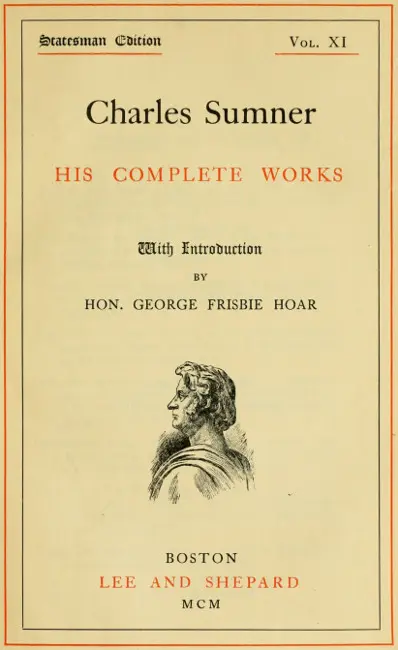
"Charles Sumner: His Complete Works, Volume 11 (of 20)" by Charles Sumner is a historical collection written in the late 19th century. The volume features a series of speeches and reports that reflect Sumner's strong advocacy for equality, civil rights, and the abolition of slavery. These works encapsulate significant political debates and legislative matters from the era of the Civil War through Reconstruction, offering insight into the social and legal struggles faced in the United States during this tumultuous period. The opening of this volume introduces several key issues addressed by Sumner, particularly the exclusion of colored witnesses in judicial proceedings. He highlights the historical injustices that arise from discriminatory laws allowing states to deny people of color their rights as witnesses based on their race. Sumner's opening remarks present a thorough examination of various state statutes that enforced these exclusions, showing how such legal frameworks contributed to the systemic oppression of African Americans. He passionately argues for legislative changes to rectify these injustices, drawing comparisons to historical injustices and advocating for an equitable legal system.
Introduction adapted from the source catalogue; source summaries may be automatically generated.
Free to read · English · 136,786 words · No account needed
MAKE TIME FOR A GOOD BOOK
On by default. Untick to stop anonymous reading totals. Each page counts after 10 seconds in view. How this works.
Anonymous counting is on unless you have switched it off.
It is true that diplomatic and commercial intercourse was suspended, that the two powers armed, and that on both sides force was employed. But this painful condition of things, though naturally causing great anxiety, did not constitute war. One power may, in its own discretion, suspend diplomatic and commercial intercourse with another; it may assume all the harness of war, and even use force in retaliation, retortion, or reprisal; but all this falls short of war, especially when public acts and declarations show that war was not intended. Such conduct tends to war, and, if continued, naturally ends in war. But it is not of itself that terrible transformation by which one nation, with all its people, is converted into the enemy of another nation, with all its people, so that every citizen of the one becomes the enemy of every citizen of the other, and all pending rights and contracts between them disappear, at least for a time.
If war be the extinguisher of claims, it is because, in theory, the claimant is supposed to have opportunity for reparation by seizing the property of the enemy, wherever he can find it on the high seas. But no reprisals against France were authorized by the United States; no war on private property was permitted; so that the only principle on which war is the extinguisher of claims fails to apply.
But not even an act of war constitutes war. The two parties determine if war exists. To their public acts and mutual declarations we repair for interpretation of their conduct.
2. On the part of the United States the declarations are explicit that war did not exist, although it seemed imminent. Congress was convened in May, 1797, to deliberate on the threatening aspect of affairs, and adopt measures of public defence, which were continued in 1798 and 1799; but in all this series of acts there is constant and sedulous negation of the state of war. The Act of May 28, 1798, after reciting that “armed vessels sailing under authority or pretence of authority from the Republic of France have committed depredations on the commerce of the United States, and have recently captured the vessels and property of citizens thereof on and near the coasts,” proceeds to authorize the seizure of any such armed vessel; but nothing is said of war.[215] Another Act, bearing date the same day, authorizes a provisional army, “in the event of a declaration of war against the United States, or of actual invasion of their territory by a foreign power, or of imminent danger of such invasion discovered in the opinion of the President to exist, before the next session of Congress.”[216] The Act of June 13, 1798, to continue in force only till the end of the next session, and renewed February 9, 1799, for a limited term, suspended commercial relations between the two countries, under penalties of forfeiture;[217] but such acts, however menacing, are absolutely inconsistent with an existing state of war, which of itself, without any additional act, suspends all commercial relations between the belligerent parties. The Act of June 25, 1798, authorizes our merchant vessels to subdue and capture any French armed vessel from which an assault or other hostility shall be first made.[218] The Act of July 6, 1798, respecting alien enemies, begins with the words of limitation, “Whenever there shall be a declared war between the United States and any foreign nation.”[219] The Act of July 7, 1798, declares the treaties no longer “legally obligatory”;[220] but if war existed, such an act would have been superfluous. The Act of July 16, 1798, authorizes augmentation of the army “for and during the continuance of the existing differences between the United States and the French Republic.”[221] The Act of March 2, 1799, also authorizes augmentation of the army, “in case war shall break out.”[222] Another Act, passed the next day, provides that certain troops authorized by the Act shall not be raised, “unless war shall break out between the United States and some European prince, potentate, or state.”[223] And as late as February 20, 1800, while our envoys were on the way to Paris, another Act was passed, providing that further enlistments should be suspended, “unless, in the recess of Congress, and during the continuance of the existing differences between the United States and the French Republic, war shall break out between the United States and the French Republic.”[224] All these cumulative measures refer to war, not as actually existing, but only as a future possibility. Meanwhile there were “existing differences” only. Finally, on the 14th of May, 1800, four months before the signature of the Convention, and when the plenipotentiaries on each side were at a dead-lock, another Act was passed, authorizing the abandonment of the military preparations set on foot in contemplation of the contingency of war.[225] Such is a synopsis of testimony from Congressional legislation. And now, when it is considered that Congress alone, under the Constitution, has power to declare war, that it never made any declaration of war against France, and that throughout this whole period of trouble, in its whole series of acts, it expressly negatived the fact of war, is it not impossible to assert, that, according to the understanding of our Government, war actually existed? What Congress did, and what it failed to do, answer in the affirmative.
Your reading position is saved on this browser. Take it to another device with a library code. Reading pages adapt to text, rather than matching a printed edition.
Charles Sumner

Charles Sumner

Charles Sumner

Charles Sumner
BEHIND THE BOOK
This eBook is for the use of anyone anywhere in the United States and most other parts of the world at no cost and with almost no restrictions whatsoever. You may copy it, give it away or re-use it under the terms of the Project Gutenberg License included with this eBook or online at www.gutenberg.org. If you are not located in the United States, you will have to check the laws of the country where you are located before using this eBook. Read the source licence.
The original source file, including credits and licence, is retained by this library. Request an original-format copy at no charge. Please include the book title and Project Gutenberg identifier #48376.
KEEP YOUR CURIOSITY GOING

David Patterson (Spirit) Hatch

David Patterson (Spirit) Hatch

David Patterson (Spirit) Hatch
Cécile Tormay

Moritz Busch
John L. Ransom