
Charles Sumner: his complete works, volume 20 (of 20)
Charles Sumner
THE CLASSIC COLLECTION · 1873
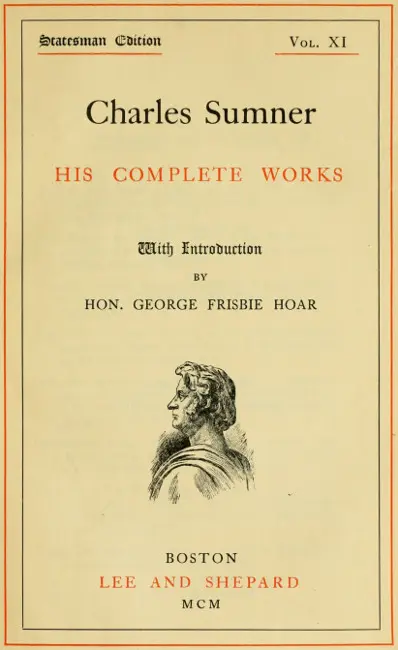
"Charles Sumner: His Complete Works, Volume 11 (of 20)" by Charles Sumner is a historical collection written in the late 19th century. The volume features a series of speeches and reports that reflect Sumner's strong advocacy for equality, civil rights, and the abolition of slavery. These works encapsulate significant political debates and legislative matters from the era of the Civil War through Reconstruction, offering insight into the social and legal struggles faced in the United States during this tumultuous period. The opening of this volume introduces several key issues addressed by Sumner, particularly the exclusion of colored witnesses in judicial proceedings. He highlights the historical injustices that arise from discriminatory laws allowing states to deny people of color their rights as witnesses based on their race. Sumner's opening remarks present a thorough examination of various state statutes that enforced these exclusions, showing how such legal frameworks contributed to the systemic oppression of African Americans. He passionately argues for legislative changes to rectify these injustices, drawing comparisons to historical injustices and advocating for an equitable legal system.
Introduction adapted from the source catalogue; source summaries may be automatically generated.
Free to read · English · 136,786 words · No account needed
MAKE TIME FOR A GOOD BOOK
On by default. Untick to stop anonymous reading totals. Each page counts after 10 seconds in view. How this works.
Anonymous counting is on unless you have switched it off.
New England $39,306,729 $65,516,155 New York, Pennsylvania, and New Jersey 50,865,198 75,044,721 ---------- ---------- $90,171,927 $140,560,876 90,171,927 ---------- Aggregate increase in Eastern States $50,388,949
Being over fifty-five and three fourths per cent.
These tables speak. They show the range within which the State banks undertake to operate, and their consequent interference with the national system. If it be said that in certain parts of the country, as in New England and New York, the State banks have performed good service, I reply, that, even admitting all that is claimed, the service is local and incomplete. It does not embrace the West.
The present endeavor is to provide a remedy for this trouble by a comprehensive national system, discharging the function performed by the State banks, and embracing the whole country. It is called national because it belongs to the nation, and not to any particular State, and because its origin, aim, and inspiration are all national. It is conceived in no hostility or unkindness to the State banks, but in a patriotic purpose to do what can be done to secure what all desire,--a national currency. The State banks will be welcome to a place in the system, like State troops coming forward for the defence of the Republic; but they cannot be tolerated, if they stand aloof, or refuse to take the post assigned them. At a moment of peril, when the Government is bending all its energies to save the national currency, a mutiny among State banks will be hardly less disastrous than a mutiny among State troops. Every murmur or mutter of such mutiny ought to be repressed at once. All should be summoned to perfect and harmonious coöperation in that cause which embraces the whole country, in every walk of life, whether military or civil.
I know not how others are impressed, but to my mind it is difficult to imagine anything, short of those everlasting principles of human freedom involved in this war, which should at this moment be more carefully watched than the currency of the country. Let this be safe, and everything will be safe,--army, navy, and the whole national cause. Such a currency will constitute an epoch in the history of the country,--ay, Sir, in the history of the world. There have been ministers in other countries and other times whose names are immortal from association with commercial reforms. Colbert was the founder of the commercial system of France; Peel was the founder of free trade in England. But the present Secretary of the Treasury, when the new system is at last triumphant over all obstacles, including the mutiny of State banks and the lukewarmness of Senators, may boast that he has given a currency to his country. Next after the great gift of human freedom there is nothing greater he could give,--nothing that comes home so completely to the business and bosoms of the people, rich and poor, throughout our wide-spread empire. An improved currency is like sunshine, penetrating every corner of the land, under which commerce, business, comfort, civilization, life itself, will put forth blossom and fruit. Nobody in the community too high, nobody too low, not to feel the new-found boon filling every household and travelling on every highway. But it is seen now in another aspect. An improved currency is like a new levy of national troops, a new navy afloat, a new contribution of supplies. It is the herald and assurance of untold success. In itself it is a present daily victory,--fruitful parent of victory everywhere.
Your reading position is saved on this browser. Take it to another device with a library code. Reading pages adapt to text, rather than matching a printed edition.
Charles Sumner

Charles Sumner

Charles Sumner

Charles Sumner
BEHIND THE BOOK
This eBook is for the use of anyone anywhere in the United States and most other parts of the world at no cost and with almost no restrictions whatsoever. You may copy it, give it away or re-use it under the terms of the Project Gutenberg License included with this eBook or online at www.gutenberg.org. If you are not located in the United States, you will have to check the laws of the country where you are located before using this eBook. Read the source licence.
The original source file, including credits and licence, is retained by this library. Request an original-format copy at no charge. Please include the book title and Project Gutenberg identifier #48376.
KEEP YOUR CURIOSITY GOING

David Patterson (Spirit) Hatch

David Patterson (Spirit) Hatch

David Patterson (Spirit) Hatch
Cécile Tormay

Moritz Busch
John L. Ransom