
Charles Sumner: his complete works, volume 20 (of 20)
Charles Sumner
THE CLASSIC COLLECTION · 1873
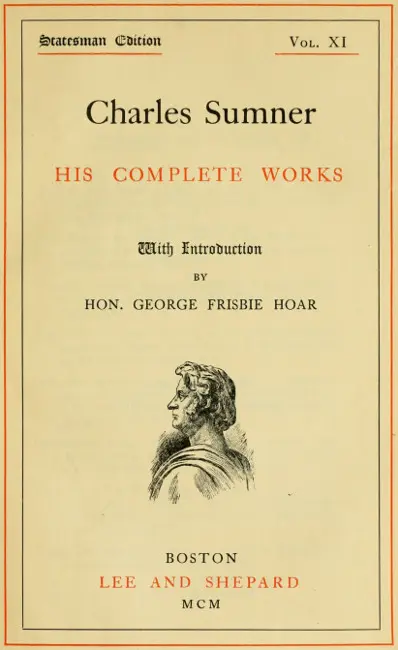
"Charles Sumner: His Complete Works, Volume 11 (of 20)" by Charles Sumner is a historical collection written in the late 19th century. The volume features a series of speeches and reports that reflect Sumner's strong advocacy for equality, civil rights, and the abolition of slavery. These works encapsulate significant political debates and legislative matters from the era of the Civil War through Reconstruction, offering insight into the social and legal struggles faced in the United States during this tumultuous period. The opening of this volume introduces several key issues addressed by Sumner, particularly the exclusion of colored witnesses in judicial proceedings. He highlights the historical injustices that arise from discriminatory laws allowing states to deny people of color their rights as witnesses based on their race. Sumner's opening remarks present a thorough examination of various state statutes that enforced these exclusions, showing how such legal frameworks contributed to the systemic oppression of African Americans. He passionately argues for legislative changes to rectify these injustices, drawing comparisons to historical injustices and advocating for an equitable legal system.
Introduction adapted from the source catalogue; source summaries may be automatically generated.
Free to read · English · 136,786 words · No account needed
MAKE TIME FOR A GOOD BOOK
On by default. Untick to stop anonymous reading totals. Each page counts after 10 seconds in view. How this works.
Anonymous counting is on unless you have switched it off.
[289] “Ubi justitia vera non est, nec jus potest esse.”--De Civitate Dei, Lib. XIX. c. 21, § 1.
[290] Speech in the Impeachment of Warren Hastings, February 16, 1788: Works (London, 1822), Vol. XIII. pp. 168, 169.
[291] Speech on the Address of Thanks, January 9, 1770: Hansard’s Parliamentary History, Vol. XVI. col. 661.
[292] De Soto, De Justitia et Jure, Lib. IV. Quæst. 2, Art. 2. Mackintosh, quoting these words, declares, with proper exultation, that “Philosophy and Religion appear by the hand of their faithful minister to have thus smitten the monsters in their earliest infancy.”--Dissertation on the Progress of Ethical Philosophy, Sec. III.: Miscellaneous Works (London, 1851), p. 24.
[293] Paley’s Moral Philosophy, with Annotations by Richard Whately (London, 1859): Annot., Book III. Part ii. ch. 3, Slavery, p. 178.
[294] Plutarch’s Lives, tr. Clough, Vol. IV. p. 565, Appendix. Diogenes Laertius, De Clarorum Philosophorum Vitis, etc., Lib. IV. c. 2, Xenocrates.
[295] Discorsi sopra la prima Deca di T. Livio, Lib. III. cap. 1.
[296] Essays: Of Honor and Reputation.
[297] Records of the Governor and Company of the Massachusetts Bay, December 4, 1638, Vol. I. p. 246. Palfrey, History of New England, Vol. I. p. 553.
[298] Collection des Constitutions, Chartes et Lois Fondamentales des Peuples de l’Europe et des deux Amériques, par MM. P. A. Dufau, J. B. Duvergier, et J. Guadet, (Paris, 1823,) Tom. I. pp. 97, 98.
[299] Ibid., p. 135.
“Les mortels sont égaux; leur masque est différent.
…
Avoir les mêmes droits à la félicité,
C’est pour nous la parfaite et seule égalité.”
Discours en Vers sur l’Homme; Discours I., De l’Égalité des Conditions: Œuvres (Paris, 1833), Tom. XII. pp. 45, 47.
[301] Poëme sur la Loi Naturelle, 4me Partie: Ibid., p. 176.
[302] Collection des Constitutions, etc., par Dufau, Duvergier, et
Guadet, Tom. I. p. 256.
[303] Ibid., p. 247.
[304] Collection des Constitutions, etc., par Dufau, Duvergier, et
Guadet, Supplément, p. 212.
[305] Ibid., Tom. III. p. 122.
[306] Ibid., Tom. IV. p. 73.
[307] Ibid., Tom. II. p. 511.
[308] Ibid., Tom. I. p. 232.
[309] Ibid., Supplément, p. 188.
[310] Ibid., p. 41.
[311] Ibid., p. 155.
[312] Ibid., p. 74.
[313] Annuaire Historique Universel, 1831, Appendice, Documents
Historiques, p. 155.
[314] Ibid., 1849, Appendice, Documents Historiques, p. 134.
[315] British and Foreign State Papers, 1847-48, Vol. XXXVI. p. 890.
[316] Art. XXIV. Statuto Fondamentale del Regno: Annuario Diplomatico
del Regno d’Italia.
[317] History, Book III. c. 80. See, ante, Vol. II. p. 339.
[318] Hallam says of this scene, which occurred after the murder of Smerdis the Magian, that it is “conceived in the spirit of Corneille.”--Middle Ages (London, 1853), Vol. II. p. 344, note, Ch. VIII. Part 2.
[319] Discours de la Servitude Volontaire: Œuvres, ed. Feugère, (Paris,
1846,) pp. 26, 27.
Your reading position is saved on this browser. Take it to another device with a library code. Reading pages adapt to text, rather than matching a printed edition.
Charles Sumner

Charles Sumner

Charles Sumner

Charles Sumner
BEHIND THE BOOK
This eBook is for the use of anyone anywhere in the United States and most other parts of the world at no cost and with almost no restrictions whatsoever. You may copy it, give it away or re-use it under the terms of the Project Gutenberg License included with this eBook or online at www.gutenberg.org. If you are not located in the United States, you will have to check the laws of the country where you are located before using this eBook. Read the source licence.
The original source file, including credits and licence, is retained by this library. Request an original-format copy at no charge. Please include the book title and Project Gutenberg identifier #48376.
KEEP YOUR CURIOSITY GOING

David Patterson (Spirit) Hatch

David Patterson (Spirit) Hatch

David Patterson (Spirit) Hatch
Cécile Tormay

Moritz Busch
John L. Ransom