
Charles Sumner: his complete works, volume 20 (of 20)
Charles Sumner
THE CLASSIC COLLECTION · 1873
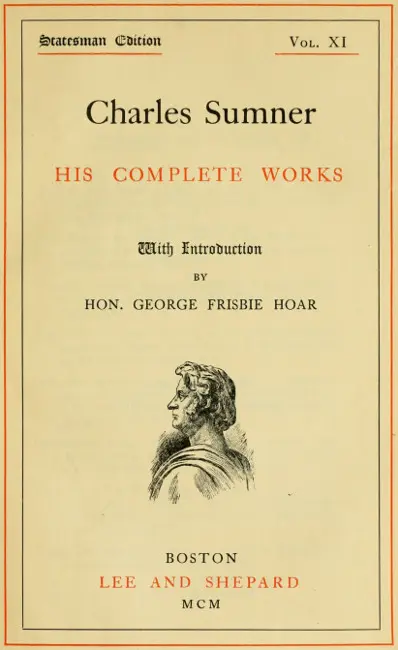
"Charles Sumner: His Complete Works, Volume 11 (of 20)" by Charles Sumner is a historical collection written in the late 19th century. The volume features a series of speeches and reports that reflect Sumner's strong advocacy for equality, civil rights, and the abolition of slavery. These works encapsulate significant political debates and legislative matters from the era of the Civil War through Reconstruction, offering insight into the social and legal struggles faced in the United States during this tumultuous period. The opening of this volume introduces several key issues addressed by Sumner, particularly the exclusion of colored witnesses in judicial proceedings. He highlights the historical injustices that arise from discriminatory laws allowing states to deny people of color their rights as witnesses based on their race. Sumner's opening remarks present a thorough examination of various state statutes that enforced these exclusions, showing how such legal frameworks contributed to the systemic oppression of African Americans. He passionately argues for legislative changes to rectify these injustices, drawing comparisons to historical injustices and advocating for an equitable legal system.
Introduction adapted from the source catalogue; source summaries may be automatically generated.
Free to read · English · 136,786 words · No account needed
MAKE TIME FOR A GOOD BOOK
On by default. Untick to stop anonymous reading totals. Each page counts after 10 seconds in view. How this works.
Anonymous counting is on unless you have switched it off.
[257] Mr. Webster, in his careful speech of 12th January, 1835, says: “So far as can be learned from official reports, there are something more than six hundred vessels with their cargoes which are supposed to form claims under this bill.”--Works, Vol. IV. p. 177.
[258] From a Review of the Veto Message of President Pierce, by James
H. Causten, pp. 21, 22.
[259] Institutes of Natural Law, Book I. ch. 17, § 5.
[260] De Jure Belli ac Pacis, Lib. II. cap. 17, § 4.
[261] Le Droit des Gens, Liv. II. ch. 18, § 342.
[262] Elements of International Law (ed. Lawrence), Part IV. ch. 1, § 3.
[263] The Amiable Nancy, 3 Wheaton, R., 560.
[264] Hon. S. P. Chase.
[265] Favorable statement of facts, without coming to any conclusion.
[266] This bill was voted by the Senate, February 3, 1835, yeas 25,
nays 20.
[267] This bill was voted by the Senate June 8, 1846, yeas 27, nays 23.
[268] This bill (being Mr. Clayton’s bill as voted by the Senate) was voted by the House August 4, 1846, yeas 94, nays 87. It thus passed both houses, but was vetoed by President Polk as a Senate bill; and on the veto the Senate voted yeas 27, nays 15,--no two thirds.
[269] This bill was voted by the Senate, January 24, 1851, without a
division.
[270] This bill was voted by the Senate, Feb. 15, 1854, yeas 27, nays
15.
[271] This bill was voted by the House, January 27, 1855, yeas 111, nays 77, and by the Senate, February 6th, yeas 28, nays 17, but was vetoed by President Pierce as a House bill; and the House vote on the veto was yeas 113, nays 86,--not two thirds,--so the bill was lost.
[272] This bill was voted by the Senate, January 10, 1859, yeas 26,
nays 20.
[273] Congressional Globe, 38th Cong. 1st Sess., p. 1178, March 18,
1864. See, also, p. 1180.
[274] Notes on Virginia, Query XVIII.: Writings, Vol. VIII. p. 403.
[275] Elliot’s Debates (2d edit.), Vol. III. p. 442.
[276] Elliot’s Debates (2d edit.), Vol. III. p. 590.
[277] Works, Vol. X. pp. 377, 378.
[278] Notes on the Confederacy, April, 1787: Madison’s Letters and other Writings, Vol. I. p. 322. Congressional Globe, 37th Cong. 2d Sess., p. 1808, April 24, 1862.
[279] Taylor v. Porter, 4 Hill, R., 146, 147.
[280] Elliot’s Debates (2d edit.), Vols. I. p. 334, III. p. 658, IV. p.
243.
[281] Letter to Egbert Benson, 1780: Life, by his Son, Vol. I. pp. 229,
230.
[282] Saadi: The Gulistan, tr. Gladwin, Chap. VII., Tale 16.
[283] The famous device of Paracelsus was a mediæval verse, Alterius non sit qui suus esse potest,--meaning that no man who can be his own should be another’s; which is good as far as it goes, but it does not disclose the whole truth.
[284] Cochin, L’Abolition de l’Esclavage, Tom. II., 2me Partie, Liv. X.
ch. 2, 3.
[285] S. Gregorii Registrum Epistolarum, Lib. VI. Ep. 12: Opera Omnia, (Edit. Benedict., Parisiis, 1705,) Tom. II. col. 800.
[286] Paradise Lost, Book XII. 64-71.
[287] Debates in the Federal Convention, August 25, 1787: Madison Papers, Vol. III. pp. 1429, 1430.
[288] De Legibus, Lib. I. c. 16.
Your reading position is saved on this browser. Take it to another device with a library code. Reading pages adapt to text, rather than matching a printed edition.
Charles Sumner

Charles Sumner

Charles Sumner

Charles Sumner
BEHIND THE BOOK
This eBook is for the use of anyone anywhere in the United States and most other parts of the world at no cost and with almost no restrictions whatsoever. You may copy it, give it away or re-use it under the terms of the Project Gutenberg License included with this eBook or online at www.gutenberg.org. If you are not located in the United States, you will have to check the laws of the country where you are located before using this eBook. Read the source licence.
The original source file, including credits and licence, is retained by this library. Request an original-format copy at no charge. Please include the book title and Project Gutenberg identifier #48376.
KEEP YOUR CURIOSITY GOING

David Patterson (Spirit) Hatch

David Patterson (Spirit) Hatch

David Patterson (Spirit) Hatch
Cécile Tormay

Moritz Busch
John L. Ransom