Modern daughters
Alexander Black
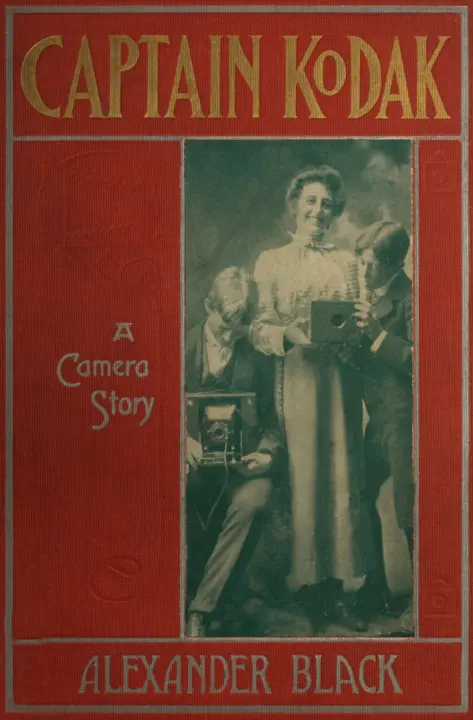
THE CLASSIC COLLECTION · 1899
"Captain Kodak: A Camera Story" by Alexander Black is a fictional narrative written in the late 19th century. The story revolves around an amateur photographer, Allan Hartel, and his adventures alongside his friends, particularly in relation to the excitement and challenges that come from their shared interest in photography. The plot begins with Allan receiving a camera, which ignites a series of events involving friendships, mishaps, and community interactions centered around photography. At the start of the narrative, readers are introduced to Allan and his friend McConnell amidst an amusing chaos after a circus elephant escapes and creates havoc in their town, Hazenfield. Allan expresses a desire to have documented the incident with a photograph, hinting at his budding passion for photography. Shortly afterward, he reveals to McConnell that he won a camera as a prize from a composition contest. This revelation sparks their enthusiasm for setting up a darkroom and experimenting with photography, leading them to a night filled with events surrounding a factory fire that they eagerly attempt to photograph. The opening sets the tone for a blend of adventure, friendship, and the exploratory nature of youth as they dive into the world of photography.
Introduction adapted from the source catalogue; source summaries may be automatically generated.
Free to read · English · 50,307 words · No account needed
MAKE TIME FOR A GOOD BOOK
On by default. Untick to stop anonymous reading totals. Each page counts after 10 seconds in view. How this works.
Anonymous counting is on unless you have switched it off.
“In that case,” said Owen, “I guess we might as well tell the rest of
the town.”
“What do you mean?” McConnell was mystified.
“Only that I thought that maybe we should keep quiet about selling the
pictures.”
“I see,” McConnell assented, “until you get the money.”
“Oh, I mean anyway,” said Allan. “Perhaps the factory folks may not want everybody to know, and everybody would know if they heard that they had bought the plates.”
“That settles it!” exclaimed McConnell, “I’ll be quiet. I won’t even tell the postman, and I always tell him everything. Have you printed the proofs yet?”
“No; the plates aren’t dry yet, somehow. We are going down to get the dark-room things, and we shall get some proof paper.”
“I’ll go with you,” McConnell said, pushing his book under the porch
seat.
Little Artie, McConnell’s younger brother, came running around the house. “Take my picture taken,” he cried to Allan, who was carrying the camera.
“It’s funny,” laughed McConnell, “but Artie always gets it that way. He has heard us say ‘get your picture taken,’ and he always says ‘take my picture taken,’ or ‘take your picture taken.’”
Artie repeated his request, peering into the finder of Allan’s box. “All right,” said Allan.
“Wait a minute,” called McConnell, “wait till I put him on my wheel.” Artie was lifted up. “Now,” said McConnell.
Artie started when he heard the click of the shutter. “Did you take my picture taken?” he asked.
“Yes,” Allan laughed, “I took your picture taken.”
“Then let me see it,” demanded Artie.
“Not yet, Artie,—to-morrow.”
Artie then went back to a box of sand in which he had been playing.
It took Allan nearly an hour to complete his purchases. He had the advantage of Owen’s advice, in the choice of trays, for instance. Owen had tried lacquered tin, glass, and pressed paper, but liked rubber best. These cost more, but as he only required three, two to be used in developing and a larger one, capable of holding four plates, for “fixing,” Allan felt that he could afford it,—especially with his share of the fifty dollars to come.
Certainly it was great fun to buy these utensils, and the shining glass graduate,—Dr. Hartel had promised Allan a second, large, graduate, as well as a hydrometer and some stopper bottles; the brass-hinged printing frames, the “hypo” and developing chemicals, and the dark-room lamp.
Your reading position is saved on this browser. Take it to another device with a library code. Reading pages adapt to text, rather than matching a printed edition.
Alexander Black
Alexander Black
BEHIND THE BOOK
This eBook is for the use of anyone anywhere in the United States and most other parts of the world at no cost and with almost no restrictions whatsoever. You may copy it, give it away or re-use it under the terms of the Project Gutenberg License included with this eBook or online at www.gutenberg.org. If you are not located in the United States, you will have to check the laws of the country where you are located before using this eBook. Read the source licence.
The original source file, including credits and licence, is retained by this library. Request an original-format copy at no charge. Please include the book title and Project Gutenberg identifier #70197.
KEEP YOUR CURIOSITY GOING
Coulson Kernahan

Maurice Baring
Frances Wright
Cécile Tormay

Frederic Jesup Stimson

W. H. P. (William Henry Pope) Jarvis