Modern daughters
Alexander Black
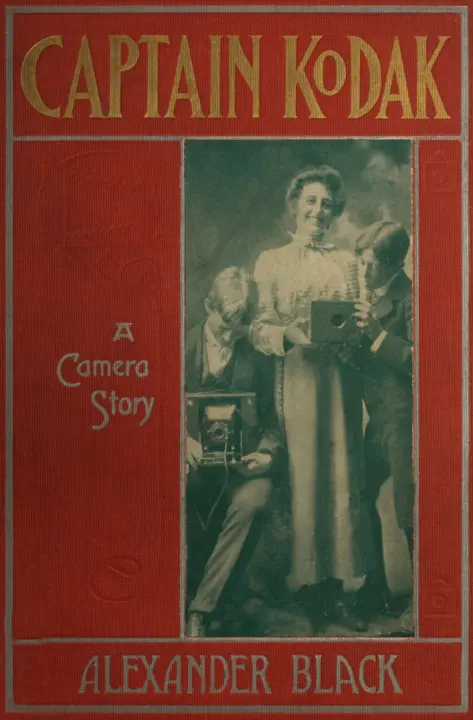
THE CLASSIC COLLECTION · 1899
"Captain Kodak: A Camera Story" by Alexander Black is a fictional narrative written in the late 19th century. The story revolves around an amateur photographer, Allan Hartel, and his adventures alongside his friends, particularly in relation to the excitement and challenges that come from their shared interest in photography. The plot begins with Allan receiving a camera, which ignites a series of events involving friendships, mishaps, and community interactions centered around photography. At the start of the narrative, readers are introduced to Allan and his friend McConnell amidst an amusing chaos after a circus elephant escapes and creates havoc in their town, Hazenfield. Allan expresses a desire to have documented the incident with a photograph, hinting at his budding passion for photography. Shortly afterward, he reveals to McConnell that he won a camera as a prize from a composition contest. This revelation sparks their enthusiasm for setting up a darkroom and experimenting with photography, leading them to a night filled with events surrounding a factory fire that they eagerly attempt to photograph. The opening sets the tone for a blend of adventure, friendship, and the exploratory nature of youth as they dive into the world of photography.
Introduction adapted from the source catalogue; source summaries may be automatically generated.
Free to read · English · 50,307 words · No account needed
MAKE TIME FOR A GOOD BOOK
On by default. Untick to stop anonymous reading totals. Each page counts after 10 seconds in view. How this works.
Anonymous counting is on unless you have switched it off.
CHENEY was very much frightened, but he cried sullenly, “You let me go!”
Allan did let him up from the ground, but still held fast to him. “So you are the thief, Cheney? And you want more, do you?” Allan’s voice trembled. “Cheney, I’m going to hand you over to the police. You deserve it. You robbed me, and now you were trying to do it again.” “No, I wasn’t,” whimpered Cheney. “Let me go, Allan! Don’t have me arrested. Please, Allan!”
Then Cheney suddenly gave a violent twist of his body, hoping to catch Allan unawares, and escape. But Allan’s fingers never loosened their hold.
“It’s no use, Cheney,” Allan said, speaking as quietly as his excitement would permit. “It wouldn’t do you any good to get away, anyhow. I know who it is, and you would be arrested before morning.”
Cheney began to cry. “Don’t, Allan.”
“But you are a thief, Cheney.”
“No, I ain’t, Allan; I did take them, but I just put them back.”
“Put them back?”
“Yes, Allan, they’re up there all right.”
“Do you mean that you have brought them back?”
“Sure,” Cheney answered fervently.
“Well, let us see,” said Allan. “You go up first;” and he made Cheney go ahead of him up the stairs in the dark—for he had absently blown out his light when he went into the house. Allan struck a match at the top step.
“See! there they are!” and Cheney pointed to the three plates lying on a chair, the first object Cheney had encountered in the dark.
Allan picked up the plates, holding the match in his other hand. The match burned out, and he struck another, and lighted his “white lamp.” Then he looked at the plates, one by one, to see that they were not injured. Convinced that they were not harmed, he turned to Cheney, who stood falteringly and uneasily watching him.
“Well, you can go, Cheney, for all I care.”
Cheney immediately began to recover his self-possession.
“Oh, I was only foolin’, Allan. I was goin’ to bring them back.”
“You did bring them back,” said Allan. “That saved you. I guess I can get Detective Dobbs to let you go.”
“Detective Dobbs,” stammered Cheney; “you’re bluffing.”
“Well, Dobbs isn’t,” said Allan. “He suspected you from the first. He spoke to you about the plates, didn’t he?”
“Yes,” Cheney admitted, “but I didn’t think he knew anything. He only said some pictures were stolen, and if I saw anybody with them I better tell him to get them back in a hurry.”
Your reading position is saved on this browser. Take it to another device with a library code. Reading pages adapt to text, rather than matching a printed edition.
Alexander Black
Alexander Black
BEHIND THE BOOK
This eBook is for the use of anyone anywhere in the United States and most other parts of the world at no cost and with almost no restrictions whatsoever. You may copy it, give it away or re-use it under the terms of the Project Gutenberg License included with this eBook or online at www.gutenberg.org. If you are not located in the United States, you will have to check the laws of the country where you are located before using this eBook. Read the source licence.
The original source file, including credits and licence, is retained by this library. Request an original-format copy at no charge. Please include the book title and Project Gutenberg identifier #70197.
KEEP YOUR CURIOSITY GOING
Coulson Kernahan

Maurice Baring
Frances Wright
Cécile Tormay

Frederic Jesup Stimson

W. H. P. (William Henry Pope) Jarvis