Modern daughters
Alexander Black
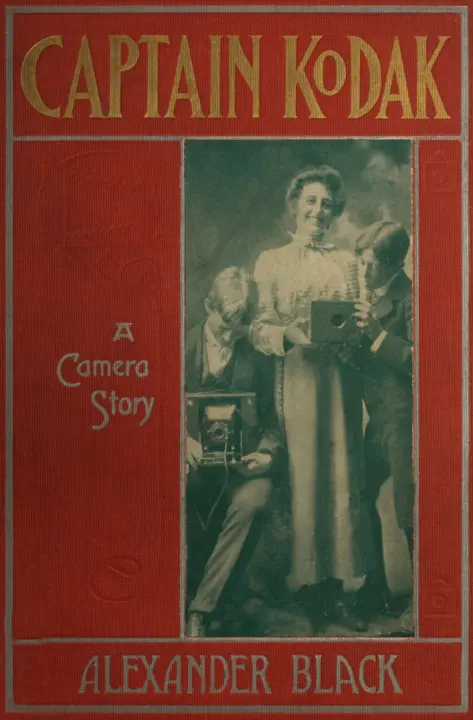
THE CLASSIC COLLECTION · 1899
"Captain Kodak: A Camera Story" by Alexander Black is a fictional narrative written in the late 19th century. The story revolves around an amateur photographer, Allan Hartel, and his adventures alongside his friends, particularly in relation to the excitement and challenges that come from their shared interest in photography. The plot begins with Allan receiving a camera, which ignites a series of events involving friendships, mishaps, and community interactions centered around photography. At the start of the narrative, readers are introduced to Allan and his friend McConnell amidst an amusing chaos after a circus elephant escapes and creates havoc in their town, Hazenfield. Allan expresses a desire to have documented the incident with a photograph, hinting at his budding passion for photography. Shortly afterward, he reveals to McConnell that he won a camera as a prize from a composition contest. This revelation sparks their enthusiasm for setting up a darkroom and experimenting with photography, leading them to a night filled with events surrounding a factory fire that they eagerly attempt to photograph. The opening sets the tone for a blend of adventure, friendship, and the exploratory nature of youth as they dive into the world of photography.
Introduction adapted from the source catalogue; source summaries may be automatically generated.
Free to read · English · 50,307 words · No account needed
MAKE TIME FOR A GOOD BOOK
On by default. Untick to stop anonymous reading totals. Each page counts after 10 seconds in view. How this works.
Anonymous counting is on unless you have switched it off.
“They’re not mine to show, now,” said Allan, with a pride that he could not conceal, even from Cheney. “I sold them.”
“Sold ’em!” exclaimed Cheney. “To who?”
“To the factory people. There’s something about the factory being set afire, and beside that there’s some insurance trouble about where the fire started, and they’ve given me fifty dollars for the plates.”
Cheney gave a long whistle. “Golly!” he cried. “You’re right in it, ain’t yer! Fifty dollars! I didn’t suppose any picture could ever be worth as much as that.”
“You see,” said Allan, “they can use the pictures as proof if there’s
any trouble.”
“Proof of what?” Cheney demanded incredulously.
“Proof of which side of the wing the fire started.”
Cheney smiled as if this idea was very amusing. “I hope you get it,” he said, as Allan went on.
Allan felt rather sorry to have said anything to Cheney about the sale of the plates. When he came to think the thing over he could see that the factory people, while they had not said so, might not wish to have the matter known. Allan felt, too, as if he had been boasting, even though Cheney had drawn him into the confession.
He made up his mind not to say a word to any one else, and determined to ask Owen and McConnell not to speak about it. When Owen heard from Allan about his meeting with Cheney and how sorry he was that he had said anything to Cheney, he himself agreed with Allan.
“I shan’t mention it,” Owen assured Allan. “I haven’t mentioned it to any one but mother. She wondered where I had been, of course. I think you had better speak to McConnell.”
“I shall,” said Allan. “Big McConnell would be just the one to spread the thing everywhere.”
“Let us go around to McConnell’s now,” suggested Owen, “and tell him
about it.”
They found McConnell sitting in a swing in his yard reading a book. “McConnell is always reading,” said Owen.
“Hello!” called Allan. “What are you reading, McConnell? I’ll bet it is about an Indian, a detective, or a princess.”
“Wrong,” replied McConnell. “It’s about a farmer’s boy.”
“And what does he get to be?” Owen asked.
“I don’t know yet,” McConnell returned. “Maybe a farmer!” he added,
laughing.
Allan then spoke about the fire and the pictures.
“I tell you,” said McConnell, “I haven’t said anything to anybody but the folks at home, and Billy Basset, and the butcher, and—yes, and Mr. Hanford.”
Your reading position is saved on this browser. Take it to another device with a library code. Reading pages adapt to text, rather than matching a printed edition.
Alexander Black
Alexander Black
BEHIND THE BOOK
This eBook is for the use of anyone anywhere in the United States and most other parts of the world at no cost and with almost no restrictions whatsoever. You may copy it, give it away or re-use it under the terms of the Project Gutenberg License included with this eBook or online at www.gutenberg.org. If you are not located in the United States, you will have to check the laws of the country where you are located before using this eBook. Read the source licence.
The original source file, including credits and licence, is retained by this library. Request an original-format copy at no charge. Please include the book title and Project Gutenberg identifier #70197.
KEEP YOUR CURIOSITY GOING
Coulson Kernahan

Maurice Baring
Frances Wright
Cécile Tormay

Frederic Jesup Stimson

W. H. P. (William Henry Pope) Jarvis