Modern daughters
Alexander Black
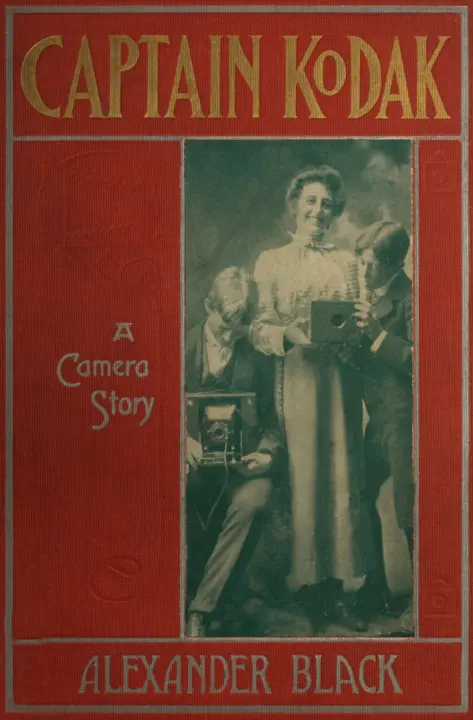
THE CLASSIC COLLECTION · 1899
"Captain Kodak: A Camera Story" by Alexander Black is a fictional narrative written in the late 19th century. The story revolves around an amateur photographer, Allan Hartel, and his adventures alongside his friends, particularly in relation to the excitement and challenges that come from their shared interest in photography. The plot begins with Allan receiving a camera, which ignites a series of events involving friendships, mishaps, and community interactions centered around photography. At the start of the narrative, readers are introduced to Allan and his friend McConnell amidst an amusing chaos after a circus elephant escapes and creates havoc in their town, Hazenfield. Allan expresses a desire to have documented the incident with a photograph, hinting at his budding passion for photography. Shortly afterward, he reveals to McConnell that he won a camera as a prize from a composition contest. This revelation sparks their enthusiasm for setting up a darkroom and experimenting with photography, leading them to a night filled with events surrounding a factory fire that they eagerly attempt to photograph. The opening sets the tone for a blend of adventure, friendship, and the exploratory nature of youth as they dive into the world of photography.
Introduction adapted from the source catalogue; source summaries may be automatically generated.
Free to read · English · 50,307 words · No account needed
MAKE TIME FOR A GOOD BOOK
On by default. Untick to stop anonymous reading totals. Each page counts after 10 seconds in view. How this works.
Anonymous counting is on unless you have switched it off.
ABOVE the stalls in Dr. Hartel’s stable were three rooms, in one of which a coach-man used to sleep in the days when the place had been used by Judge Solling. The two other rooms were only partly finished. In one of these was a sink with running water, which had long been marked in Allan’s fancy as the focal point of the dark-room.
“We can’t fix anything here to-night,” said Owen.
“Of course not,” admitted Allan.
Owen had carried over two trays, “one for developing and the other for fixing,” and at his suggestion Allan procured an “agate iron” tray from the kitchen to wash the plates in. “Mind you fetch it back!” said Nora.
“Is it dark enough here?” asked Allan, turning to the back windows.
“Yes,” answered Owen; “but in the daytime you would have to cover up the windows in some way, and keep the daylight in the front rooms from getting in around these doors.”
Meanwhile Owen, in the red light of his lamp, was fussing with two bottles, a proceeding which excited the greatest interest on the part of the two other boys. Allan often had seen his father make chemical experiments, and he had seen Owen develop once before; but he was not a photographer then, and had not watched each motion with the same feeling of concern and anticipation.
“I forgot my graduate,” Owen complained.
“Shall I get one of father’s?” asked Allan.
“No, I can guess the amount pretty well in this old glass.”
Owen poured from each of his bottles, and then added water from the tap, inspected the trays critically, and turned the flame of the lamp a little lower. “Now,” he said, “we are all ready.”
“Ship ahoy!” came a voice from the stable stairs. It was the Doctor.
“Can’t we come?” That was Edith.
“Yes, yes! Come right up!” shouted Allan, running to the head of the stairs to pilot the newcomers, “though I don’t know where you are going to sit—we haven’t any chairs.”
“Oh, we shan’t mind that!” said the Doctor.
“We are just ready,” said Owen.
Allan thought it was good of Owen to say “we,” for he himself had taken but small part in the important preparations.
“I hope this won’t make you nervous, Owen,” the Doctor said. “I don’t know that I should want to perform an operation with so many onlookers.”
“I may not do the right thing,” Owen confessed; “but I only know how to do the one thing, anyway, and that is to pour on the developer and let the thing go.”
Your reading position is saved on this browser. Take it to another device with a library code. Reading pages adapt to text, rather than matching a printed edition.
Alexander Black
Alexander Black
BEHIND THE BOOK
This eBook is for the use of anyone anywhere in the United States and most other parts of the world at no cost and with almost no restrictions whatsoever. You may copy it, give it away or re-use it under the terms of the Project Gutenberg License included with this eBook or online at www.gutenberg.org. If you are not located in the United States, you will have to check the laws of the country where you are located before using this eBook. Read the source licence.
The original source file, including credits and licence, is retained by this library. Request an original-format copy at no charge. Please include the book title and Project Gutenberg identifier #70197.
KEEP YOUR CURIOSITY GOING
Coulson Kernahan

Maurice Baring
Frances Wright
Cécile Tormay

Frederic Jesup Stimson

W. H. P. (William Henry Pope) Jarvis