Modern daughters
Alexander Black
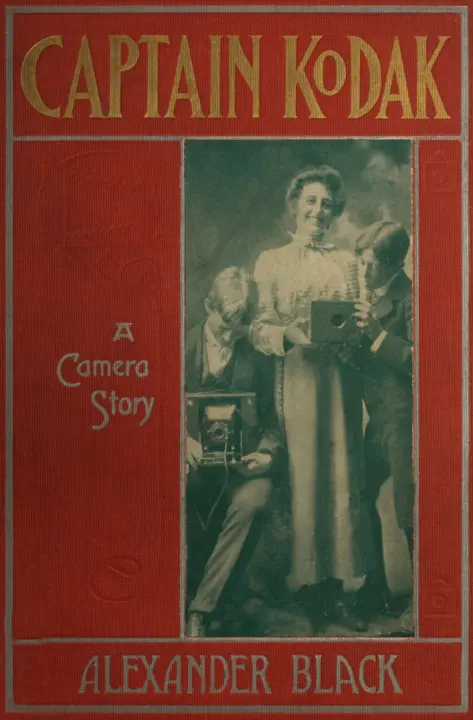
THE CLASSIC COLLECTION · 1899
"Captain Kodak: A Camera Story" by Alexander Black is a fictional narrative written in the late 19th century. The story revolves around an amateur photographer, Allan Hartel, and his adventures alongside his friends, particularly in relation to the excitement and challenges that come from their shared interest in photography. The plot begins with Allan receiving a camera, which ignites a series of events involving friendships, mishaps, and community interactions centered around photography. At the start of the narrative, readers are introduced to Allan and his friend McConnell amidst an amusing chaos after a circus elephant escapes and creates havoc in their town, Hazenfield. Allan expresses a desire to have documented the incident with a photograph, hinting at his budding passion for photography. Shortly afterward, he reveals to McConnell that he won a camera as a prize from a composition contest. This revelation sparks their enthusiasm for setting up a darkroom and experimenting with photography, leading them to a night filled with events surrounding a factory fire that they eagerly attempt to photograph. The opening sets the tone for a blend of adventure, friendship, and the exploratory nature of youth as they dive into the world of photography.
Introduction adapted from the source catalogue; source summaries may be automatically generated.
Free to read · English · 50,307 words · No account needed
MAKE TIME FOR A GOOD BOOK
On by default. Untick to stop anonymous reading totals. Each page counts after 10 seconds in view. How this works.
Anonymous counting is on unless you have switched it off.
The Doctor laughed quietly. “I see,” he said, “you administer the medicine and let nature do the rest. After all, that is the about the most any of us can do.”
“Now,” asked Allan, “do you want one of the plates?” He had been standing with the plate-holders in his hand.
“Yes,” Owen answered, “we’re all ready.”
They opened a holder and took out one of the plates. Owen placed the plate in one of the trays, poured his developing mixture over it, and began gently to rock the tray, the spectators crowding about him in a semicircle.
“Of course,” said Owen, “it may be a long time coming up.” Presently he added, “It may be very much under-exposed, you know.”
At the end of five minutes the plate remained obstinately free from any
sign of an image.
“I don’t see a thing,” said Edith.
“But, Edith!” expostulated Allan, “it sometimes takes a long while.”
“I think I have done the thing right,” murmured Owen, in perplexity. Then he suddenly turned to Allan. “Say, which one of the plates is this?”
Allan’s face took on a queer look in the red light. “I don’t know,” he answered blankly. It had not occurred to him before. “I know we didn’t double any.”
“I hope not,” Owen interposed anxiously.
“But I forgot to turn the holder-slides over to show which had been
exposed.”
“Well,” said Owen, “we’ll have to try them until we find the three exposed ones. You had the four holders in the box?”
“Yes,” asserted Allan, “eight plates.”
At the end of another five minutes, Owen said, “I’m sure this can’t be one of the exposed plates,” and, with a last flip of the developer, he took the plate out and placed it on the shelf over the sink.
“And can’t you use it again?” asked Edith, sympathetically.
Owen shook his head. “No. That one’s done for. Now,” he added, “let us try one of the others.”
“I’m sure this is one,” said Allan, repentantly. He felt as if he had made a bad blunder on his first photographic expedition. “I remember now which way I carried the holders,” and he handed Owen another plate.
The semicircle of faces drew about Owen’s shoulders again. It seemed a long while to wait, while Owen rocked the tray affectionately, as if it were a cradle, and Allan’s spirits had begun to fall, when McConnell cried, “There’s something!”
“It’s just a spot on the plate,” said Edith.
Your reading position is saved on this browser. Take it to another device with a library code. Reading pages adapt to text, rather than matching a printed edition.
Alexander Black
Alexander Black
BEHIND THE BOOK
This eBook is for the use of anyone anywhere in the United States and most other parts of the world at no cost and with almost no restrictions whatsoever. You may copy it, give it away or re-use it under the terms of the Project Gutenberg License included with this eBook or online at www.gutenberg.org. If you are not located in the United States, you will have to check the laws of the country where you are located before using this eBook. Read the source licence.
The original source file, including credits and licence, is retained by this library. Request an original-format copy at no charge. Please include the book title and Project Gutenberg identifier #70197.
KEEP YOUR CURIOSITY GOING
Coulson Kernahan

Maurice Baring
Frances Wright
Cécile Tormay

Frederic Jesup Stimson

W. H. P. (William Henry Pope) Jarvis