Nova Scotia
Beckles Willson
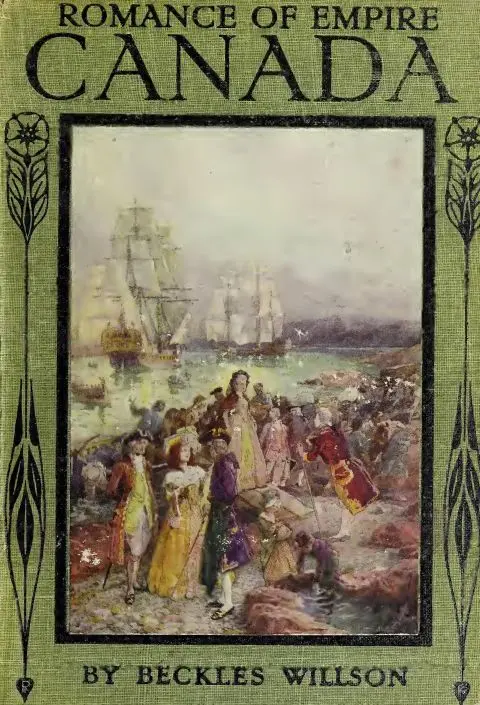
THE CLASSIC COLLECTION · 1907
"Canada" by Beckles Willson is a historical account written in the early 20th century. The work delves into the rich history and legends of Canada, portraying the valiant heroes and pivotal events that shaped the nation as a saga might be recounted around a tribal fire. It aims to make this history accessible and engaging, particularly for a younger audience, while also appealing to readers of all ages through its compelling narrative. The opening of the book introduces the context of Jacques Cartier's historic voyage in the early 16th century, marking the beginning of French exploration in New France. As Cartier sets sail from St. Malo in 1534 under the commission of King Francis of France, the text contrasts the royal festivities in England with Cartier's perilous journey across the Atlantic. The narrative vividly describes Cartier's encounters with the Indigenous peoples and the landscape of Canada, emphasizing the discoveries and challenges he faced, ultimately establishing the French flag in what is now Canadian territory and laying the groundwork for future expeditions.
Introduction adapted from the source catalogue; source summaries may be automatically generated.
Free to read · English · 79,094 words · No account needed
MAKE TIME FOR A GOOD BOOK
On by default. Untick to stop anonymous reading totals. Each page counts after 10 seconds in view. How this works.
Anonymous counting is on unless you have switched it off.
When the poor harassed "Black Robes" and their panic-stricken Indian charges finally rested under the sheltering walls of Quebec, Montmagny was no longer Governor. He had, after twelve years' service, gone back to France, and a new Governor had arrived in his stead. But the Indians still called the new Governor, and all the Governors who came afterwards, by the name of "Onontio." They were told that Montmagny in French signified "Great Mountain," Onontio in the Huron tongue, and supposed it was a title bestowed by the pale-faces on all their rulers in Canada.
Despite the unspeakable horrors, bloodshed, and martyrdom related in the last chapter, nothing of lasting value was accomplished by the hapless mission to the Hurons except a knowledge of the great Lake Superior, which an interpreter, named Jean Nicollet, had discovered a few years before.
Season now followed season, and each saw the French but little better than prisoners in their three towns on the St. Lawrence. If they ventured very far out of these fortified posts, it was only to give the Iroquois a chance to spring upon them and bear {77} back their scalps in triumph to their lodges in the wilderness. The French might have made a treaty of alliance with their English neighbours in New England, who had now set up a number of towns and were flourishing, although they too were at the mercy of the surrounding savages. But the French Governor made it a condition of the treaty that the New Englanders should help Canada to exterminate the terrible Iroquois. This the English colonists were loath to do; they had no wish to bring the Iroquois tomahawks down upon their heads also, as the French had done; and so the plan fell through. After a time one of the Iroquois tribes, having lost a great many of their fighting men in the long war, began to think of making recruits. The idea occurred to them that the unfortunate Hurons and Algonquins, who had joined their fortunes to the French, would be the very men for their purpose, if they could only induce them to desert the alliance. Forthwith they sent courtiers to announce to the Hurons that they no longer bore them any grudge and were willing to adopt them--to receive them into the bosom of their lodges. But it soon appeared that all the Iroquois were not unanimous in their approval of this plan, and as their treachery was well known, the Hurons and Algonquins, now settled on the Isle of Orleans near Quebec, naturally hesitated about accepting the offer. The few foolish ones who trusted in Iroquois good faith were actually tomahawked by their so-called friends on the way to the Iroquois lodges. In attempting to punish a band of Iroquois ambushed near his fort, Du Plessis Bochat, the Governor of {78} Three Rivers, lost his life; Father Buteaux was killed on his way to his mission, and another priest, Father Poucet, was borne away to a Mohawk village, and after being tortured was sent back to Quebec to offer peace to the French. Peace was indeed welcome, but the French were naturally still suspicious. The truth was that the Iroquois were then too busily engaged in destroying the Eries, a tribe which had burned one of their most illustrious chiefs, to spare time to massacre the pale-faces. As the chief, a Seneca, had stood with unquivering nerve at the stake he had cried out, "Eries, you burn in me an entire nation!" for he knew the Senecas would avenge his death. Much, then, as the Governor, De Lauzon, wanted peace, neither he nor his Indian allies knew how far they could trust the Iroquois. It was at last decided that if the Onondagas, one of the five Iroquois nations, would receive a Jesuit mission, a body of Hurons should be sent under escort to be adopted into their tribe. From the Onondagas there came a message to say they would agree to this, and in June 1656 the expedition set out from Quebec. It consisted of a large body of Hurons, as well as Onondagas, fifty French soldiers, led by the brave captain, Dupuy, and two priests, Dablon and Chaumonot. Scarcely was the party well under way, when a band of Mohawks fell upon them, and before they pretended to discover that they were attacking members of their own confederacy, they had killed and wounded a number of Onondagas. Profuse excuses and apologies followed, the Mohawks explaining that they took them, the Onondagas, for Hurons. {79} The expedition was suffered to proceed. The truth is, the Mohawks were jealous of the Onondagas in obtaining an alliance with the French and Hurons. To show their power and their contempt of the pale-faces, they continued their journey eastward to the Isle of Orleans, and under the very guns of the fort of Quebec surprised the defenceless Hurons who dwelt there, and fiercely murdered or captured all they came upon, even the women and children. In broad daylight they paddled their fleet of bark canoes in front of Quebec, laughing and yelling defiance to the French, and making their unhappy captives join in dancing and songs of triumph. The Governor this time was a weak man, and all he could do was to wring his hands and regret bitterly that he had ever sent any mission to the Onondagas. He began to fear for their safety.
Your reading position is saved on this browser. Take it to another device with a library code. Reading pages adapt to text, rather than matching a printed edition.
Beckles Willson
Beckles Willson
BEHIND THE BOOK
This eBook is for the use of anyone anywhere in the United States and most other parts of the world at no cost and with almost no restrictions whatsoever. You may copy it, give it away or re-use it under the terms of the Project Gutenberg License included with this eBook or online at www.gutenberg.org. If you are not located in the United States, you will have to check the laws of the country where you are located before using this eBook. Read the source licence.
The original source file, including credits and licence, is retained by this library. Request an original-format copy at no charge. Please include the book title and Project Gutenberg identifier #62154.
KEEP YOUR CURIOSITY GOING
Cécile Tormay

Moritz Busch
John L. Ransom

Maurice Baring
Frances Wright
Cécile Tormay