Nova Scotia
Beckles Willson
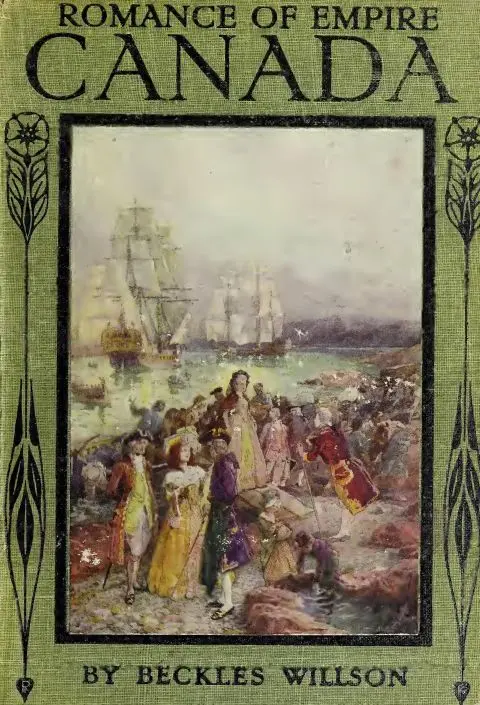
THE CLASSIC COLLECTION · 1907
"Canada" by Beckles Willson is a historical account written in the early 20th century. The work delves into the rich history and legends of Canada, portraying the valiant heroes and pivotal events that shaped the nation as a saga might be recounted around a tribal fire. It aims to make this history accessible and engaging, particularly for a younger audience, while also appealing to readers of all ages through its compelling narrative. The opening of the book introduces the context of Jacques Cartier's historic voyage in the early 16th century, marking the beginning of French exploration in New France. As Cartier sets sail from St. Malo in 1534 under the commission of King Francis of France, the text contrasts the royal festivities in England with Cartier's perilous journey across the Atlantic. The narrative vividly describes Cartier's encounters with the Indigenous peoples and the landscape of Canada, emphasizing the discoveries and challenges he faced, ultimately establishing the French flag in what is now Canadian territory and laying the groundwork for future expeditions.
Introduction adapted from the source catalogue; source summaries may be automatically generated.
Free to read · English · 79,094 words · No account needed
MAKE TIME FOR A GOOD BOOK
On by default. Untick to stop anonymous reading totals. Each page counts after 10 seconds in view. How this works.
Anonymous counting is on unless you have switched it off.
Not wholly unfounded were the Governor's alarms. At first all went smoothly enough with the little band of Frenchmen in the heart of the Onondaga country. This particular tribe of the Iroquois appeared delighted at the coming of the French. But quickly signs of danger began to multiply. The pale-face soldiers grew aware that a plot was on foot to murder them in the little fort they had built, close to where the present prosperous city of Syracuse now stands. Dupuy, being an able and courageous man, resolved by some means or another to foil the savages and escape back to Canada. This is the stratagem he hit upon; it was the custom of these Indians to hold mystic feasts, at which it was a point of honour to eat everything that was set before them {80} by their hosts. If a man failed to eat the whole of a dish--even to the fifth helping--it was taken by the host as a personal insult. Dupuy planned such a feast, and arranged to stuff them so plentifully that not a single brave would be capable of rising from the banquet. The plan worked perfectly, the Indians not observing that the French concealed most of their food instead of eating it, so that by midnight the gorged and drunken Onondagas were sunk in a gluttonous sleep. Dupuy had taken good care beforehand to build secretly within his fort a number of large, light, flat-bottomed skiffs, and now when dawn came the Frenchmen stole away, carrying these with them to the Oswego River, reaching Quebec at last, in spite of ice and rapids, with the loss of only three men, who were drowned. The Indians pursued, but their birch-bark canoes were useless on the icy stream, and they had to give up the chase.
The escape from the Onondagas was a very clever and daring deed, and shows the material the colonists of New France were made of in those days. A deed still more daring and important was to follow. The Iroquois threw off the mask and determined to deal the French in Canada a deadly blow. A mighty force of the Five Nations was organised, to meet at the junction of the Ottawa and St. Lawrence rivers, and swoop down first upon Montreal and then upon the other settlements. It so happened that there lived in Ville Marie at this time a young nobleman, Daulac des Ormeaux, who chose to be known to the other colonists as Adam Dollard. Having left France in order to escape the consequences of {81} some rash act, he burned for some chance to retrieve the honour of his name. The valiant youth now saw with joy the long-looked-for opportunity arrive at his door, and he obeyed the summons. From the Governor did Dollard obtain leave to lead a party of volunteers against the savage foe. Gathering sixteen gallant fellows about him, all swore a solemn oath to give or take no quarter, but by sheer force of their arms break the force of the blow which was about to descend on their beloved town. A mad enterprise truly did it seem, but for sheer valour nothing finer has been known since fearless Leonidas and his handful of Greeks held the pass at Thermopylae. The seventeen heroes, together kneeling, took the Sacrament at the hands of the pale priest, and set forth for the Long Sault (or Rapids) of the Ottawa. There in the dense woods they found a disused old Indian stockade by which the invading host had to pass. Entrenching themselves as well as they could, they waited. A few friendly Hurons and Algonquins joined them, wondering at the hardihood of the pale-face warriors, and shamed into lending them a helping hand. The storm broke. A horde of 700 screaming savages, picked men of the Iroquois, flung themselves upon them. Easy work it seemed to crush out this feeble band. To their astonishment, Dollard and his men beat them back. Again and again they came on, and again and again were they repulsed. By this time, appalled at the fearful odds against them, the friendly Indians had fled from the side of the besieged, all but one Huron chief, Annahotaha, and four Algonquins. These stood firm. {82} Every loophole in the stockade darted its tongue of fire; so faultless was the aim that nearly every time a musket rang out an Iroquois fell dead. Fortunately Dollard had brought plenty of ammunition. Some musketoons of large calibre, from whose throats scraps of lead and iron belched forth, slew and wounded several of the enemy at a single discharge. Thus three days wore away and still the terrible struggle came to no end. In the intervals, by day and night, Dollard and his men offered up prayers to Heaven on their knees in the melting snow. Their food was now gone, and, worse still, they had no water. No hope now remained save to keep the Iroquois a few hours longer at bay; they were certain only of a martyr's reward. On the part of the besiegers so many men had they lost that they sickened of the fight, and some amongst them even counselled going home. But other chiefs shrank from such a disgrace.
Your reading position is saved on this browser. Take it to another device with a library code. Reading pages adapt to text, rather than matching a printed edition.
Beckles Willson
Beckles Willson
BEHIND THE BOOK
This eBook is for the use of anyone anywhere in the United States and most other parts of the world at no cost and with almost no restrictions whatsoever. You may copy it, give it away or re-use it under the terms of the Project Gutenberg License included with this eBook or online at www.gutenberg.org. If you are not located in the United States, you will have to check the laws of the country where you are located before using this eBook. Read the source licence.
The original source file, including credits and licence, is retained by this library. Request an original-format copy at no charge. Please include the book title and Project Gutenberg identifier #62154.
KEEP YOUR CURIOSITY GOING
Cécile Tormay

Moritz Busch
John L. Ransom

Maurice Baring
Frances Wright
Cécile Tormay