Nova Scotia
Beckles Willson
THE CLASSIC COLLECTION · 1907
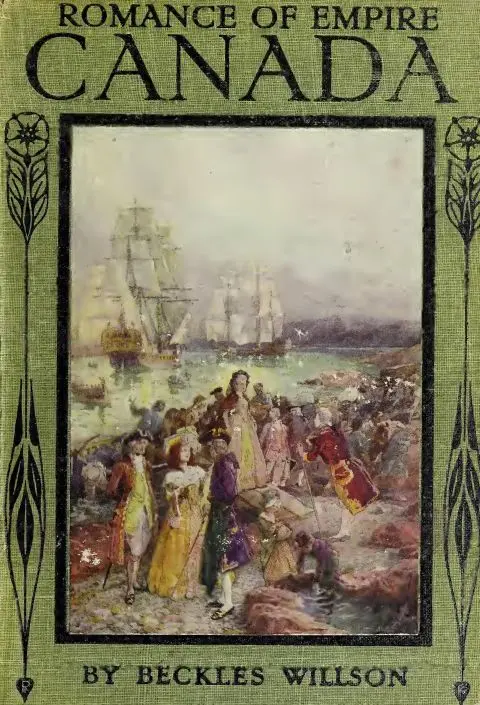
"Canada" by Beckles Willson is a historical account written in the early 20th century. The work delves into the rich history and legends of Canada, portraying the valiant heroes and pivotal events that shaped the nation as a saga might be recounted around a tribal fire. It aims to make this history accessible and engaging, particularly for a younger audience, while also appealing to readers of all ages through its compelling narrative. The opening of the book introduces the context of Jacques Cartier's historic voyage in the early 16th century, marking the beginning of French exploration in New France. As Cartier sets sail from St. Malo in 1534 under the commission of King Francis of France, the text contrasts the royal festivities in England with Cartier's perilous journey across the Atlantic. The narrative vividly describes Cartier's encounters with the Indigenous peoples and the landscape of Canada, emphasizing the discoveries and challenges he faced, ultimately establishing the French flag in what is now Canadian territory and laying the groundwork for future expeditions.
Introduction adapted from the source catalogue; source summaries may be automatically generated.
Free to read · English · 79,094 words · No account needed
MAKE TIME FOR A GOOD BOOK
On by default. Untick to stop anonymous reading totals. Each page counts after 10 seconds in view. How this works.
Anonymous counting is on unless you have switched it off.
When the Sieur de Monts abandoned Acadia, thinking, as indeed it seemed, an evil spell had been cast upon it, he turned his attention to Quebec and the river St. Lawrence. Here, far inland, was a fair region which promised wealth and glory, and over this region he appointed Champlain his lieutenant. Of the two ships which De Monts fitted out one was for the fur trade, of which King Henry, ere his heart was pierced by the dagger of Ravaillac, gave him a monopoly for one year; the other was to carry colonists to found a new French settlement. You have seen how one after another the French colonies had, from this cause or that, come to destruction; but with such a wise and strong head as Samuel de Champlain, one now was expected to bear better and more lasting fruit. Truly, whatever their faults, the founders of New France were very determined men, arising fresh after each disaster, resolved to people with their countrymen the great Western wilderness. When Champlain's ships, once safely through the Straits of Belle Isle, reached Tadoussac, Champlain left there his associate Pontgravé to barter for furs with the {30} Indians. He himself continued his voyage up the river until he came to the spot where Jacques Cartier had passed the winter of 1535, and with his men consumed a whole spruce-tree in order to drive away the scurvy.
It was at Quebec (a word meaning in the Indian language a strait) that on the third day of July 1607 Champlain gave orders to disembark. In the shadow of the towering rock of Cape Diamond, the first thing to be done was to clear a site and erect cabins for shelter. As his men toiled on unceasingly the natives gathered round in wonder and admiration. They were unaccustomed to much manual work themselves, their squaws doing most of the labour. They saw in a few short weeks the bastions of a fort and cannon set up. Scarcely had the workmen completed their task and got all snug and tidy for the winter than a plot was formed amongst some of Champlain's followers to kill him. The leader of the plot was a Norman locksmith, Jean Duval, a brave and violent fellow who had served with Champlain in Acadia, and was impatient under any kind of authority. According to the plan the conspirators drew up, their leader was to be shot, the stores pillaged, and then they were all to fly to Spain with the booty. Lucky it was for the great and good pioneer that one of the plotters, filled with remorse, went to Champlain a few days before the mutiny was to be carried out and confessed all. Champlain with great promptitude seized Duval and hanged him to the nearest tree, but the rest he only sent back to France, where the good King, at his {31} request, pardoned them. Meanwhile Pontgravé had collected and sailed away with his cargo of furs. Spring came; the snows melted and were replaced by green meadows and blossoming trees; everywhere the birds sang. Champlain, without waiting for Pontgravé's return, set off up the river and soon met again friendly Indian chiefs of the Algonquin and Huron tribes, who told him terrible tales of their sufferings at the hands of their enemies the Iroquois or the Five Nations. In their despair these chiefs sought out the Man-with-the-Iron-Breast, as they called Champlain, on account of the steel breast-plate he wore, and asked his help against the blood-thirsty Iroquois. These men of the Five Nations, Mohawks, Senecas, Cayugas, Onondagas, and Oneidas, lived in the forests south of Lake Ontario, and were perhaps at once the most intelligent and the most cruel of all the Indians on the continent. It was the Iroquois who had destroyed the old Huron towns of Stadacona and Hochelaga which Cartier had seen and described, and as they bore the Hurons and Algonquins an implacable enmity, it was natural that they would extend this enmity to the pale-faces who had now come to dwell in the Huron country. They might, it is true, have been propitiated; but Champlain did not stop to consider any questions of policy: he favoured at once the idea of alliance with the surrounding red-men, an alliance which was to cost him and his new colony a bloody and fearful price. Champlain, then, made three warlike expeditions into the country of the Iroquois during the next six years. In the first he paddled in canoes {32} up the Richelieu River and came to a beautiful lake, to which he gave his own name ("Lake Champlain"). Meeting a party of Iroquois of the Mohawk nation or tribe, he fell upon them suddenly. The Mohawks fancied at first that they had only to do with Algonquins, and felt confident of victory, until the Frenchmen's muskets rang out; then not fast enough could they flee in panic from the magic bullets, leaving many slain, including their bravest chiefs. Champlain had only 60 Frenchmen and Indians, while the Mohawks numbered 200; but his victory was complete; not one of his force was killed, and the town of the enemy was wiped from the face of the earth. Notwithstanding Champlain's protests, the Algonquins insisted on torturing one of their Iroquois captives to death by every device of savage cruelty. Mercy was not in their code; they neither gave it, nor, when captured, expected it.
Your reading position is saved on this browser. Take it to another device with a library code. Reading pages adapt to text, rather than matching a printed edition.
Beckles Willson
Beckles Willson
BEHIND THE BOOK
This eBook is for the use of anyone anywhere in the United States and most other parts of the world at no cost and with almost no restrictions whatsoever. You may copy it, give it away or re-use it under the terms of the Project Gutenberg License included with this eBook or online at www.gutenberg.org. If you are not located in the United States, you will have to check the laws of the country where you are located before using this eBook. Read the source licence.
The original source file, including credits and licence, is retained by this library. Request an original-format copy at no charge. Please include the book title and Project Gutenberg identifier #62154.
KEEP YOUR CURIOSITY GOING
Cécile Tormay

Moritz Busch
John L. Ransom

Maurice Baring
Frances Wright
Cécile Tormay