Nova Scotia
Beckles Willson
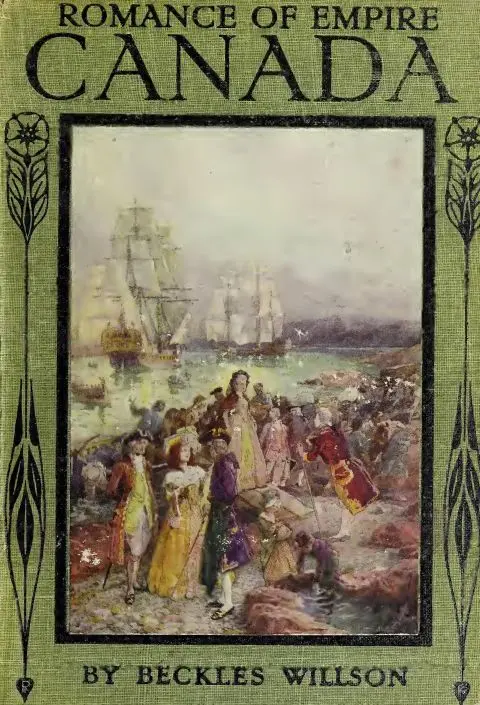
THE CLASSIC COLLECTION · 1907
"Canada" by Beckles Willson is a historical account written in the early 20th century. The work delves into the rich history and legends of Canada, portraying the valiant heroes and pivotal events that shaped the nation as a saga might be recounted around a tribal fire. It aims to make this history accessible and engaging, particularly for a younger audience, while also appealing to readers of all ages through its compelling narrative. The opening of the book introduces the context of Jacques Cartier's historic voyage in the early 16th century, marking the beginning of French exploration in New France. As Cartier sets sail from St. Malo in 1534 under the commission of King Francis of France, the text contrasts the royal festivities in England with Cartier's perilous journey across the Atlantic. The narrative vividly describes Cartier's encounters with the Indigenous peoples and the landscape of Canada, emphasizing the discoveries and challenges he faced, ultimately establishing the French flag in what is now Canadian territory and laying the groundwork for future expeditions.
Introduction adapted from the source catalogue; source summaries may be automatically generated.
Free to read · English · 79,094 words · No account needed
MAKE TIME FOR A GOOD BOOK
On by default. Untick to stop anonymous reading totals. Each page counts after 10 seconds in view. How this works.
Anonymous counting is on unless you have switched it off.
During the next three years Champlain was kept very busy in explorations, in attacking the Iroquois, and in protecting his colony. During this time he returned to France, and was favourably received at Fontainebleau by King Henry, who listened with interest to Champlain's tale of his adventures in "New France." But in spite of royal favour, Champlain had so many rivals and enemies that, like Poutraincourt in Acadia, he found it impossible to get the charter renewed, and so his friend and patron, De Monts, was obliged to try and get along without it. Equipping two more ships, he sent Champlain back with them to Canada.
The great ambition of Champlain's soul was to {33} find a passage through the continent to China. At last it seemed to him that the friendliness of the Hurons and Algonquins would furnish him with the means of attaining this desire. He had just made arrangements with the chiefs, when the news came to him of King Henry's assassination, and he felt it was necessary for him to return without delay again to France. De Monts, his patron, still enjoyed the title of Lieutenant-General of New France, but his resources and influence had been sadly crippled by the King's death, and the cost of keeping up Quebec, Tadoussac, and Acadia was very great. He had no longer the monopoly, that is to say, the sole right of buying and selling Canadian furs--it was a right thrown open to other traders; and when Champlain on his next voyage back from France once more sailed up the St. Lawrence, he found many strange fur-traders trafficking with the savages.
The leader had now more to do and think about than ever; he wished, moreover, to prepare a fitting home for a fair and youthful partner who was ever in his thoughts. During his absence in Paris he had espoused a charming Huguenot girl named Helen Bouillé, daughter of the murdered King's private secretary. Her name survives to-day in "Helen's Island" in the river opposite Montreal. So many traders did Champlain find in the vicinity of this island, that he built a fort there and resolved to turn the site of Hochelaga into a trading station. Two uneventful years passed by, and then, in the very year Argall was destroying hapless Port Royal (1613), Champlain's imagination was kindled by the {34} astonishing tale of a certain Nicholas Vignau. This adventurer had passed a winter amongst the red-men of the upper Ottawa River. Vignau told his chief that, in company with some Algonquins, he had once arrived at a remote sea-shore, where his eyes had beheld the fragments of a wrecked English ship. Champlain's heart bounded with joy; he thought his hopes were now about to be realised. Taking Vignau, two white followers, and an Indian guide, the explorer passed the dangerous rapids of the Ottawa and made the acquaintance, one after another, of its lakes, cataracts, and islands. He pressed on, passed the Rideau (Curtain) Falls, so named because of the resemblance of this sheet of water to a great white curtain. He and his awe-struck companions stared at the raging, foaming cauldron of the Chaudière, close to where the city of Ottawa, capital of the Canadian Dominion, now stands, while the Indians cast into the waters gifts of tobacco and other things to propitiate the angry god of the waters. At last the party reached Allumette Island. Here dwelt a friendly Algonquin chief named Tessouat, who received the Frenchmen hospitably and invited them to a banquet. Tessouat knew Vignau; he knew also how he had passed his time amongst the men of his tribe. So when Champlain related at the feast what Vignau had told him of his journey to the sea-shore, Tessouat bluntly told his guest that Vignau, though a pale-face, was a liar, and that he had never been on such a journey. For a while the shock of this discovery overwhelmed Champlain with rage and sorrow. {35} Tessouat was so indignant at the way the French leader had been deceived, that he wanted Vignau to be put to death, but Champlain was of too noble and forgiving a nature for that, and contented himself with rebuking the offender. At the same time, although Vignau confessed his falsehood, we are able to see to-day a certain foundation for his story which was obscured from Canada's founder. We happen to know now what Champlain centuries ago did not dream of: that only three hundred miles separate Allumette Island from the southern end of the great inland sea, Hudson's Bay. This body of water two or three brief seasons before had been discovered by an Englishman, who, like Champlain, had tried to find a short route to China and the East Indies.
Your reading position is saved on this browser. Take it to another device with a library code. Reading pages adapt to text, rather than matching a printed edition.
Beckles Willson
Beckles Willson
BEHIND THE BOOK
This eBook is for the use of anyone anywhere in the United States and most other parts of the world at no cost and with almost no restrictions whatsoever. You may copy it, give it away or re-use it under the terms of the Project Gutenberg License included with this eBook or online at www.gutenberg.org. If you are not located in the United States, you will have to check the laws of the country where you are located before using this eBook. Read the source licence.
The original source file, including credits and licence, is retained by this library. Request an original-format copy at no charge. Please include the book title and Project Gutenberg identifier #62154.
KEEP YOUR CURIOSITY GOING
Cécile Tormay

Moritz Busch
John L. Ransom

Maurice Baring
Frances Wright
Cécile Tormay