
Last letters from the living dead man
David Patterson (Spirit) Hatch
THE CLASSIC COLLECTION · 1890
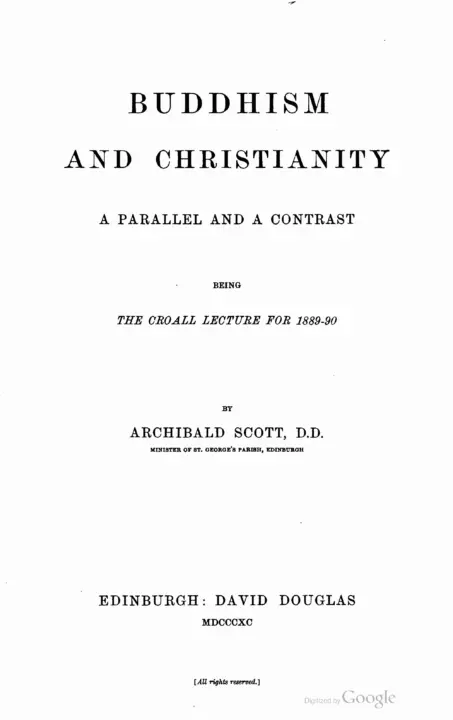
"Buddhism and Christianity: A Parallel and a Contrast" by Archibald Scott is a scholarly examination of the similarities and differences between Buddhism and Christianity, written in the late 19th century. This work presents a series of lectures, focusing on a comparative analysis of the two religions, to illuminate their unique features as well as their shared elements. Scott aims to foster a deeper understanding of both faiths, suggesting that studying these religions can enhance Christian appreciation for its own beliefs. The opening of the text provides a preface where Scott acknowledges the complexity of both religions and expresses a commitment to presenting Buddhism fairly, despite its historical misrepresentations. He highlights the significance of Buddhism as a major world religion that offers insights into human life and ethics. Scott also stresses the importance of comparative theology in strengthening Christianity rather than undermining it, encouraging an impartial study to discern universal truths that resonate within both traditions. He outlines the necessity to explore the distinct origins and developments of each faith while establishing a framework for a fruitful dialogue between the two.
Introduction adapted from the source catalogue; source summaries may be automatically generated.
Free to read · English · 95,734 words · No account needed
MAKE TIME FOR A GOOD BOOK
On by default. Untick to stop anonymous reading totals. Each page counts after 10 seconds in view. How this works.
Anonymous counting is on unless you have switched it off.
Vie de Jésus, p. 98, 4th ed.; Paris, 1863.
Footnote 27:
The Buddhists, as Professor Kuenen remarks, do not believe in angels, and they have no Messiah. Tathagata, which Mr. de Bunsen translates “The Coming One,” i.e. Messiah, means “One who has gone” or “has arrived at” (Nirvana), like his predecessors. So Oldenberg, Rhys Davids, Bigandet, Edkins, Rajendralal Mitra: see too Dr. Kellogg, Light of Asia and the Light of the World, pp. 106, 107.
Footnote 28:
See for these and other curious instances his article on “The Obligations of the New Testament to Buddhism,” Nineteenth Century, Dec. 1880.
Footnote 29:
Natural and Universal Religions, Hibbert Lectures, 1882.
Footnote 30:
Strom. i. 15; Porphyry, de Abstin. iv. 17.
Footnote 31:
Schwanbeck, Megasthenes Indica, p. 20; Lassen, Ind. Alterthumskunde, 209; H. H. Wilson, Essays, ii. p. 314 seq.; Reinaud, Relations Politiques et Commerciales de l’Empire Romain avec l’Asie Central, Paris, 1863; Priaulx, Travels of Apollonius and the Indian Embassies to Rome, Paris, 1873.
Footnote 32:
The question of the disciples in John ix. 2, concerning the man who was born blind, “Who did sin, this man or his parents, that he was born blind?” is alleged by Professor Seydel (Das Evangelium von Jesu in seinen Verhältnissen zu Buddha-Sage und Buddha-Lehre) to indicate an idea introduced into the Gospel from a foreign source, as the doctrine of the pre-existence of souls was then unknown among the Jews. Meyer in his critical and exegetical Handbook to St. John’s Gospel has shown that no one required to go outside the sphere of Jewish thought for an explanation of this part of the disciples’ question. In addition to his quotations from the Rabbinical books illustrating this Jewish belief, Kuenen in his brief criticism of Seydel adduces another from the Wisdom of Solomon viii. 20, as also rendering the Buddhist derivation of this “thought quite superfluous” (Hibbert Lectures, 1882, Appendix). Many instances of agreement in thought and phraseology with the Gospels in passages in Buddhist works are adduced by Dr. Kellogg, Light of Asia, etc., p. 137 seq., and are satisfactorily accounted for by the similarity of circumstances under which Buddha and the Saviour taught and the condition of men which they both perceived and described.
Footnote 33:
Lucius, Die Therapeuten und ihre Stellung in der Geschichte der Askese, Strassburg, 1880; also Der Essenismus in seinem Verhältniss zum Judenthum, Strassburg, 1881.
Footnote 34:
Dissertation in Commentary on Colossians, pp. 119, 157.
Footnote 35:
Jewish Wars, ii. 8. 2-13; Antiq. xiii. 5. 9; xv. 10. 4, 5; xviii.
1. 2-6.
Footnote 36:
Edersheim, Life and Times of Jesus the Messiah, vol. i. p. 325.
Footnote 37:
Hibbert Lectures, 1882, p. 203.
Footnote 38:
Oldenberg, Buddha, sein Leben, seine Lehre, seine Gemeinde, translated by W. Hoey, 1882, p. 6; Williams and Norgate.
Footnote 39:
Dr. Joseph Edkins, Chinese Buddhism, pp. 250, 343; Trübner, 1880.
Footnote 40:
Fergusson, Tree and Serpent Worship, Introduction, p. 77.
Footnote 41:
Your reading position is saved on this browser. Take it to another device with a library code. Reading pages adapt to text, rather than matching a printed edition.
BEHIND THE BOOK
This eBook is for the use of anyone anywhere in the United States and most other parts of the world at no cost and with almost no restrictions whatsoever. You may copy it, give it away or re-use it under the terms of the Project Gutenberg License included with this eBook or online at www.gutenberg.org. If you are not located in the United States, you will have to check the laws of the country where you are located before using this eBook. Read the source licence.
The original source file, including credits and licence, is retained by this library. Request an original-format copy at no charge. Please include the book title and Project Gutenberg identifier #67171.
KEEP YOUR CURIOSITY GOING
David Patterson (Spirit) Hatch

David Patterson (Spirit) Hatch

David Patterson (Spirit) Hatch

Edwin Abbott Abbott

Richard Watson
T. G. (Theophilus Gould) Steward