
Last letters from the living dead man
David Patterson (Spirit) Hatch
THE CLASSIC COLLECTION · 1890
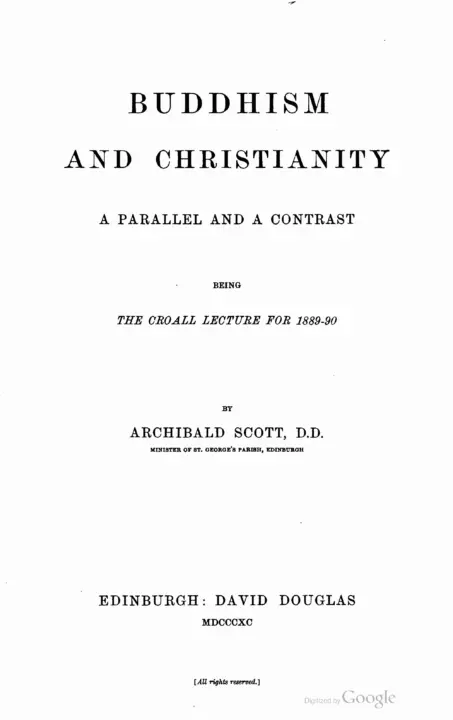
"Buddhism and Christianity: A Parallel and a Contrast" by Archibald Scott is a scholarly examination of the similarities and differences between Buddhism and Christianity, written in the late 19th century. This work presents a series of lectures, focusing on a comparative analysis of the two religions, to illuminate their unique features as well as their shared elements. Scott aims to foster a deeper understanding of both faiths, suggesting that studying these religions can enhance Christian appreciation for its own beliefs. The opening of the text provides a preface where Scott acknowledges the complexity of both religions and expresses a commitment to presenting Buddhism fairly, despite its historical misrepresentations. He highlights the significance of Buddhism as a major world religion that offers insights into human life and ethics. Scott also stresses the importance of comparative theology in strengthening Christianity rather than undermining it, encouraging an impartial study to discern universal truths that resonate within both traditions. He outlines the necessity to explore the distinct origins and developments of each faith while establishing a framework for a fruitful dialogue between the two.
Introduction adapted from the source catalogue; source summaries may be automatically generated.
Free to read · English · 95,734 words · No account needed
MAKE TIME FOR A GOOD BOOK
On by default. Untick to stop anonymous reading totals. Each page counts after 10 seconds in view. How this works.
Anonymous counting is on unless you have switched it off.
This must be read in the light of Professor Max Müller’s What can
India teach us?
Footnote 42:
Luke viii. 46.
Footnote 43:
Even Kuenen and Wellhausen assume as established that Monotheism shows itself with unmistakable distinctness in Hebrew prophecies of the eighth century B.C. (Hibbert Lectures, 1882, p. 119; Theological Review, 1874, pp. 329, 336; Encyc. Brit., art. ISRAEL). Professor H. Schultz maintains that Monotheism was established in Israel from the time of Moses downward, among the leaders of thought at least. (Alttest. Theolog., 2d ed., 1878, pp. 440, 457.)
Footnote 44:
Light of Asia and Light of the World, pp. 40, 102, 161.
Footnote 45:
Weber, Indische Studien, vol. i. p. 400; J. Muir, Sanskrit Texts, p. xxxiv; Lorinser, Bhagavadgitâ, Appendix, translated by Muir in Ind. Antiq. vol. ii. p. 283.
Footnote 46:
Buddha, sein Leben, seine Lehre, seine Gemeinde, translated by Wm.
Hoey, 1882, p. 292.
Footnote 47:
Müller, Gifford Lectures, Natural Religion, p. 169.
Footnote 48:
Dr. Caird, Introduction to the Philosophy of Religion, p. 343 seq.
Footnote 49:
Sir A. Mitchell, Rhind Lectures for 1876 and 1878, The Past in the Present, pp. 207, 214; Edinburgh, Douglas, 1880.
Footnote 50:
Whately, Political Economy, p. 68.
Footnote 51:
Max Müller, Gifford Lectures, Natural Religion, p. 54.
Footnote 52:
The savagery of a great city is in some aspects more awful than that
of Africa.
Footnote 53:
T. W. Rhys Davids, Hibbert Lectures, p. 10.
Footnote 54:
Tylor, Primitive Culture, vol. i. p. 380.
Footnote 55:
Müller, Introduction to the Science of Religion, p. 41; Chips from a German Workshop, vol. ii. p. 254.
Footnote 56:
Fairbairn, Studies in Religion and Philosophy, p. 13.
Footnote 57:
Baring Gould, Origin and Development of Religious Belief, vol. i. p.
109.
Footnote 58:
“Nations,” says Professor Goldwin Smith, “redeem each other. They preserve for each other principles, truths, and hopes, and aspirations which, committed to the keeping of one, might become extinct for ever. They thus not only raise each other again when fallen, but they prevent each other from falling.”—Lectures on the Study of History, delivered in Oxford 1859-61, p. 71.
Footnote 59:
Celsus, quoting our Lord’s saying, Matt. xix. 24, and the exhortation to forgive our enemies, Matt. v. 43, 45, alleged they were transferred and coarsely perverted from Plato, de Legibus, and Crito.—Origen, contra Celsum, Book vi. chaps. 15, 16, and Book vii. chap. 61.
Footnote 60:
Enarr. in Psalm. cxl. 6. Clement of Alexandria regarded Greek philosophy as a προπαιδεία or preparatory discipline for the reception of Christian truth, Strom. vi. chap. 8, and as a step to something higher, ὑποβάθραν οὖσαν τῆς κατὰ Χριστὸν φιλοσοφίας, Strom. vi. chap. 17.
Footnote 61:
Trench, Hulsean Lectures for 1846, p. 153.
LECTURE II.
THE HISTORICAL ANTECEDENTS OF BUDDHISM AND CHRISTIANITY, AND THE
EVIDENTIAL VALUE OF THEIR RESPECTIVE SCRIPTURES.
Your reading position is saved on this browser. Take it to another device with a library code. Reading pages adapt to text, rather than matching a printed edition.
BEHIND THE BOOK
This eBook is for the use of anyone anywhere in the United States and most other parts of the world at no cost and with almost no restrictions whatsoever. You may copy it, give it away or re-use it under the terms of the Project Gutenberg License included with this eBook or online at www.gutenberg.org. If you are not located in the United States, you will have to check the laws of the country where you are located before using this eBook. Read the source licence.
The original source file, including credits and licence, is retained by this library. Request an original-format copy at no charge. Please include the book title and Project Gutenberg identifier #67171.
KEEP YOUR CURIOSITY GOING
David Patterson (Spirit) Hatch

David Patterson (Spirit) Hatch

David Patterson (Spirit) Hatch

Edwin Abbott Abbott

Richard Watson
T. G. (Theophilus Gould) Steward