
Last letters from the living dead man
David Patterson (Spirit) Hatch
THE CLASSIC COLLECTION · 1890
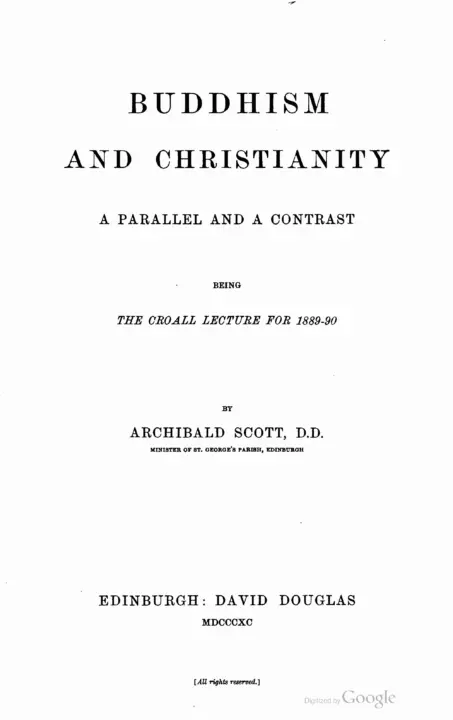
"Buddhism and Christianity: A Parallel and a Contrast" by Archibald Scott is a scholarly examination of the similarities and differences between Buddhism and Christianity, written in the late 19th century. This work presents a series of lectures, focusing on a comparative analysis of the two religions, to illuminate their unique features as well as their shared elements. Scott aims to foster a deeper understanding of both faiths, suggesting that studying these religions can enhance Christian appreciation for its own beliefs. The opening of the text provides a preface where Scott acknowledges the complexity of both religions and expresses a commitment to presenting Buddhism fairly, despite its historical misrepresentations. He highlights the significance of Buddhism as a major world religion that offers insights into human life and ethics. Scott also stresses the importance of comparative theology in strengthening Christianity rather than undermining it, encouraging an impartial study to discern universal truths that resonate within both traditions. He outlines the necessity to explore the distinct origins and developments of each faith while establishing a framework for a fruitful dialogue between the two.
Introduction adapted from the source catalogue; source summaries may be automatically generated.
Free to read · English · 95,734 words · No account needed
MAKE TIME FOR A GOOD BOOK
On by default. Untick to stop anonymous reading totals. Each page counts after 10 seconds in view. How this works.
Anonymous counting is on unless you have switched it off.
T. W. Rhys Davids estimates the number at five hundred millions (Handbook of Buddhism, p. 6). The previous general estimate was about four hundred millions; but Dr. A. J. Happer, missionary at Canton for forty-five years, reduces this number to seventy-three millions. Sir Monier Williams, in his recent book on Buddhism, quoting Professor Legge’s introduction to Travels of Fa-Hian, calculates the number at one hundred millions, and claims for Christianity, with its four hundred and thirty millions of adherents, the numerical preponderance over all others.
Footnote 9:
T. W. Rhys Davids, Buddhism, pp. 4, 7; Sir Monier Williams,
Buddhism, p. 171.
Footnote 10:
Dr. Caird, Introduction to the Philosophy of Religion, Croall Lectures, 1878-9, pp. 82 seq.; T. W. Rhys Davids, Hibbert Lectures, 1881, On the Origin and Growth of Religion as illustrated by Buddhism, p. 7.
Footnote 11:
To draw proper inferences from statistics of the spread and supremacy of a religion, we must first investigate the circumstances in which it was propagated, and the intellectual and moral conditions of the peoples whom it has converted. If it has gained only the belief of one section of the human race, it is evidently not entitled to rank with another which proves itself influential among all sections. A religion dominant only over inferior races is manifestly of less value than another which, while satisfying the wants of the lowest and most degraded peoples, is yet fulfilling the spiritual aspirations of the highest. The first, if in any way related to the second, can only be so as preparatory and prophetic of the mission which the second alone can accomplish.
Footnote 12:
Sacred Books of the East, vol. i. Introd.
Footnote 13:
Köppen, Die Religion des Buddha, s. 231; J. Barthelemy Saint-Hilaire, Le Bouddha, etc., pp. 78, 144, 181; Spence Hardy, Manual of Buddhism, p. 358.
Footnote 14:
Sir Monier Williams, Buddhism, p. xv, Introd.
Footnote 15:
Alabaster, Modern Buddhist; in the Wheel of the Law, p. 73; Trübner
and Co., 1871.
Footnote 16:
5th April 1885. In the Madras Times for October 29, 1886, a meeting of the Society for the Propagation of True Religion is advertised, for reading and exposition of the Bhagavad-Gita.
Footnote 17:
The Light of Asia; The Occult World; Esoteric Buddhism; Theosophy of Archaic Religions.
Footnote 18:
Parerga, 3d ed. i. 59.
Footnote 19:
Westminster Review, New Series, vol. xlviii. p. 469.
Footnote 20:
Gerald Massey, Light, 16th June 1883.
Footnote 21:
Among these are reckoned Adam, Fohi, Laotze, Jesus, Mohammed, and Jenghiz Khān.—Kinnealy, Commentary on the Apocalypse, p. 685.
Footnote 22:
Pember, Earth’s Earlier Ages, p. 326.
Footnote 23:
H. H. Wilson, Essays, vol. ii. p. 376; Huc and Gabet, Travel in Tartary and Thibet; translated by Mrs. p. Sinnett and W. Hazlitt.
Footnote 24:
Buddhist Birth Stories, translated by T. W. Rhys Davids, vol. i
Introd. p. xli.
Footnote 25:
Foucher de Careil, Hegel et Schopenhauer, p. 306.
Footnote 26:
Your reading position is saved on this browser. Take it to another device with a library code. Reading pages adapt to text, rather than matching a printed edition.
BEHIND THE BOOK
This eBook is for the use of anyone anywhere in the United States and most other parts of the world at no cost and with almost no restrictions whatsoever. You may copy it, give it away or re-use it under the terms of the Project Gutenberg License included with this eBook or online at www.gutenberg.org. If you are not located in the United States, you will have to check the laws of the country where you are located before using this eBook. Read the source licence.
The original source file, including credits and licence, is retained by this library. Request an original-format copy at no charge. Please include the book title and Project Gutenberg identifier #67171.
KEEP YOUR CURIOSITY GOING
David Patterson (Spirit) Hatch

David Patterson (Spirit) Hatch

David Patterson (Spirit) Hatch

Edwin Abbott Abbott

Richard Watson
T. G. (Theophilus Gould) Steward