
Last letters from the living dead man
David Patterson (Spirit) Hatch
THE CLASSIC COLLECTION · 1890
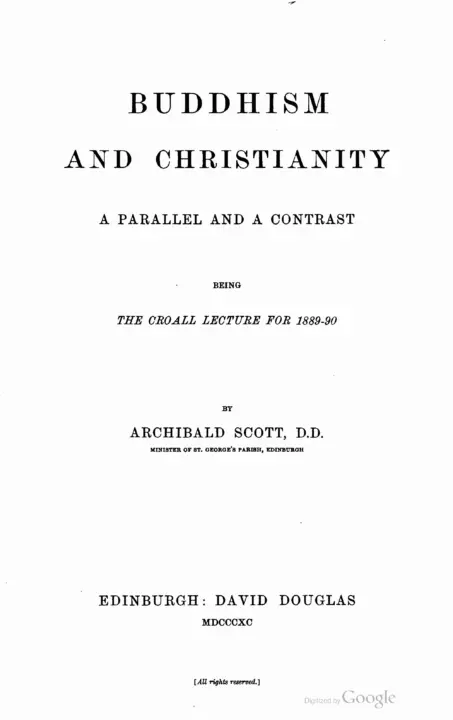
"Buddhism and Christianity: A Parallel and a Contrast" by Archibald Scott is a scholarly examination of the similarities and differences between Buddhism and Christianity, written in the late 19th century. This work presents a series of lectures, focusing on a comparative analysis of the two religions, to illuminate their unique features as well as their shared elements. Scott aims to foster a deeper understanding of both faiths, suggesting that studying these religions can enhance Christian appreciation for its own beliefs. The opening of the text provides a preface where Scott acknowledges the complexity of both religions and expresses a commitment to presenting Buddhism fairly, despite its historical misrepresentations. He highlights the significance of Buddhism as a major world religion that offers insights into human life and ethics. Scott also stresses the importance of comparative theology in strengthening Christianity rather than undermining it, encouraging an impartial study to discern universal truths that resonate within both traditions. He outlines the necessity to explore the distinct origins and developments of each faith while establishing a framework for a fruitful dialogue between the two.
Introduction adapted from the source catalogue; source summaries may be automatically generated.
Free to read · English · 95,734 words · No account needed
MAKE TIME FOR A GOOD BOOK
On by default. Untick to stop anonymous reading totals. Each page counts after 10 seconds in view. How this works.
Anonymous counting is on unless you have switched it off.
Footnote 90:
Oldenberg, Buddha, etc., p. 10.
Footnote 91:
Sacred Books of the East, vol. i. p. xxii.
Footnote 92:
Tylor, Primitive Culture, vol. ii. p. 338; Weber, Indian Literature, p. 38; Sir Monier Williams, Religious Thought and Life in India, p. 18.
Footnote 93:
See Satapatha-Brâhmana, translated by Professor Eggeling in vols. xii. and xxvi. of Sacred Books of the East. Max Müller places the age of these books within the ninth and seventh centuries B.C.
Footnote 94:
E. Quinet, Le Génie des Religions, p. 185; Paris, 1857.
Footnote 95:
Sir Monier Williams, Religious Thought and Life in India, p. 24, referring to the Aitareya-Brahmana, vii. 13.
Footnote 96:
Oldenberg, Buddha, etc., p. 15; T. W. Rhys Davids, Hibbert Lectures,
p. 25.
Footnote 97:
Gough, Philosophy of the Upanishads, pp. 41, 42.
Footnote 98:
Sacred Books of the East, vols. i. and xv. No one has dated any of the Upanishads earlier than 600 B.C., and some of them are very late.
Footnote 99:
Sacred Books of the East, vol. i. p. lxvi.
Footnote 100:
Svetâsvatara-Upanishad, iii. 7, iv. 14, 16, v. 13, vi. 7, 9, Sacred Books of the East, vol. xv.
Footnote 101:
Oldenberg, Buddha, etc., pp. 47, 48; Gough, Phil. Upan. pp. 61,
67.
Footnote 102:
T. W. Rhys Davids, Hibbert Lectures, p. 28.
Footnote 103:
History of Israel, vol. i. pp. 41, 47.
Footnote 104:
Gifford Lectures, Natural Religion, p. 563.
Footnote 105:
It is significant that in the beginning of the Bible Nature-worship seems stamped as accursed in its symbol, the serpent, and that the whole Bible from beginning to end is a Divine protest against that worship in all its forms. Mankind in all ages is tempted to become as the gods, and in a low condition he has almost everywhere succumbed to the temptation. He feasts his gods, compels them to serve him, is really higher than they, and thus he degrades himself or falls from the ideal of one made in the image and after the likeness of God.
Footnote 106:
Ewald, History of Israel, vol. i. pp. 320-322.
Footnote 107:
Some ascribe it to the Deuteronomist, ch. vi. 4.
Footnote 108:
Professor Müller finds the first traces of a Maker or Creator in the Vedic deity Tvashtar, the carpenter—the clever workman, even smith, forging bolts for Indra therein, Rig-Ved. iii. 55. 19. “Tvashtar, the enlivener, endowed with many forms, has nourished the creatures and produced them in many ways; all these worlds are his.” Of another god, latterly called Pragâpati, he quotes Rig-Ved. x. 81. 2, as one who, “creating the earth, disclosed the sky by his power.” Very significantly, however, he reminds us that the same poet loses the idea, and speaks of the secret of creation as undiscoverable.—Müller’s Natural Religion, p. 245. Also Introd. to Upanishads, Sacred Books of the East, vol. xv. p. xxiv.
Footnote 109:
Fairbairn, Religion in History and in the Life of To-day, pp. 39-51.
Your reading position is saved on this browser. Take it to another device with a library code. Reading pages adapt to text, rather than matching a printed edition.
BEHIND THE BOOK
This eBook is for the use of anyone anywhere in the United States and most other parts of the world at no cost and with almost no restrictions whatsoever. You may copy it, give it away or re-use it under the terms of the Project Gutenberg License included with this eBook or online at www.gutenberg.org. If you are not located in the United States, you will have to check the laws of the country where you are located before using this eBook. Read the source licence.
The original source file, including credits and licence, is retained by this library. Request an original-format copy at no charge. Please include the book title and Project Gutenberg identifier #67171.
KEEP YOUR CURIOSITY GOING
David Patterson (Spirit) Hatch

David Patterson (Spirit) Hatch

David Patterson (Spirit) Hatch

Edwin Abbott Abbott

Richard Watson
T. G. (Theophilus Gould) Steward