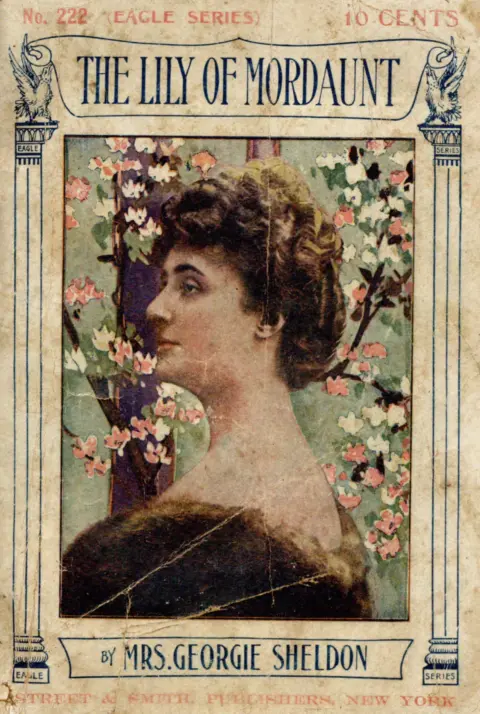
The lily of Mordaunt
Georgie, Mrs. Sheldon
THE CLASSIC COLLECTION · 1879
"Brownie's Triumph" by Mrs. Georgie Sheldon is a fiction novel written in the late 19th century. The story centers around the character of Brownie Douglas, a young heiress whose life takes a dramatic turn after the death of her wealthy aunt, leaving her without the fortune she expected. The novel explores themes of resilience, societal expectations, and the journey of a young woman as she confronts the realities of life in a world that suddenly feels far less secure. The opening of "Brownie's Triumph" introduces readers to a lively scene set during the World’s Centennial Exposition in Philadelphia. Brownie Douglas, a petite and spirited young woman, has just encountered her elegant friend Aspasia Huntington, who is struggling with her extravagant attire. The narrative unfolds with comedic moments involving a clumsy countryman, showcasing the contrast between the two young ladies. As the girls navigate through the exposition, they attract the attention of two young men, setting the stage for potential romantic developments amidst Brownie's transition from wealth to self-sufficiency after her aunt's passing. This initial glimpse of both frivolity and deeper themes offers a captivating start to Brownie’s journey.
Introduction adapted from the source catalogue; source summaries may be automatically generated.
Free to read · English · 100,316 words · No account needed
MAKE TIME FOR A GOOD BOOK
On by default. Untick to stop anonymous reading totals. Each page counts after 10 seconds in view. How this works.
Anonymous counting is on unless you have switched it off.
The moment the door had opened, and his eyes had fallen upon his crippled brother, Sir Charles had stood as one transfixed.
The hideous deformity had been the first thing to attract his attention, of course. That misplaced head, the misshapen shoulders, the withered, helpless hand, the twisted leg and foot had struck a terrible feeling in his heart. Then his eyes had sought the sad, pale face with an eager, searching gaze, as if seeking to know something of the soul within that distorted body.
At once he marked the grandly shaped head, with its broad, square forehead, which looked almost majestic beneath the crown of snowy hair. He marked the delicate, refined features, the deep, true, blue eyes, with their dark, sweeping lashes, the sensitive, expressive mouth, and the firm, decided chin.
It was a noble, attractive face, and as he looked, the shock of repulsion which he had at first experienced passed, and in its place came a tender pity and affection born of sympathy and the knowledge that this was his kin—his brother.
At Lady Ruxley’s word he went eagerly toward him, and clasping his hand in a strong, protecting clasp, exclaimed:
“My brother! How glad I am for the gift, even though it comes so late. Shall we begin to love each other now, Herbert?”
The two men—one so strong, handsome, and self-reliant in his glorious manhood, the other so weak and helpless in his deformity—gazed into each other’s eyes with a look which seemed to read their very souls, and the tears started unbidden to each.
“God bless you, my brother!” murmured Herbert Randal, with quivering lips, while a deep joy, such as he had never known in all his life before, thrilled him through and through.
Isabel Coolidge, looking on and beholding this scene, saw herself in a new light. She was bowed with shame and humiliation at the thought of her own selfish, wasted life, while she realized the grandness of Sir Charles’ nature as she had never done before, and knew she was unfit to mate with him.
She knew, also, although he had spoken no word to that effect, that that hour would probably separate them forever.
“Charles! Charles! my dear boy!” cried Lady Ruxley, in trembling tones, while tears rained over her wrinkled face, “I hoped you would stand this test of character nobly. I have always been proud of you, but God knows that I love you at this moment with a deeper love than ever before.”
Your reading position is saved on this browser. Take it to another device with a library code. Reading pages adapt to text, rather than matching a printed edition.
Georgie, Mrs. Sheldon
Georgie, Mrs. Sheldon
Georgie, Mrs. Sheldon
Georgie, Mrs. Sheldon
BEHIND THE BOOK
This eBook is for the use of anyone anywhere in the United States and most other parts of the world at no cost and with almost no restrictions whatsoever. You may copy it, give it away or re-use it under the terms of the Project Gutenberg License included with this eBook or online at www.gutenberg.org. If you are not located in the United States, you will have to check the laws of the country where you are located before using this eBook. Read the source licence.
The original source file, including credits and licence, is retained by this library. Request an original-format copy at no charge. Please include the book title and Project Gutenberg identifier #71118.
KEEP YOUR CURIOSITY GOING
Coulson Kernahan

Maurice Baring
Frances Wright
Cécile Tormay

Frederic Jesup Stimson

W. H. P. (William Henry Pope) Jarvis